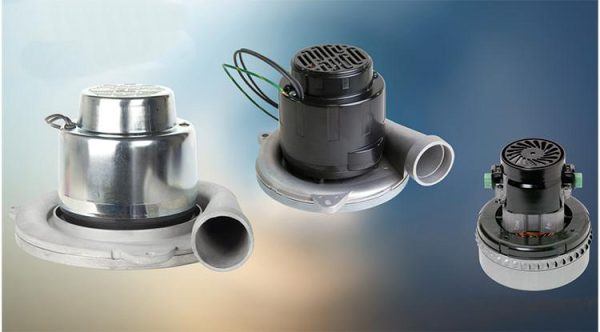
Universal motor-driven vacuums have been a staple in many industries for years.
Whether for vacuum cleaners, scrubbers, extractors, central vacuum systems, material transport, animal dryers, foggers or sprayers, these brushed motors are considered critical because of their versatility, durability and dependability.
Although universal motors are a very mature design, many cutting-edge technologies as well as ongoing research have spurred evolution of these devices.
Over the last 30 years, they have become smaller, lighter and faster. Additionally, there have been significant improvements in component designs.
Bearings can now reach 50,000 to 70,000 RPMs, while commutators, brushes and fans can operate at higher speeds while lasting a normal lifetime.
What are Brushed Universal Motors?
 Brushed universal motors use a wound rotor and stator in series with one another. A commutator and carbon brushes serve as a high-speed mechanical switching system to serially distribute current to the rotor or armature coils and produce torque as they interact with the magnetic field produced by the stationary field coils.
In addition to the air-moving applications mentioned above, universal motors are commonly found in smaller, corded appliances, possess high speed and have excellent starting capability. Their speed-torque characteristics make them ideal for driving fan loads. They speed up in a non-linear way as load decreases and partly compensate for clogging filters in vacuum cleaners, delivering sustained performance. The workhorses of many applications, these motors are economical, have a high horsepower-per-pound ratio and are less costly than their brushless counterparts.
Design & Speed
When it comes to your application, you may have several goals to consider. Vacuum or pressure, airflow, cost, life and noise are just a few. Brushed motors are less expensive than their brushless counterparts. However, they do not provide the same features or life expectations. Brushes are consumable items.
While brushless motors do provide longer life, there is a cost for the magnets and electronics. Many brushless blowers also offer other technical features such as speed control, tach out signals and programmability. Brushed motors are more basic in design but deliver strong performance relative to cost.
The output power of a motor is the product of torque and speed at a given point, or: P ~ T x N
By taking speeds up, torque requirements are reduced at the same power level. Further, torque is proportional to the copper and steel content of a motor. Fans are smaller and faster. Smaller, faster motors allow similar air performance (output power) in a smaller, lighter and less expensive package.
When it comes to speed, brushed vacuum motors are fast. Historically, their standard speed was 15,000 to 25,000 RPM. This has been limited by component reliability. In recent years, however, material-savvy design evolution has allowed the standard speed to increase to between 30,000 and 40,000 RPM in many models. Some designs routinely run 40,000 to 45,000 RPM, while others exceed 50,000 RPM.
Smaller and faster motors present challenges rotating components. To accomplish this suppliers and manufacturers rose to the occasion.
- Bearing manufacturers improved their designs with new greases and glass-filled nylon ball cages.
- The commutator manufacturers improved their bar anchoring systems, developing internal reinforcing rings and better phenolics.
- Carbon brush manufacturers developed additives for their molded brushes to promote good filming at high speeds and to reduce friction wear and arcing.
- Motor manufacturers have also stepped up their manufacturing game with improved processes to allow reliable operation at these speeds. Processes such as commutator turning, fusing and armature impregnation are critical to long life.
Applications – Managing the Air Path
Vacuum blowers are available in two basic styles, thru-flow and bypass, referring to the relative paths of the working and cooling air. Each has advantages depending on the application.
Thru-Flow Motors
In thru-flow motors, the dry, filtered working air travels through the fan system and is discharged directly over the motor windings as it exits. The working air provides the cooling air for the motor. For thru-flow motors:
- Working air = cooling air
- Restriction in working air restricts the cooling ability of a motor; often thermal protection is required.
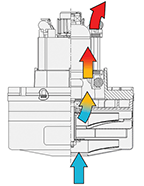 Thru-flow motors come in single- or two-stage configurations. Adding multiple fan stages allows pressure to build with each stage, delivering higher vacuum or pressure to the application. Single stage systems tend to provide better airflow at lower pressure/vacuum.
Bypass Motors
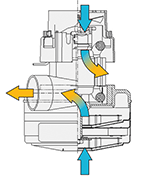 In bypass motors, the working air is independent from the cooling air. A separate fan is used to direct cooling air over the windings. Bypasses are used when it is important to ensure that the cooling air doesn’t mix with the vacuum or blower working air.
Since the working air does not travel across the motor windings, bypass motors are a great option for scrubbers, carpet extraction and other wet pickup applications since debris and moisture will not contact the windings directly. The working air should still be filtered. However, bypass motors are not designed to pump water.
The OEM designer must take care when designing a bypass motor into a system:
- The working and cooling air systems are separated from each other; they operate at different pressure levels. Mixing them can disrupt the cooling flow.
- The cooling air path should be baffled to separate the cooling inlet from the cooling exhaust. Failure to do this can cause recirculation with increased heating of the air and poor cooling performance.
Bypass motors are available in peripheral and tangential discharge configurations and in single or multiple stages. Again, the purpose of the stages is to create more pressure or vacuum.
For bypass motors:
- Working air ≠ cooling air.
- There is a separate cooling fan.
- The separate paths can safely handle moist working air, but not liquids.
- Working air discharge can be tangential or peripheral.
Bison also offers bypass designs in various diameters from 4.2”— 9” in many vacuum and airflow ranges.
Determining the Ideal Design for Brushed Vacuum Motors
Here are some questions you should answer to determine the ideal design for your application.
These include:
- What type of air will be picked up? Do you need a motor that has to pick up dry or moist air?
- What are the cooling requirements? You will need to figure out whether external cooling will be necessary, or if there is enough working air flow for cooling.
- What will the operating point be? You will need to determine what kind of airflow rate, pressure or suction, current draw or input power will be necessary to perform the intended job.
- What is the type of voltage? You will need to understand the available operating voltage.
- Will you need an alternating current (AC) or a direct current (DC) motor? Are you using line voltage or batteries? Or some other power supply? Universal motors can run on AC or DC, but they are sensitive to voltage. They must be designed for the operating voltage. What is your operating voltage level?
- What other features do you need? Does your application require thermal protection, serviceable brushes, air discharge (tangential, peripheral or thru-flow) or bearing protection? What about a specific life requirement?
- Do you have regulatory agency requirements? Specific insulation class needs? Thermal protection for locked rotors in unattended installations? End product agency requirements such as blocked inlet protection?
Protecting Bearings Against Moisture
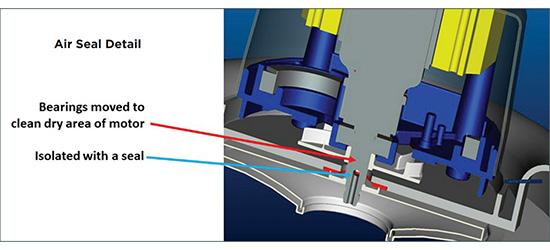
Lamb® vacuum motors by Bison take the worry out of protecting bearings from moisture damage. Engineers have developed several solutions to protect bearings in moist applications. One approach uses air seal technology where a small fan creates a localized pressure in a chamber near the bearing. The pressure pushes moisture-laden air away from the bearings to keep them free of contaminants.
Another approach incorporates a PTFE washer on the shaft and right below the bearings on the pressure side. It works to create a physical sliding seal, keeping moisture away rather than using pressure to blow it away. Some motor designs incorporate both air seal technology and PTFE washers.
Bison’s 6.6” and 8.4” bypasses have been designed with a physical separation between the bearing and the fan system, offering the ultimate bearing protection.
These designs are typically validated using specialized life testing to ensure optimal moisture protection. The test exposes the bearings to detergent suds and validates the effectiveness of the bearing protection. For additional protection, these systems often incorporate precision ball bearings with specialized greases and seals.
Modern brushed universal motors now combine higher speeds, improved component reliability, and compact form factors to deliver robust performance across a wide range of vacuum and blower applications. With options spanning thru-flow and bypass designs, specialized bearing protection for moist environments, and multiple diameter and staging configurations, OEMs can match air-path management, life, and regulatory requirements without abandoning familiar, proven motor technology. By defining air type, cooling strategy, operating point, voltage, and protection needs early in the development cycle, engineering teams can specify brushed vacuum motors that meet today’s performance expectations while maintaining an efficient, serviceable platform for industrial and commercial equipment.
About the Author
Dave Gill is a Senior Project Engineer at Bison®, an AMETEK business, based in Kent, Ohio. He brings decades of experience in motor and blower system design, supporting engineers across a wide range of industrial applications. Dave is known for his practical, engineering-focused approach to solving complex air-moving challenges and optimizing system performance, efficiency, and reliability.