Why predictive analytics, robotics, and data driven logistics are transforming how and where goods move
For decades, industrial real estate has been designed for a world where uncertainty is managed with storage, not with real‑time coordination. Warehouses grew in size and number to buffer against unpredictable demand, fragmented data, and slow coordination between supply chain stakeholders. Inventory was positioned as close as possible to anticipated need, ensuring availability even when visibility was limited.
This model is starting to shift. Advances in predictive analytics, robotics, and transportation coordination are enabling supply chains that move goods continuously rather than storing them in place. As visibility improves and systems become more connected, the need for large scale inventory is diminishing. This shift is transforming how facilities are designed, where they are located, and what role they play. Industrial real estate is moving away from storage‑heavy infrastructure toward systems optimized for flow and lean, efficient operations.
The stakes for this shift are structural and long-lasting. Just as the standardized shipping container reshaped ports, ships, trucks, and even bridge heights, the way today’s facilities are designed for automation and throughput will define the physical constraints the industry works within for decades. Choosing infrastructure optimized for continuous movement rather than storage sets the “gauge” that future buildings, vehicles, and logistics networks will be forced to follow.
From Buffer to Throughput: The Changing Role of the Warehouse
Traditional warehouse networks were built to absorb uncertainty at every stage. Manufacturers produced based on aggregated forecasts, distributors added safety margins, and goods accumulated across regional hubs to ensure availability. Each layer introduced excess, but also stability. As data becomes more accessible across the supply chain, that structure becomes less necessary. When transportation systems are coordinated and demand signals are clearer, goods can move more directly from origin to destination. Instead of waiting in storage, products can be routed dynamically based on real-time needs.
Intermediate facilities still exist, but their function is shifting. Rather than holding inventory, they act as transfer points, briefly handling goods as they move between transportation modes. This is especially visible in urban environments, where large shipments may transition to smaller, last mile delivery systems. The result is a supply chain that prioritizes throughput over storage. Goods spend less time sitting idle, and facilities are designed to support movement rather than accumulation.
Precision Over Excess: How Predictive Data Reduces Inventory
A major driver of this shift is the way demand is understood and communicated. Historically, manufacturers relied on distributors and retailers to interpret customer behavior. Each layer introduced its own assumptions, often inflating orders to avoid shortages. When demand data is fragmented, overproduction becomes the default. Excess inventory builds as each stakeholder adds a buffer, leading to waste across the system. Predictive analytics reverses that pattern. With direct access to consumption data, manufacturers can align production more closely with actual demand. Instead of producing for uncertainty, they produce for known need, with smaller contingencies.
This has two immediate effects. First, it reduces the volume of goods that require storage. Second, it decreases waste, with fewer unsold products, fewer resources consumed, and fewer facilities needed to hold surplus inventory. In this model, the buffer shifts from physical goods to informational accuracy. Reliability comes from having the information you need, not excess product.
Designing for Automation: Smaller Footprints, Faster Operations
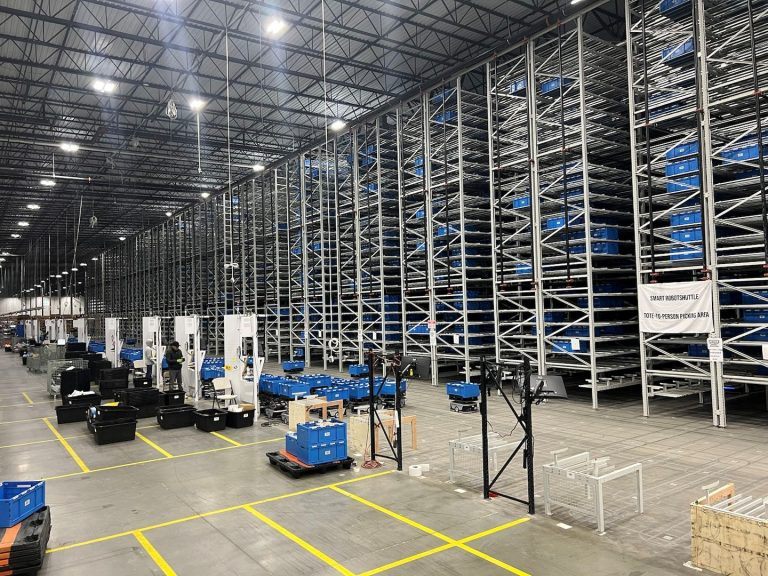
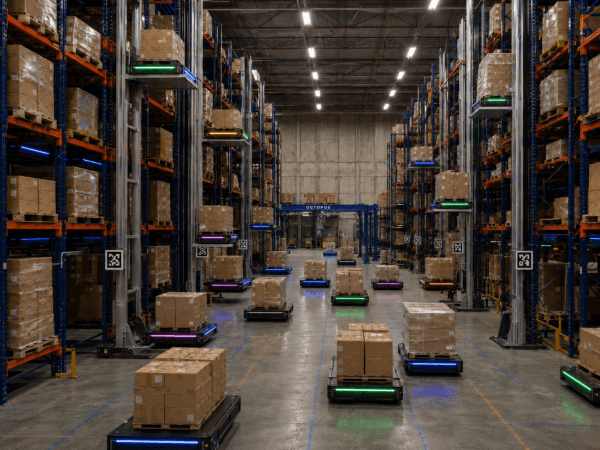
As inventory levels decrease, the design of the warehouse itself changes. Automation is the primary driver of this transformation. In traditional facilities, a significant portion of space is dedicated to circulation. Forklifts and operators require wide aisles to move goods, meaning much of the building is not used for storage. In some cases, circulation space can account for the majority of the footprint. Automated systems eliminate that requirement. When goods move autonomously, aisles can be removed, allowing facilities to operate within a much smaller footprint. Storage density increases, and space is used more efficiently. Just as important, these facilities become the place where new automation can be built, tested, and scaled. The real constraint is no longer how much product a building can hold, but how effectively it can host and evolve the “machine that builds the machine”—the robotics and systems that determine how quickly the entire network can change.
Operational speed also improves. Loading and unloading processes that once took hours can be completed in minutes, reducing the need for multiple loading docks and enabling faster vehicle turnover. As a result, facilities require fewer access points and less staging area. These changes extend beyond the building interior, reshaping how technical labor is used. When buildings rely on modern, software‑driven automation rather than aging mechanical systems, scarce engineering and maintenance talent can shift from band‑aiding legacy equipment to developing and overseeing higher‑value innovations across the network. Taken together, these shifts allow facilities to be smaller, more flexible, and easier to integrate into a wider range of environments.
Connectivity and Location: The New Foundations of Industrial Real Estate
Even as physical space becomes less of a concern, digital infrastructure becomes critical. Automated operations depend on reliable, high-performance connectivity across the entire facility, from internal networks to site-wide coverage. In many existing warehouses, connectivity gaps are common due to location or building materials, and in an automated environment, those gaps become operational risks. Facilities must be designed with connectivity in mind from the outset, accounting for interference from dense materials, ensuring consistent coverage across all operational areas, and supporting systems that require continuous communication. Without this foundation, automation cannot function effectively.
Connectivity also lays the groundwork for digital twins, live software representations of the facility and the assets moving through it. When vehicles, robots, and building systems continuously report their position and status into a unified model, operators can manage flows in real time, detect issues earlier, and coordinate movement across trucks, yard, and interior space as a single, continuous system rather than a series of disconnected steps.
At the same time, site selection is evolving. Smaller, more efficient facilities can be located closer to end users, shifting logistics operations toward urban and densely populated areas. Proximity reduces delivery time and supports emerging last mile models, including smaller vehicles and decentralized distribution. This shift introduces new considerations. Urban sites must accommodate at least minimal loading infrastructure and integrate with surrounding activity. As delivery methods continue to evolve, buildings may also need to support new forms of access, from curbside operations to rooftop or elevated transfer points. The combination of strong connectivity and strategic location is becoming a defining characteristic of modern industrial real estate.
A More Efficient System: Aligning Operations with Sustainability
Reducing inventory has clear operational benefits, but it also has environmental implications. Producing only what is needed lowers material waste and reduces the energy required to manufacture, transport, and store excess goods. Facility size plays a significant role in this equation. Large buildings require more energy for heating, cooling, and lighting, particularly in specialized environments such as cold storage. Maintaining these conditions at scale is both costly and resource intensive. That makes the placement and design of high‑intensity facilities even more important. Concentrating the most energy‑ and resource‑heavy operations in smaller, automation‑optimized spaces and eliminating unnecessary storage elsewhere in the network reduces the overall environmental footprint while preserving the capacity needed to support growth.
By reducing the footprint of these facilities, companies can significantly lower energy consumption. This is especially impactful in environments that require continuous climate control, where even small reductions in space translate to substantial savings in energy and operating costs. At the same time, more precise production reduces the volume of goods that ultimately go unused. Instead of building excess into the system, supply chains become more closely aligned with actual consumption. Efficiency and sustainability are no longer separate objectives. In a real-time supply chain, they reinforce each other.