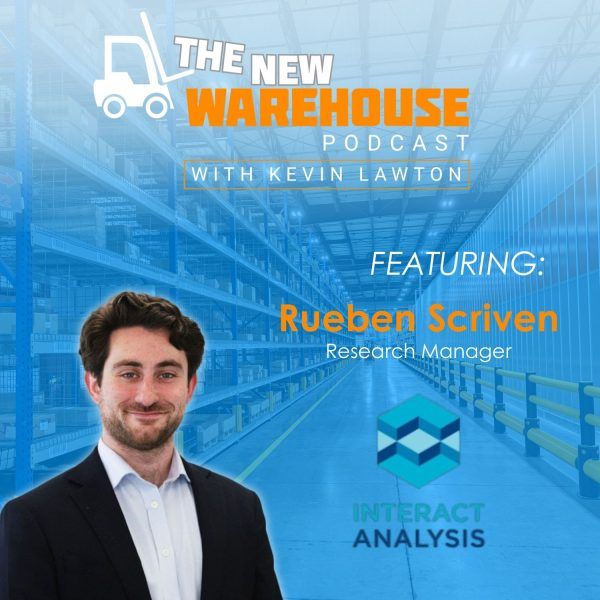
Welcome to another exciting episode of The New Warehouse Podcast. In this episode, host Kevin sits down with Rueben Scriven, Research Manager at Interact Analysis. Interact Analysis is a premier market intelligence firm providing clarity to the complex warehouse industry.
This discussion dives deep into the findings of their mid-year warehouse automation report, exploring market shifts, regional trends, and emerging technologies. This episode provides a vital roadmap for operators looking to future-proof their supply chains in a changing landscape.
The Evolution of Pouch Sortation and Segment Shifts
Sectors like food and beverage are experiencing unexpected acceleration, driven by smaller product quantities and rising logistical complexity. Conversely, the apparel sector is entering a cooling period following a massive pandemic-era investment boom.
Admittedly, Rueben Scriven notes that “part of this update is us putting our hands up and saying that we’ve probably got it a little bit too aggressive” regarding previous apparel forecasts. Amid these shifts, traditional technologies are finding entirely new life outside of their original applications. Pouch sortation systems, historically confined to apparel warehouses, are rapidly expanding into healthcare, pharmacy, and parcel facilities to maximize overhead spatial efficiency.
Scriven highlights, “We’ve effectively lifted our projections a bit by accounting for the fact that we’re seeing more use cases of pouch outside of the apparel sector”. This expansion proves that old design paradigms are shifting, and, as Scriven states, “this prophecy…from 10 years ago is starting to become a little bit more grounded in truth.“
Contract Innovation Fuels High 3PL Automation Growth
Third-party logistics (3PL) providers are adopting automation at a historically high rate. The industry is overcoming this barrier through flexible co-investment frameworks and Robotics-as-a-Service (RaaS) models.
Scriven explains the historical bottleneck by noting that “Contract lengths tend to be too short to justify automation investments. Now, there have been several factors recently that have made automation more attractive.” Furthermore, macroeconomic shifts and tariff uncertainties have prompted more companies to outsource their supply chains, leading to a net increase in logistics investments.
Scriven observes that “3PL saw more companies outsourcing their logistics because of the uncertainty around tariffs and how tariffs would affect logistics”. This influx of capital allows 3PLs to actively integrate advanced robotics, changing how they position themselves to customers. As the market evolves, Scriven points out an overarching trend where “this prediction is starting to come true” regarding the ultimate convergence of system integrators and 3PL providers.
The Warehouse Automation Market is Moving from Custom Engineering to Modular Plug-and-Play Systems
The fundamental nature of system integration is changing as the industry moves toward rapid deployment models. The market is actively shifting away from highly customized, rigid engineering projects toward standardized, modular systems.
Scriven highlights this baseline change by stating, “We’re seeing this shift in the industry away from highly customized systems more towards more modular, plug-and-play systems”. Rather than bending unique steel and writing bespoke software code for every warehouse, system integrators are now configuring highly pre-designed platforms.
Scriven elaborates that “10 years ago, an automated system was highly customized. Steel was bent for that particular project, and code was written for that particular project”. This evolution drastically lowers traditional deployment costs and reduces integration complexity. Both of which end-user surveys reveal are the single largest barriers to automation adoption. Rather than building things from scratch, the modern landscape is dictated by predefined technology stacks, or as Scriven summarizes, “the integrator is configuring them rather than kind of customizing them”.
Key Takeaways on the Warehouse Automation Market
- The Final Frontier: Robotic piece picking is hitting an inflection point. Vendors natively integrate arms into wider systems rather than treating them as an afterthought.
- The Integration Barrier: End-user surveys reveal that integration complexity, not budget or ROI, is the primary obstacle preventing automation adoption.
- The 3PL Convergence: Automation providers are increasingly building and running their own facilities, signaling a structural convergence between 3PLs and system integrators.
- Micro-Fulfillment Resurgence: Following a boom-and-bust cycle, grocery micro-fulfillment centers (MFCs) are seeing renewed interest led by large-scale rollouts from giants like Walmart.