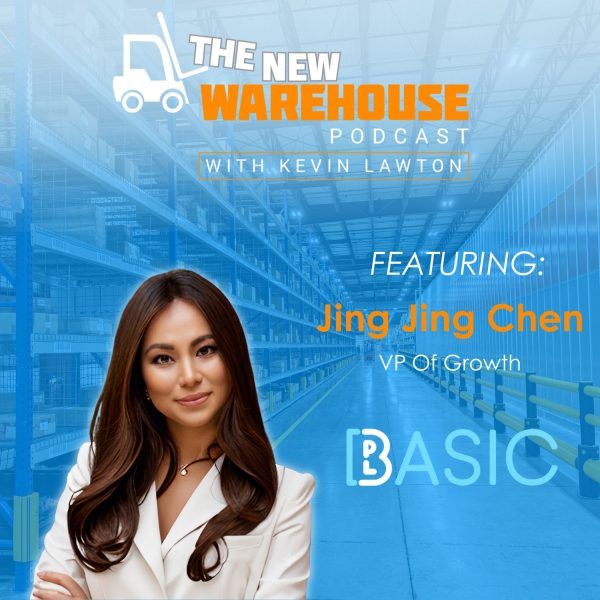
In this episode of The New Warehouse, Kevin welcomes Jing Jing Chen, Vice President of Growth at Basic 3PL. They discuss how the rapid rise of social commerce is transforming fulfillment operations. Jing Jing shares how Basic 3PL has built an automation-first fulfillment network that combines robotics, technology, and skilled employees to help brands thrive in an increasingly fast-paced e-commerce landscape.
Social Commerce Fulfillment Requires a New Approach
Social commerce has fundamentally changed how products move through the supply chain. Instead of predictable order volumes, fulfillment providers must be prepared for demand that can surge within minutes after a product goes viral.
Basic 3PL has intentionally designed its operation around the challenge most 3PLs fight against. Rather than treating demand spikes as exceptions, the company assumes they will happen every day. As Jing Jing explains, “This is our norm. So the reason why we named it Basic was that this is our basic, our standard. This is our day-to-day. We build from peak.” That philosophy influences everything from warehouse design to staffing and technology investments.
Consumer expectations continue to accelerate this shift by increasingly expecting next-day delivery. Jing Jing notes, “You have the instant fulfillment expectation.” She adds that “Shoppers want their packages now. Who wants the packages tomorrow, not five days, seven days?” However, meeting those expectations requires infrastructure capable of processing unpredictable demand without sacrificing fulfillment speed or accuracy.
Automation Creates Speed Without Replacing People
Automation plays a central role in Basic 3PL’s strategy, but Jing Jing emphasizes that robotics work alongside people rather than replacing them. Robots handle repetitive movement throughout the warehouse while employees focus on oversight, troubleshooting, and operational decision-making.
As she explains, “Our robotics are designed to be our pick packers, so they do the heavy lifting. They’re the ones that are retrieving the goods, the inventory from the shelves, and bringing it down to the human level.” The result is faster throughput while reducing physically demanding work. She also notes that automation doesn’t eliminate the need for people because “it removes the heavy lifting from a human labor, but you still need very much a human factor… to react with any troubleshooting and manage the facility.”
This hybrid model extends beyond the technology itself. Employees are cross-trained to work across multiple functions, allowing labor to shift wherever demand is greatest. Combined with robotics, this flexibility enables the company to maintain same-day fulfillment while managing increasingly unpredictable order volumes. Rather than viewing automation and labor as competing strategies, Basic 3PL treats them as complementary parts of a modern fulfillment operation.
Building Infrastructure for the Future of Social Commerce Fulfillment
As social commerce continues to grow, fulfillment providers must think beyond warehouse capacity. They need scalable technology, intelligent inventory placement, and networks designed to support brands of every size. Basic 3PL has invested heavily in all three, expanding to more than 25 warehouse facilities across the United States while building infrastructure that can quickly adapt to changing demand.
Jing Jing believes technology will separate tomorrow’s logistics leaders from the rest of the market. “We want to be the anchor of support to social commerce because we have the ecosystem and infrastructure built for this.” She also recognizes that many growing brands lack dedicated logistics expertise, making accessible technology increasingly valuable. As Basic 3PL expands its offerings, such as Basic Go, the goal is to provide emerging businesses with enterprise-level fulfillment capabilities.
Looking ahead, Jing Jing sees innovation as essential rather than optional. “You have to be technology forward. If you don’t have the technology in place, then it’s quite a stretch to get to where you need to based on the demand today.” As consumer expectations continue to rise, modern fulfillment will depend on technology, automation, and flexible operations working together to deliver speed without sacrificing service.
Key Takeaways
- Social commerce has created unpredictable demand for fulfillment, requiring a different operational mindset.
- Automation improves warehouse speed while allowing employees to focus on higher-value operational work.
- Cross-trained employees provide flexibility during demand spikes and peak seasons.