
Port of Long Beach prepares for Year of Transformation

Operations and infrastructure investments planned for 2022 Transformation is needed across the supply chain in order to accommodate the growth and future opportunities in international trade, Port of Long Beach Executive Director Mario Cordero said Wednesday during a virtual State of the Port address. Technology, partnerships, and a continued shift toward 24-hour operations will aid the entire goods movement industry from the docks to doorsteps, Cordero said during the second virtual State of the Port address – available for viewing now at www.polb.com/stateoftheport. “We continue to debate the same issues year after year, while the operational model remains status quo – never changing,” Cordero said. “The test is not in how many containers we move but in how we transform and build a port that benefits everyone.” A soft launch is scheduled later this month for the “Supply Chain Information Highway,” a data-sharing tool that will maximize efficiency by tracking cargo across various modes of transportation. The Port will continue to enhance on-dock rail to accelerate cargo movement, through improved rail infrastructure and partnerships. Additionally, the Port of Long Beach will advocate for 24-hour operations for the entire supply chain – shipping terminals, warehouses, trucking, and other critical links. “Despite challenges in the global economy, it’s been an incredible year for the Port of Long Beach,” said Long Beach Mayor Robert Garcia. “And that’s thanks to all of our incredible workers at our ports. Everyone has been working extremely hard to make sure we meet America’s needs and efficiently move cargo in and out of our port.” The Port ended 2021 with 9,384,368 twenty-foot equivalent units processed, up 15.7% from the previous record of more than 8.11 million TEUs moved in 2020. The significant increase in cargo was driven by evolving consumer spending habits during the COVID-19 pandemic when consumer demand for travel and entertainment declined due to health precautions and pivoted toward online spending. “We have all heard so much about the supply chain backlog, but what is actually happening is that our dockworkers are moving more cargo than ever – and doing so during a pandemic,” Harbor Commission President Steven Neal said. “We are building a bright future for the Port of Long Beach, the goods movement industry, and for the community.” Key projects completed in 2021 include the final phase of the Long Beach Container Terminal, the greenest, most technologically advanced terminal in North America, along with the adjacent Fireboat Station No. 15. Over the next decade, the Port plans to invest in rail improvements that will improve efficiency, reduce truck trips and lessen environmental impacts amid increases in cargo. Construction begins in 2023 on the Port’s rail program centerpiece, the Pier B On-Dock Rail Support Facility, which will allow longer trains to be created more frequently. The Port continues its dedication to enhancing the environment. Looking ahead, the Port plans to transform the drayage truck fleet to zero emissions by 2035, funded by a Clean Truck Fund rate starting in April. Terminal operators are also doing their part by deploying zero-emission cranes, vehicles, and yard equipment.
U.S. Rail Traffic for the week ending February 5, 2022
The Association of American Railroads (AAR) has reported U.S. rail traffic for the week ending February 5, 2022. For this week, total U.S. weekly rail traffic was 458,152 carloads and intermodal units, down 7.6 percent compared with the same week last year. Total carloads for the week ending February 5 were 218,286 carloads, down 3.6 percent compared with the same week in 2021, while U.S. weekly intermodal volume was 239,866 containers and trailers, down 11 percent compared to 2021. Two of the 10 carload commodity groups posted an increase compared with the same week in 2021. They were coal, up 4,682 carloads, to 64,582; and chemicals, up 348 carloads, to 33,921. Commodity groups that posted decreases compared with the same week in 2021 included motor vehicles and parts, down 4,614 carloads, to 10,432; grain, down 2,569 carloads, to 23,517; and petroleum and petroleum products, down 2,315 carloads, to 9,148. For the first five weeks of 2022, U.S. railroads reported a cumulative volume of 1,120,551 carloads, down 3.1 percent from the same point last year; and 1,241,309 intermodal units, down 14 percent from last year. Total combined U.S. traffic for the first five weeks of 2022 was 2,361,860 carloads and intermodal units, a decrease of 9.1 percent compared to last year. North American rail volume for the week ending February 5, 2022, on 12 reporting U.S., Canadian and Mexican railroads totaled 308,622 carloads, down 4.4 percent compared with the same week last year, and 318,404 intermodal units, down 10.6 percent compared with last year. Total combined weekly rail traffic in North America was 627,026 carloads and intermodal units, down 7.6 percent. North American rail volume for the first five weeks of 2022 was 3,199,148 carloads and intermodal units, down 10 percent compared with 2021. Canadian railroads reported 69,102 carloads for the week, down 10.5 percent, and 63,418 intermodal units, down 10.5 percent compared with the same week in 2021. For the first five weeks of 2022, Canadian railroads reported a cumulative rail traffic volume of 652,624 carloads, containers, and trailers, down 15.2 percent. Mexican railroads reported 21,234 carloads for the week, up 9.9 percent compared with the same week last year, and 15,120 intermodal units, down 4.4 percent. Cumulative volume on Mexican railroads for the first five weeks of 2022 was 184,664 carloads and intermodal containers and trailers, down 1.4 percent from the same point last year. To view the U.S. Rail Traffic charts, click here.
EP 253: Zebra and RFID

In this episode, I was joined by Matt Seltz of Zebra Technologies to discuss RFID. Matt is the Senior Director of Operation and Product Success for Zebra’s Advanced Location Technology Business Unit. We discuss the evolution of RFID in the warehousing space, how it creates efficiency, and Zebra’s new portals. Key Takeaways RFID is a radio frequency technology that can be utilized to locate assets through tags. As Matt explains there are both active and passive tags depending on the application. One thing about RFID is that it has been around for quite some time but there have been limitations when it comes to the cost of the tags and also the accuracy in reading and range. Matt explains how the technology has now developed to the point where the accuracy of the reading is very good and the technology improvements are also allowing the cost to come down. The benefits of RFID are creating more efficiencies in your operation, increasing inventory accuracy and traceability. With RFID technology in place, you can get incredibly accurate location placements of your inventory so it helps to prevent the loss of inventory and can help you to pinpoint where certain items are. Additionally, depending on the application it can also help you to be more efficient and reduce the amount of labor needed for certain tasks. Matt gives a great example of how it can reduce the amount of paperwork that receiving docks need to worry about because there is data capture happening on the RFID scans. Zebra just released new RFID portals that are designed for multiple different applications. There is a portal specifically for dock doors which has improvements that create better scans and reduce accidental captures from other nearby tags. There is also a table that has an RFID reader built-in which allows workers to capture RFID information right on the table without needing any additional hardware. The tunnel portal allows RFID tag data to be captured while assets travel along a conveyor. Listen to the episode below and leave a comment with your thoughts. The New Warehouse Podcast EP 253: Zebra and RFID
Jim Indelicato Material Handling Scholarship announced

The Material Handling Education Foundation, Inc. (MHEFI) and MHI member Agile Business Media, Publishers of DC Velocity Magazine, and CSCMP’s Supply Chain Quarterly, recently announced the successful launch of “The Jim Indelicato Material Handling Scholarship.” “We face a labor shortage today that is not going away any time soon,” said Gary Master, president of Agile Business Media. “It is our job as leaders to assist in training and developing our next wave of talent that the world desperately needs to keep our supply chains operating smoothly. Remembering Jim’s passion for this industry and by assisting in its future development is the best way we can properly remember Jim and honor his contributions.” Scholarships will be awarded to students majoring in related fields in the amount of $1,500.00 each for the first year. To contribute to this fund, visit mhi.org/mhefi/donors. For more information about the scholarship program, contact Donna Varner at the Material Handling Education Foundation at 704-676-1190 or Gary Master at 412-596-7387. The Material Handling Education Foundation, Inc. (MHEFI) is an independent charitable organization that was established in 1976. Since 1976, our programs have supported over 1,000 students and educators seeking pathways to quality educational programs and fulfilling careers. The demands of today’s global economy and fast-paced technological change reinforce the need to draw top talent to sustain and strengthen material handling and supply chain businesses for the future.
MHI announces MODEX 2022 Innovation Award finalists

MHI just released the list of finalists for the 2022 MHI Innovation Award. After receiving 121 submissions for this year’s awards, five independent judges comprised of professionals from the material handling and supply chain industry completed the initial review process. Four finalists were chosen as the most innovative products in each category – Best New Innovation; Best Innovation of an Existing Product; and Best IT Innovation based on concept, value, and impact. Best New Product Finalists: Beckhoff Automation for XPlanar Boston Dynamics for Stretch Exotec for The Skypod System Phantom Auto for Remote Operation Platform Logistics Best Innovation of an Existing Product Finalists: Ancra Systems B.V. for Skateloader System AutoStore for Grocery Micro Fulfillment Center (MFC) Solution ProGlove for MARK Display Rufus Labs, Inc. for Rufus WorkHero: Superhuman Platform for Supply Chain Best IT Innovation Finalists: SVT Robotics for The SOFTBOT® Platform, from SVT Robotics Systems Loading Dock Equipment for myQ Dock Management Veryable, Inc. for On-Demand Labor Marketplace Yard Management Solutions for Yard Management Solutions The MHI Innovation Award serves to educate and provide valuable insights on the latest manufacturing and supply chain products and services to MODEX attendees. MODEX 2022 exhibitors were called to submit a new product, product line, technology or service, or new application of existing products or technology that creates quantifiable and sustainable results in terms of ROI, cost savings, and customer satisfaction. On Monday, March 28, 2022, finalists will present their unique solutions to a panel of judges on the show floor at MODEX 2022. The winners in each category will be announced at MODEX 2022 on March 30th during MHI Industry Night with Preacher Lawson. MHI would like to thank the five judges for graciously volunteering their time as Innovation Award judges.
Yale Reliant wins product of the year award

Yale Reliant™, a lift truck operator assistance system, was crowned a 2021 Product of the Year by readers of Material Handling Product News and MaterialHandling247.com. The innovative technology suite beat out three other competitors in the ergonomics and safety category. Yale Reliant is an industry-first package of technologies for supporting lift truck operator awareness and adherence to best practices. The solution monitors the operating environment and equipment information in real-time to trigger dynamic alerts and automatic performance adjustments. Performance adjustments include a broad range of functionality on the warehouse floor, such as automatic speed reduction for stability when cornering and preventing trucks from moving overweight loads. The tool can also be used to reinforce site-specific traffic rules such as proper following distance, reduced speed around pedestrians, and restricted lift height in specific areas. “With warehouse labor in short supply and pressure to fulfill greater order volumes at an increasingly fast pace, maintaining a strict focus on lift truck operating best practices can be a challenge,” says Brad Long, Brand Manager, Yale Materials Handling Corporation. “Yale Reliant is the latest example of how our lift truck technologies give warehouses the modern solutions they deserve – no need to settle for the same old, tired options.” While the system automatically limits truck performance, the operator always remains in ultimate control of the lift truck. For instance, the system activates automatic speed reduction to reinforce adherence to location-specific rules, but the operator maintains control of steering and braking to steer away from a hazard or bring the truck to a complete stop. In addition to the change in truck performance, the display monitor issues a visual alert to inform the operator of the reason for intervention. This information provides an additional layer of feedback that can be helpful for reinforcing the proper operating technique established during training.
10 factors for picking a third party logistics service provider
Selecting the right third-party logistics service provider can be a challenging experience for companies. After the coronavirus pandemic dismantled many supply chains, business continuity planning, technology and automation, and supplier diversity became the top priorities for supply chains everywhere. After all, the reputation and success of your company depend on your logistics provider’s reliability, making a third-party logistics provider a crucial part of many brands’ supply chains. Avoid a potential logistics nightmare by using these ten essential elements in selecting your perfect third-party logistics service provider or 3PL. Picking a Third-Party Logistics Service Provider 1. Logistics Capabilities A prospective third-party logistics service provider must be competent in the specific service areas that meet your company’s needs. Just because a provider is a rock star in one place, it’s not a foregone conclusion that they can service your firm properly. Also, they should have a set of abilities that can satisfy both your short-term and future requirements. For instance, EDI-capability may not be a requirement for you today, but what if it does become required for you in 12-24 months? Do you want to unwind all the onboarding and integration work invested in a new relationship? Dig a little deeper and ask: Are truckload lanes repetitive, originating from limited shipping points and terminating to a relatively limited number of consignees? Are shipments time-sensitive, or do they require drop trailers? A mid-sized, asset-based carrier would meet these needs without getting sidetracked by their exceedingly extensive list of clients. Are truckload lanes sporadic? Is there live loading/unloading, or do shipments come from many origins that terminate to an increased number of receivers? If so, a 3PL provider or broker might be a better fit. Do you require access to dedicated trucking assets and 3PL? A logistics provider with assets and a 3PL division may offer optimal solutions. Does the logistics provider claim to possess all the capabilities “under the sun,” but your organization requires only a few core services? Be wary of a company that is a “jack of all trades” and master of none. 2. Focus on Customer Satisfaction Does the logistics provider prioritize customer service, responsiveness, fluid lines of communication, and effective problem-solving? These elements can be challenging to ascertain early on but do your homework. Virtually all companies claim to have excellent customer service, but how do you know? You ask their customers. Ask for references, preferably from companies in similar industries and needs. Good customer service is no accident. If the customer service is consistently excellent, it’s likely a result of a well-documented and repeated process that will continue over the years. Another yield of good process execution is safety. It is uncommon for a logistics provider to achieve excellent results in customer service and poor outcomes in safety or vice versa. You can deduce that a safe logistics provider probably provides good customer service. 3. Commitment to Technology When you’re selecting a third-party logistic service provider, consider technology that works for you and with you. The 3PL’s technology should simplify and streamline your processes, automating your most tiresome tasks. It’s essential to ask the 3PL these questions: How does their technology connect to your online store or existing software systems? How does their software use your data to its maximum advantage? In addition to the third-party’s fulfillment services, their scalable technology should include a cloud-based warehouse management system and electronic data interchange (EDI) capabilities. Technology should help you with automation, processing orders, inventory management, tracking orders, and managing e-commerce returns. Find a 3PL committed to staying on the cutting edge of technology because the last you want to worry about when managing your business is whether the technology can support your growth. 4. Safety Record Due to the ever-changing landscape of safety regulations, you must select a carrier with a strong safety record. A review of safety ratings and statistics is available to the public here. 5. Adaptability Not all businesses are the same. While a 3PL might have a full range of logistics and fulfillment services, your business might not need access to all of them right now or ever. The right 3PL understands the importance of creating a custom plan specific to your business needs and vision. As you grow and your needs change, your 3PL partner will be there to help accommodate your business’s expansion. 6. Company Stability Whether your supply chain is complex or straightforward, select a logistics provider with overall company stability. Top suppliers are consistent suppliers. You can jeopardize quality as companies experience rapid change. How long has the company been around? Furthermore, if one high-liability event occurs and your provider cannot withstand the fallout, the liability often shifts, in effect, to you, the shipper. You can ease this concern if the provider’s “word,” name, and reputation have remained intact through decades of market turbulence and economic uncertainty. 7. Company Reputation In a new business arrangement, you can rest assured that the relationship will be tested at some point. Often, the test will reveal the service provider’s leadership and character at this juncture. Before it is too late, investigate whether the provider will respond with integrity and honor. Time will reveal whether the firm has a good, bad, or ugly reputation with customers, suppliers, and employees. How do they treat their suppliers and employees? Are they an active and positive force within their community? What type of reviews do they have online? What are the consistent themes that repeatedly appear in their marketing material? How long have they been in business? The answers will go a long way to determining how the provider will be as a supplier and partner. Bonus: Double-check all elements if a supplier’s price is significantly lower than the market. What good is a cheap price if a provider doesn’t deliver consistently or provide an adequate response in the event of a mishap? What good is a cheap price if service failures cause you to lose revenue? What good is a cheap price if your team spends countless hours resolving claims and problems? Think about the total cost associated with selecting a long-term solution provider. The provider that offers you the overall lowest cost of working together is the partner you want around for years to come. 8. Inventory Management A well-managed
EPA plans unannounced inspection push

US EPA Administrator Michael Regan recently announced plans to bolster environmental enforcement efforts in communities that have been historically and disproportionately impacted by pollution. Most notably, EPA will “use its authority to conduct unannounced inspections of suspected non-compliant facilities.” To further protect historically overburdened communities, EPA announced additional actions as part of the Agency’s commitment to environmental justice, including: Deploying a new program to expand air monitoring capacity, utilizing assets such as the ASPECT airplane, GMAP mobile air monitoring vehicle, and additional air pollution inspectors to enhance enforcement. Mobilizing Agency resources to invest in community air monitoring to better protect people and public health in vulnerable areas. Increased monitoring and oversight of polluting facilities to hold companies more accountable for their actions. In a statement following his Journey to Justice tour, Regan emphasized that the Agency must act now, since overburdened communities have historically been neglected from Federal, State, and local action: “The pollution concerns have been impacting these communities for decades. Our actions will begin to help not only the communities I visited on this tour, but also others across the country who have suffered from environmental injustices.” In addition to the Agency-wide enforcement efforts, EPA is taking specific actions across Texas and Louisiana, such as piloting new air monitoring programs along three sections of Louisiana along the Mississippi River. The area is home to more than 150 chemical facilities, most within a 10-mile radius. In Texas, EPA has increased its focus on plants that manufacture ethylene oxide, a potentially cancer-causing compound used to make antifreeze among other substances. EPA plans to formally reject the Texas Commission on Environmental Quality’s less protective risk value for ethylene oxide as well. Environmental Justice in Recent EPA Enforcement Actions EPA has already put its environmental justice initiative to work through enforcement actions. On August 26, 2021, EPA announced a settlement with an oil company related to its facility in Montebello, CA. Montebello is about eight miles east of downtown Los Angeles, home to about 61,000 residents (according to the latest census data) and known for its oil reserves. As a result, the company agreed to pay a $132,676 civil penalty. This is an excellent example of why facility managers and compliance officers must always be vigilant of new and changing EPA priorities to help ensure that personnel is trained for any challenges they may face. DOJ to Hold Individuals Accountable for Environmental Crimes US EPA largely relies on administrative (i.e., non-criminal, civil) enforcement, reserving criminal enforcement for the most egregious cases. To discourage corporate environmental crimes moving forward, the Department of Justice (DOJ) is taking a tougher stance on individuals responsible for criminal acts. Assistant Attorney General Todd Kim made it clear that DOJ takes accountability for environmental criminals seriously, and so does recent enforcement history: In FY 2020, EPA’s enforcement and compliance assurance actions resulted in 247 new criminal cases opened. This is 77 more cases than the year prior and the most since 2014. Convenient, Effective Online EHS Manager Training Managing site compliance with the many complex EPA programs that affect your business—from the Clean Air and Clean Water Acts to TSCA, EPCRA, CERCLA, and more—is a major challenge. If you’re new to the field or need an update on changing EPA rules, online training is a convenient way to quickly build in-depth expertise. The Complete Environmental Regulations online course will prepare you to identify your site’s liabilities and responsibilities under major environmental laws and regulations. This course is ideal for new EHS managers, environmental consultants, and anyone who wants clarity about how complex environmental requirements fit together.
Interthor/Logitrans is even more focused on green conversion – now with ISO 14001 certification
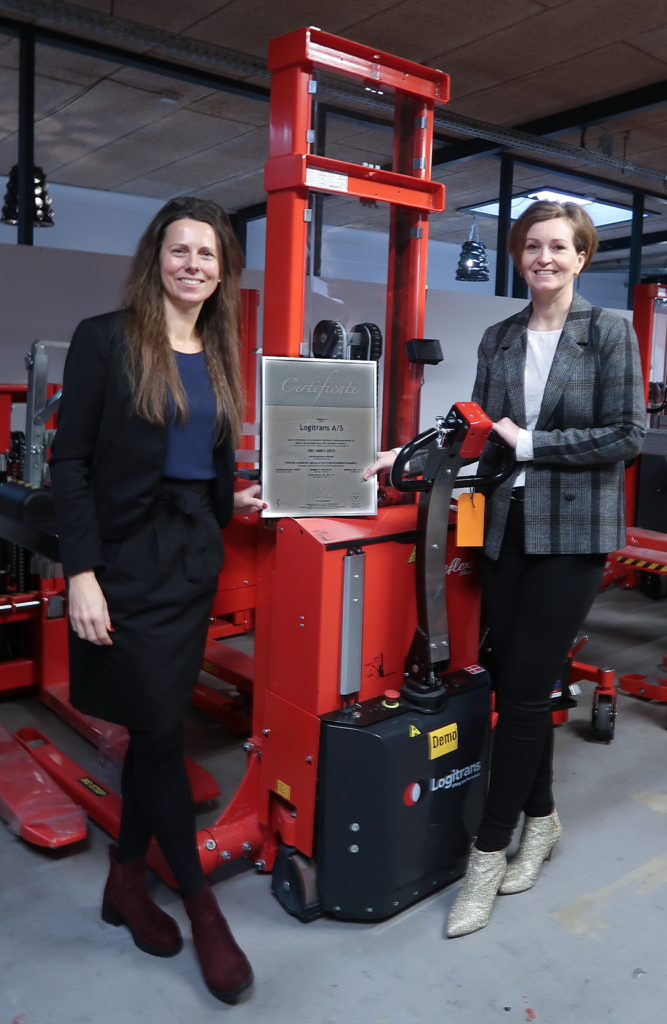
The Danish owner-managed company, Interthor Inc./Logitrans A/S, which for many decades has excelled in the global market for material handling equipment with its unique ergonomic solutions and high quality, is now even more focused on the green conversion. Most recently, Interthor/Logitrans has achieved another certification; the very recognized international standard in environmental management systems, ISO 14001. This standard sets specific requirements for the company to identify and understand its environmental impacts on activities and products. The company must establish an environmental policy, environmental objectives and set clear goals for improving its environmental efforts. “During the past year, we have worked purposefully to establish a strong foundation and a common understanding of environmental management system at Interthor / Logitrans, and we are therefore very proud of our ISO 14001 certification. With this certification, we have a tool to deliver environmental improvement results and to reduce pollution, waste generation, and inappropriate emissions into the environment ”. says Inese Niedola, QHSE Coordinator at Interthor/Logitrans. “We want to work strategically and consciously with our environmental goals and thereby minimize our environmental impact. With the ISO 14001 certification, we must constantly make improvements and evaluate. We have already done this before we were certified, but now we want to put even more focus on the environmental area. Over the past five years, Interthor/Logitrans has achieved very specific energy-saving measures, as electricity consumption has fallen by approx. 31%, which corresponds to a decrease in the CO2 footprint, cf. BBV tool, of 46.4 t. CO2″. added Niedola. “We have achieved the reduction through energy efficiency, where we, among other things. have replaced an exhaust system with regrowth and replaced an air compressor in our production, which has helped to reduce a large part of our electricity and gas consumption. We have also set some goals for further reduction and thereby expect to contribute even more to reducing our environmental impact. Our environmental certification should not just be visible on our website – it is a living and constant process that we will constantly work with “, explains Inese Niedola. Interthor/Logitrans’ goal is to work environmentally consciously, contribute actively and work purposefully with the green conversion, and Interthor / Logitrans therefore also works with the project “Klimaklar SMV” (“Climate Ready SME”), where small and medium-sized companies can get advice on how to strengthen growth and competitiveness via a specific climate strategy, CO2 calculation, and branding. Behind the project, you find the Manufacturing Industry, Danish Industry, and the Danish Industry Foundation in collaboration with other competent partners. Interthor/Logitrans also works with the nation-wide project ”Grøn Cirkulær Omstilling” (“Green Circular Transformation”), where the focus is put on development in a more sustainable and circular direction. This project is financed by the EU. “We have for a very long time focused on reducing CO2 emissions and green circular conversion, and through this work, we are now much more aware of our CO2 emission and how we can reduce it. The work has only just started, and we have high expectations and a lot of initiatives in the pipeline. One of the next projects is to make an overall sustainability strategy, which will become part of our overall strategy and a strategy for how we will implement and work with the UN’s Sustainable Development Goals. ” said CEO Gitte Kirkegaard.
Women In Trucking Association announces continued Gold Partnership with Great Dane
The Women In Trucking Association (WIT) has announced the renewal of Great Dane’s Gold Level Partnership for 2022. This partnership is crucial to the advancement of the non-profit organization’s mission to encourage the employment of women in transportation and logistics, celebrate their success, and minimize the obstacles they face. This is the eighth consecutive year that Great Dane has supported WIT as a gold-level partner. In addition to providing financial support, the company actively participates in the association. Laura Roan Hays, Regional Sales Manager at Great Dane, serves as Chair on the board of directors. “At Great Dane, we are proud to support programs like WIT which empower those in the trucking industry to find new opportunities for growth,” Roan Hays said. “My love and passion for the mission of WIT is shared by our Great Dane family, and is reflected by our core values of leadership and integrity.” “We are honored to partner with an influential industry leader like Great Dane and look forward to the continuation of the expertise and leadership Hays brings to our board of directors,” said Ellen Voie, WIT president and CEO. “Their commitment and passion for supporting the issue of gender diversity in the trucking industry is incredibly valuable to our association.” With a history dating back to 1900, Great Dane has established itself as a transportation solutions leader – delivering innovative products and exceptional services that help move America forward. Great Dane not only engineers durable and high-quality trailers and truck bodies, but also fosters relationships with customers and industry partners that last the long haul.
Pack a variety of products efficiently with the New 4000TL-Robotic Top Load Case Packer from Edson

See the 4000TL-Robotic in action March 16-18 in booth D10 at Tissue World Miami The new 4000TL-Robotic from Edson, a ProMach brand, is a top-load case packer aimed at small to midsize companies that manufacture a variety of SKUs within the away-from-home towel and tissue industry. Edson will be debuting the new 4000TL-Robotic on March 16-18 in booth D10 at Tissue World Miami. The 4000TL-Robotic is a cost-effective machine that uses a FANUC M-710iC/50 FP robot to provide a flexible top-load case packer with different end-of-arm tool options to efficiently handle specific applications. The machine can handle a wide range of products in a variety of pack patterns, primarily HSC cases up to 12 picks per minute. The 4000TL-Robotic is a great solution for contract packers and specialty product makers of rolled tissue, away-from-home, facial tissue, hand towels, folded napkins, diapers and incontinence products, feminine care, and other related paper products. The 4000TL-Robotic comes with a 10” Allen-Bradley color touch screen HMI for a simple operator-friendly interface. It achieves changeovers in less than 15 minutes to minimize downtime, and sturdy tube framing with automotive finishing to ensure the 4000TL-Robotic provides a long service life. An optional auto-adjust end-of-arm tool is also available, further minimizing changeover times. The robotic arm will also automatically adjust to the correct end-of-arm tool dependent on the application and product if there are multiple options. Another advantage the 4000TL-Robotic brings to customers is a compact footprint, occupying a similar floor space as hand-pack operations. The machine is also designed to be easily integrated into packaging lines with other end-of-line equipment. Features and benefits of the new 4000TL-Robotic include: Compact footprint for applications with limited space Ergonomic-designed with easy access to clean and maintain the machine External sealing options Low maintenance with robotic features Multiple roll layer pack patterns are available Case length: up to 30”; case width: up to 18”; case height: up to 18” including flaps Case dimensions 8” minimum height 14.5” maximum height 10” minimum length 30” maximum length 10” minimum width 18” maximum width To see the new 4000TL-Robotic in action, visit Edson in booth D10 at Tissue World Miami, March 16-18 at the Miami Beach Convention Center, Miami, Florida.
Combilift is named Timber Trade Supplier of the year from an Austrian timber publication
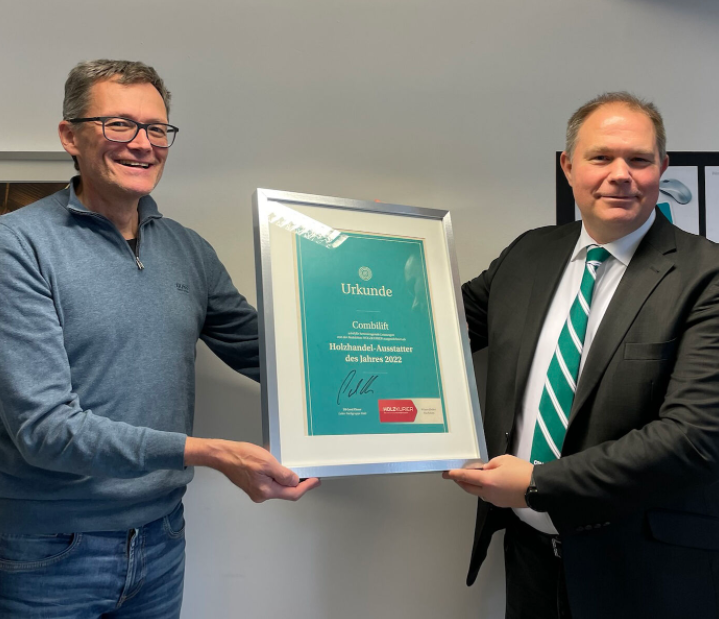
Holzkurier, an Austrian publication for the timber sector, has named Combilift as its Timber Trade Supplier of the Year for 2022. The company’s continual product development, its impressive growth in the Austrian market, and a policy of always putting the customer center stage were just some of the reasons cited by the editorial panel for choosing Combilift. Combilift delivered its first truck to Austria in 2003, when one of the original C-Series multidirectional models was bought by a customer from the timber sector. Since 2018, Gregor Kramar has held the position of Combilift’s Austrian Country Manager and has overseen the steady growth of the dealer network and the expansion of the customer base. For the last few years, Combilift’s incoming orders have recorded double-digit growth rates in German-speaking countries, and sales of more than €4 million were generated in Austria last year. “Although the majority of our customers come from the timber sector, we are also seeing significant growth in other markets, for example in the steel industry and in aluminum, modular, and window construction,” said Kramar. “Austria is a demanding market and customers have very high expectations when it comes to product quality and service, which we can fulfill thanks to our wide, ever-growing range and our reputation for putting the customer first.” “We are delighted with this award, which recognizes the position that Combilift now enjoys in this region, which is home to some of the world’s leading companies in the timber industry,” said Kramar. “So, many thanks go to the editors of Holzkurier and of course our ever-growing band of satisfied customers!”
Novanta Partners with MassRobotics to advance next generation of robotics

Novanta business units Celera Motion and ATI Industrial Automation will collaborate with MassRobotics to enable new innovations in medical/surgical robotics and other applications Novanta Inc. announced a new partnership with MassRobotics to help create and scale the next generation of successful robotics startups. Through the partnership, Novanta business units Celera Motion and ATI Industrial Automation will collaborate with MassRobotics to develop advanced innovations in medical/surgical robotics and improve robotic productivity. MassRobotics is an independent, nonprofit organization serving as an innovation hub for robotics and connected devices. Its efforts include providing innovative entrepreneurs and startups with the workspace and resources they need to develop and commercialize their products and solutions. Celera Motion is an award-winning provider of motion control components and subsystems for OEMs serving a variety of medical and advanced industrial markets. It will collaborate with MassRobotics and the other companies, organizations, and research institutions that it works with to create new innovations across a wide spectrum of applications, especially in medical robotics. “We are proud to support MassRobotics in its critical mission to create advanced robotics, particularly in the medical field,” said Matthijs Glastra, CEO of Novanta. “We are fortunate to be in a unique setting in the Boston area, surrounded by the world’s top hospitals, medical laboratories, and educational institutions. That has given rise to a unique regional ecosystem of resources — with the necessary talent, knowledge networks, infrastructure, and financial resources — to produce the best in medical/surgical robotics.” Added Brian Young, Chief Human Resources Officer of Novanta: “As a Boston-based company with technology development and manufacturing in Massachusetts, Novanta is uniquely positioned to be a leader in developing robotics talent for the region.” ATI Industrial Automation is the world’s leading engineering-based developer of robotic accessories and robot arm tooling. It will work with MassRobotics to develop sophisticated technological solutions that improve robotic productivity. “We’re thrilled to partner with MassRobotics to engineer the best innovations for the most demanding applications,” said Robert Little, president and General Manager of ATI Industrial Automation. “We love to work with people as passionate about robotics as we are, and we see incredible opportunities ahead for exciting new advancements.” MassRobotics currently leads a cluster of the highest concentration of robotics companies in the world, with roughly 400 companies, 65 resident startups, and 40 strategic partners. Through programming and events, MassRobotics helps bring together innovative startups and existing technology organizations to promote innovation and nurture the next generation of talent. “We’re excited to be part of the Boston area’s robotics community, one that is leading the next wave of technology,” said Kalpana Singh, president and General Manager of Celera Motion. “Together, we are simultaneously fostering and benefiting from our area’s incredibly innovative culture. The future is very bright for our industry, and we can’t wait to see what we’ll accomplish together.”
UgoWork to feature Lithium-Ion Batteries and Energy as a service at MODEX 2022
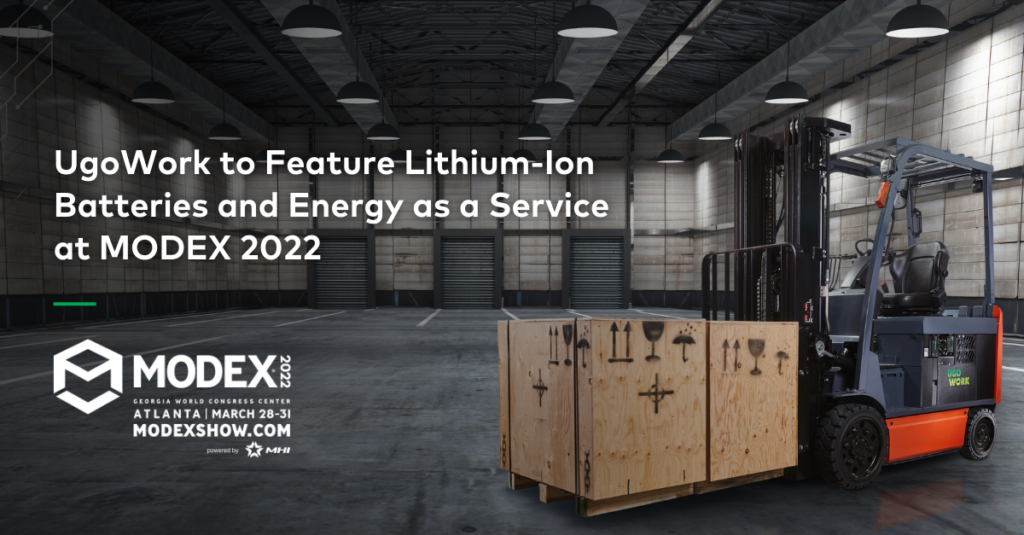
UgoWork™, a Canadian energy solutions provider specializing in the material handling industry, will be exhibiting at MODEX 2022, from March 28 to 31 at the Georgia World Congress Center in Atlanta. UgoWork develops and produces lithium-ion batteries for industrial trucks that help to reduce energy costs, operational bottlenecks, and reduce global carbon footprint. During the four-day event, UgoWork will showcase its latest innovations in lithium-ion batteries for industrial truck fleets as well as present its ground-breaking 24/7 Energy as a Service (EaaS) pay-per-use energy management program that mitigates CAPEX and OPEX. “Now, more than ever before, supply chains are under unprecedented pressure to elevate their efficiency and agility—without added costs that can impact stakeholders’ bottom lines. And to achieve this goal, forklift fleet operators must consider innovative approaches and technology”, said Philippe Beauchamp, UgoWork’s president and CEO. “With unmatched ergonomics and simplicity of its charging architecture and a revolutionary EaaS program, UgoWork is a true breath of fresh air in our market. You kind of have to see it to believe it. We are delighted with our physical presence to this MODEX edition, where warm sharing with leaders of our industry is core to innovation,” he added. Stop by and visit UgoWork at Booth #C4097.
Felling Trailers’ “Green” Air Bi-fold Ramp System
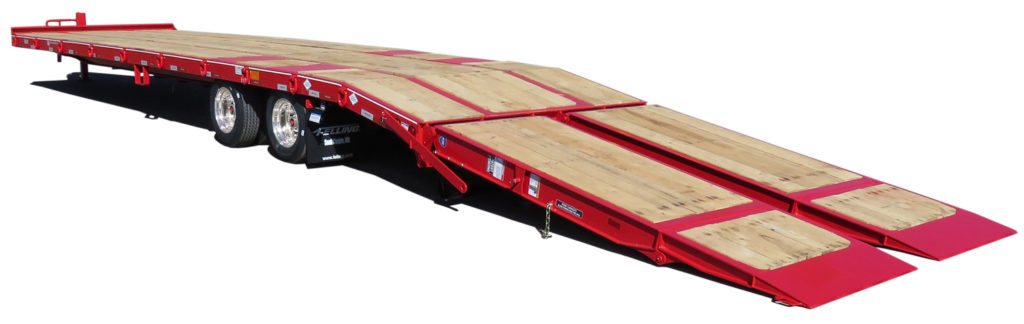
Felling Trailers’ continues to go “green” with their patent-pending Air Operated Bi-fold Ramps system. The Air Bi-Fold Ramps system first debuted at CONEXPO-CON/AGG 2020, stirring the interest of many in the construction sector. The Air Bi-Fold ramp system is part of Felling’s Controlled Flow Air Ramp series, which the company launched over a decade ago, all air-powered, no batteries, no hydraulics. The new Air Bi-Fold system is a revolutionary system that is perfect for the paving and low clearance markets. A key feature of Felling’s design is in the operation of the flip ramp. The flip ramp locks out fully when extending, preventing scraping or marring of the ground, which is undesirable, especially if it’s a new surface of any kind. Another key feature is Felling’s controlled flow air ramp technology which provides for soft ground contact of the ramp, keeping new surfaces free from being damaged. “The last thing that you want if you just paved a new parking lot is getting new asphalt down and scraping it with your trailer when you load up at the end of the day. This system eliminates that. It’s all air-powered, a totally green system,” said Patrick Jennissen, Felling’s VP of Sales & Marketing. Few manufacturers in the marketplace offer an Air Bi-Fold Ramp system, let alone with the functionality that Felling’s offers. Felling Trailer’s Air Bi-Fold Ramps are 45″ wide by 11′ (7.5′ +3.5′) wood inlaid. The 11′ Air Bi-Fold ramps were designed to accommodate the load angle necessary when loading cumbersome low clearance equipment such as paving equipment and directional drills. The Air Bi-Fold ramps’ length provides the operator with a gentler, more gradual incline to provide ease in loading/unloading with its 9.5º load angle with the option of air ride suspension when the air is dropped. Felling Trailers’ Air-Ramp technology allows operators to use the tow vehicles’ onboard air system to power the ramps, eliminating the maintenance of an onboard electric/hydraulic system. Furthermore, the patent-pending technology allows for minimal ground contact when deploying/retracting the ramps to reduce damage to the new pavement when loading/unloading. “These ramps are available on a wide range of air brake-equipped trailers and allow the safe loading of most paving equipment with ease. Air-operated ramps are far more reliable than those powered by an electric/hydraulic pump, making it a clear choice for many paving crews,” said Nathan Uphus, Felling’s Sales Manager. The new bi-fold ramp system is currently available on 20, 22.5, 25, and 30-ton tag series with plans to expand into the semi-trailer lines. Felling Trailers is excited to showcase their air-operated bi-fold ramps system once again at the World of Asphalt show taking place in Nashville, TN, March 29th-31st, 2022. The Air Bi-Fold ramp system will be featured on an FT-45-2 LP, 22.5-ton, low-profile flatbed tag trailer. Attendees can find Felling Trailers in booth 3268. Demonstrations of the air ramp system operation will be taking place throughout the duration of the show. FT-45-2 LP with Air Bi-Fold Ramps Specifications 26’ Main Deck Length Plus 6’ Double Incline Beavertail, White Oak 45” Wide x 11’ (7.5’ + 3.5’) Bi-Fold Air Operated, Oak Inlaid Ramps Air Brakes, ABS 2S/1M, Meritor WABCO (parking brakes on all axles) 25K Oil Bath Axles 49” Spread (Spring), 9700 Hutch Suspension 25,000 lb. Heavy Duty 3 Leaf Spring Suspension 235/75R 17.5” Tires on 8 Bolt Aluminum Alcoa Mirror Polish Wheels 140,000 lb Twin 2-Speed Jack (39,000 lb. Lift Capacity)
EP 252: Battery Talk 2022
On this episode, I was joined by not one but five guests! I call this one battery talk because we were talking batteries for the latest edition of Material Handling Wholesaler magazine which focuses on lithium-ion batteries in our industry. I was joined by Harold Vanasse of Enersys, Robin Schneider of Greencubes Technology, John Gelsimino of Arcon Equipment, David Suarez of One Charge, and Chris French of PowerBattUSA. We discuss the current state of batteries in the material handling industry including challenges with lithium-ion and sustainability of lithium-ion. Key Takeaways Overall the consensus from all guests was that lithium-ion is pushing its way into more operations but it is still incredibly early in the adoption cycle. While there are certainly benefits to lithium-ion the technology is still developing to the point where there are still some unanswered questions because we have just not had to cross that bridge yet. In the discussion, we touch on many of these unanswered questions and it seems the overall opinion is that we are heading in the right direction to make sure that lithium-ion gets on the right track. However, all guests were on the same page with that we will not see a total lithium-ion takeover and lead-acid will still be present in the industry 10 years from now. Some of the challenges that were raised include the sustainability of lithium-ion and the cost of entry. Right now due to lithium-ion being such a young technology for our industry there has not really been a fully developed recycling program or way to properly dispose of the batteries. Currently, they are being repurposed but the end of life has not necessarily been determined or been determined in a way that makes economic sense for all parties involved. Another point to sustainability that Chris brought up was how long will the actual supply of natural resources that lithium-ion needs last. With many things now requiring these resources to operate there may be a shortage at some point. While the total cost of ownership can be greatly reduced by switching to lithium-ion the cost of entry is very high. Most operations can not afford to switch over at once due to this which slows down the adoption of lithium-ion as many businesses do not have the resources for this. Additionally, the benefits can be the reduced amount of maintenance on these batteries but Harold points out that new forms of lead-acid are also becoming available in the market that is maintenance-free so it will be interesting to see how the market develops over the next few years. Listen to the episode below and leave your thoughts in the comments. The New Warehouse Podcast EP 252: Battery Talk 2022
Sustainable Bio-Blast™ quickly frees frozen parts with no VOCs

Renewable Lubricants new Bio-Blast™ Penetrant is a high-performance, fast-acting, biodegradable penetrant that eradicates rust and dirt to quickly free corroded nuts, bolts, and other frozen components quickly. A patented blend of additives and bio-solvents provides a fast-penetrating catalyst that is non-staining to ferrous and non-ferrous metals. Fast capillary wetting action reduces surface tension, freeing up frozen parts quickly. Unlike petroleum solvents, there is no direct loss of the penetrant into the water, soil, or work environment, so Bio-Blast™ is inherently safer for the environment. This patented non-flammable, non-combustible formulation is safer for the workplace as well. Renewable, non-toxic, OSHA and ISO-1400 compliant Bio-Blast™ contains no hazardous VOCs, making it ideal for use on nuts/bolts, air tools, rusty chains, jacks, locks dies, linkage cables, wire ropes, hinges, firearms, fishing reels, and more. Bio-Blast™ meets the Environmental Protection Agency (EPA) 2013 Vessel General Permit (VGP) guidelines for Environmentally Acceptable Lubricants (EALs) and is ideal where low toxicity, biodegradability, and non-bioaccumulation properties are required. Penetrates in close tolerances and prevents corrosion Available in 11-ounce aerosol cans, 12-ounce spray bottles, 1-gallon jugs, 5-gallon pails, 55-gallon drums, and case lots from the Hartville, Ohio factory. Renewable Lubricants, Inc. began as a research and development company in 1991, developing high-performance products that would directly replace petroleum-based products. Starting from a single corn-based engine oil developed in the inventor’s garage, the company now offers more than 250 products and has over 100 worldwide patents. They manufacture their products as environmentally friendly as possible without sacrificing performance.
Hy-Brid Lifts reports record sales in 2021
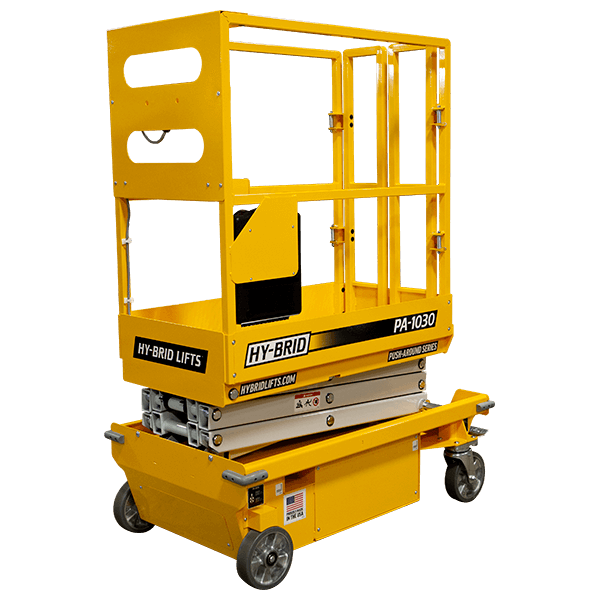
Low-level access equipment specialist Hy-Brid Lifts closed the year 2021 with record-setting sales. The company attributes this strong performance to its portfolio of class-leading products and increasing demand for safer work-at-height options. Compared to 2020, the scissor lift manufacturer’s global sales rose an impressive 99%, driven by a 140% growth in Push-Around Series sales. “We have seen a significant increase in demand for more efficient and maneuverable aerial work platforms,” said Jay Sugar, Hy-Brid Lifts CEO and President. “Not only does our product line meet these customer requirements, but our lifts are setting new industry standards.” The PS-1930, launched in early 2020, remains the world’s lightest 19-foot scissor lift and one reason Pro Series sales grew 83%. Demand for the compact ZT-1230 and its less than zero degree turn radius pushed Zero-Turn Series sales 73% higher than prior year figures. Sugar confirms that the company’s aggressive growth strategy and unique ability to pivot shaped 2021 performance. “Hy-Brid Lifts has its share of manufacturing challenges due to ongoing material sourcing and labor shortages,” Sugar said. “Having American-made products gives us the flexibility to get creative with resources and overcome these obstacles. This enables us to maintain shorter lead times than our competitors and deliver the innovative solutions our customers need.” The new year promises to be even bigger for the global scissor lift leader. Much anticipated product releases, end-user demand for compact machines, and the push toward electrifying fleets lend to a positive trend moving into 2022.
Port of Long Beach ‘Container Dwell Fee’ Start postponed

Ports of Long Beach, Los Angeles to wait until Feb. 11 to consider the program The two San Pedro Bay ports – Long Beach and Los Angeles – announced today that they will wait until Feb. 11 to consider the start of the “Container Dwell Fee.” The two ports have seen a combined decline of 68% in aging cargo on the docks since the program was announced on Oct. 25. The executive directors of both ports will reassess fee implementation after monitoring data over the next week. Fee implementation has been postponed by both ports since the start of the program. Under the temporary policy, ocean carriers can be charged for each import container dwelling nine days or more at the terminal. Currently, no date has been set to start the count with respect to container dwell time. The ports plan to charge ocean carriers $100 per container, increasing in $100 increments per container per day until the container leaves the terminal. Any fees collected from dwelling cargo will be reinvested for programs designed to enhance efficiency, accelerate cargo velocity and address congestion impacts. The policy was developed in coordination with the Biden-Harris Supply Chain Disruptions Task Force, the U.S. Department of Transportation, and multiple supply chain stakeholders.
Twin Spring Coupling announce its North American sales representatives servicing the U.S. and Canadian

Twin Spring Coupling has announced the following list of sales representative companies to support the expansion of our product range out into the Industrial distribution marketplace. The North American sales representative agents are: AF Industrial – CO, UT, WY Allied Components Inc. – AK, ID, OR, MT, WA Bick Products, Inc.- IA, IL, KS, MO, NE Industrial Component Sales – ND, SD, MN, WI RDT Industries – MI, IN, OH NTS – RI, CT, ME, VT, MA, NH Pro Power Associates – Upstate NY, Western PA Rausch Sales – Florida (Except Panhandle) RPT – AR, LA, NM, OK, TX Simpson & Associates – AL, FL Panhandle, GA, MS, TN Driven Sales – Lower NY, NJ, PA, DE, MD RGW Sales – Canada These companies have many years of power transmission experience and the fit with our coupling line is a natural add-on to their current product offerings, says Darren Finch CEO/Founder of Twin Spring Coupling. The companies in the industrial distribution channel have had lots of experience dealing with these companies, the likes of Grainger, Motion, AD, Fastenal, MSC Industrial, DXP, BDI, OTP, Turtle and Hughes, CBT, IBT, and many others, they will continue to deal with them and serve as their front-line sales and technical support agents.