After developing a way to produce solar cells using materials previously considered too expensive for use on Earth, scientists at the National Renewable Energy Laboratory have improved upon their method and made the process faster.
As reported late last year in the journal Crystals, the scientists pioneered a new growth technique, called dynamic hydride vapor-phase epitaxy (D-HVPE), as an alternative to the current growth technology. The manufacturing cost of solar cells made with III-V materials—named because of where the elements fall on the periodic table—remains too high for earthly applications. Using D-HVPE, III-V solar cells could potentially enter terrestrial markets, where their highly efficient ability to convert sunlight into electricity would prove desirable.
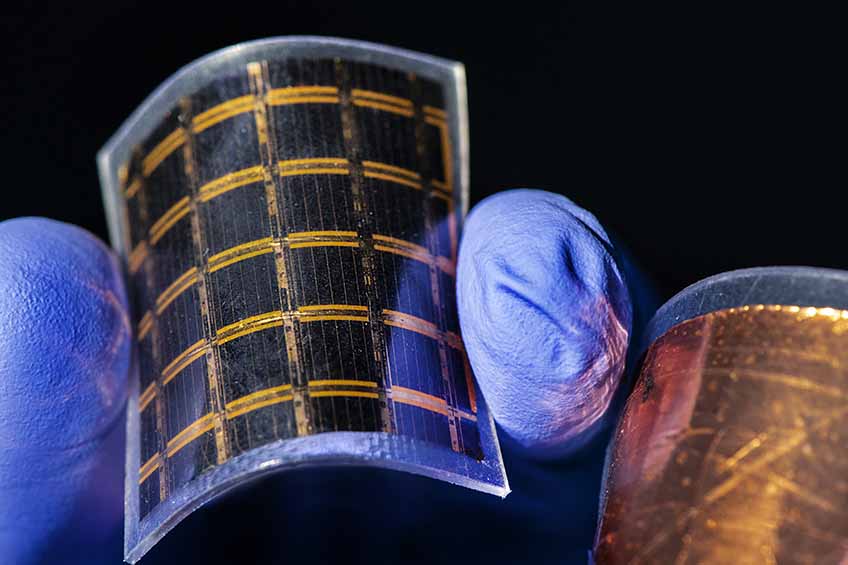
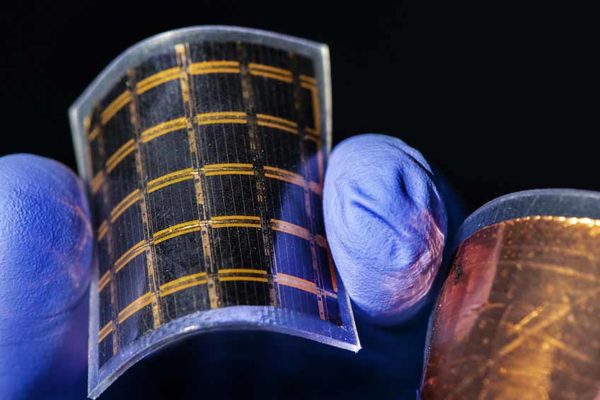
NREL scientists were able to make a flexible gallium arsenide a solar cell using dynamic HVPE, which holds the potential to greatly reduce manufacturing costs. (Photo by Dennis Schroeder / NREL)
The newly published research in Nature Communications details how the NREL researchers refined the D-HVPE process to produce solar cells more than 20 times faster than the process now commonly used called metalorganic vapor-phase epitaxy (MOVPE). The growth rate enhancement enables the growth of a base layer for the solar cell in about 23 seconds, down from over 8 minutes compared to MOVPE. MOVPE typically uses rates of about 15 micrometers an hour, although scientists have been attempting to increase that pace.
“If we can get the costs down like we think we can, that opens up a huge number of markets where these devices would be useful. Anywhere you want a high-efficiency device that’s thin, light, and flexible—electronics charging cases, electric vehicles, building-integrated PV, rooftops, drones,” said Aaron Ptak, a senior scientist at NREL and co-author of the new paper. His other co-authors, all from NREL, are Wondwosen Metaferia, Kevin Schulte, John Simon, and Steve Johnston. The title of the paper is “Gallium arsenide solar cells grown at rates exceeding 300 µm h−1 by hydride vapor phase epitaxy.”
NREL scientists have used the D-HVPE process to make solar cells with a 25% efficiency.
“The maximum efficiency we expect, using our current device design, is 27%,” said Schulte, “but fundamentally, we see no reason that we cannot reach the more than 29% efficiencies of MOVPE. There are some technical hurdles we need to clear to get there, but we are working on these hurdles.”
MOVPE deposits atoms derived from expensive precursor molecules layer-by-layer atop a semiconductor wafer, which makes for a costly and time-consuming process. The NREL researchers returned to an older process called hydride vapor phase epitaxy (HVPE), which was overtaken by MOVPE in the 1970s. While HVPE also deposits materials layer by layer, the process is faster due to the different process chemistry.
Scientists at NREL advanced HVPE by developing a dual-chambered reactor that quickly moves the substrate from one chamber, where the first layer of chemicals is deposited, to the second chamber and another layering on of chemicals. They dubbed it dynamic HVPE to distinguish the process from what had come before. D-HVPE uses much lower-cost source materials compared to MOVPE.
“D-HVPE is an alternative to MOVPE, one that promises to be much lower cost in high-volume production,” Ptak said. “What we’re promising is the same device efficiency – the same material quality – but at greatly reduced cost. High growth rates leading to high throughput are one of the ways we’re going to get to lower costs.”
The researchers also demonstrated D-HVPE of indium gallium phosphide (GaInP) at rates up to 206 micrometers an hour, over 50 times traditional MOVPE growth rates, and do not believe they have reached the ceiling for that material. GaInP is used as a passivating layer in gallium arsenide (GaAs) solar cells and can also be used as a light-absorbing layer in multijunction solar cells. Fast GaInP growth will enable rapid growth of GaInP/GaAs two-junction cells, which are even more efficient than single-junction GaAs cells.
Funding for the research came from the Energy Department’s Solar Energy Technologies Office and the Advanced Research Projects Agency-Energy.
Read more about NREL’s D-HVPE research.