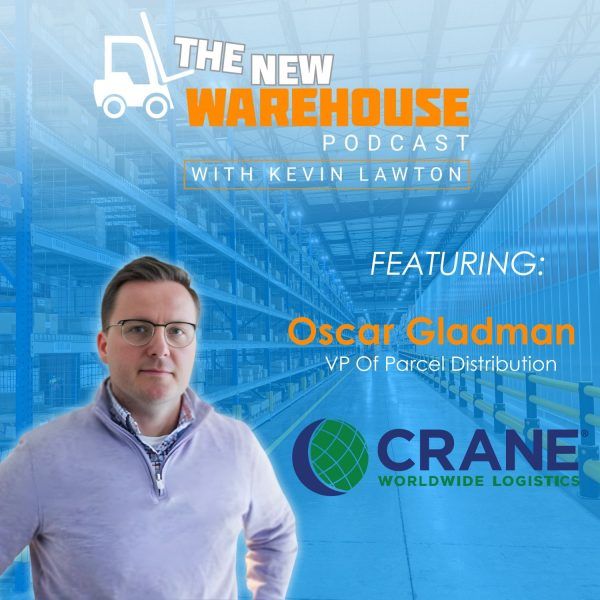
In this episode of The New Warehouse Podcast, Oscar Gladman, Vice President of Parcel Distribution at Crane Worldwide Logistics, unpacks how parcel strategy has evolved and what shippers need to understand moving forward. With more than 20 years of experience across parcel, e-commerce, and enterprise logistics, Gladman offers a grounded look at how consumer behavior, technology, and carrier dynamics have reshaped the parcel landscape.
From the rise of residential delivery to the growing complexity of carrier relationships, the conversation explores what has changed, what hasn’t, and how companies can stay flexible in an increasingly unpredictable market.
How Parcel Evolved from B2B to Consumer-Centric
Parcel shipping looks very different today than it did two decades ago. Gladman recalls a time when residential deliveries were the exception, not the rule. “Residential deliveries and direct consumer deliveries represented such a small part of the business when I started. That was really a business-to-business proposition.” As e-commerce gained momentum, that model shifted quickly.
Technology played a significant role in that transformation. Early shipping tools were manual and time-consuming, requiring printed labels and handwritten addresses. Over time, software and automation changed how shippers operated. “It’s amazing to see how much it’s changed, just from a technology perspective, but also just the way that it’s changed from business to business to consumer.”
The growth of online shopping accelerated this shift even further. Gladman noted that the turning point came as mobile usage expanded and consumers became more comfortable with online shopping. “I don’t know that I can pin down one exact moment where it changed. It kind of just snuck up on me.” What followed was an entirely new parcel environment built around speed, volume, and customer expectations.
Carrier Shifts, Tariffs, and Market Disruption
The parcel market has grown more complex as new carriers entered the space and global trade dynamics shifted. Gladman pointed to tariffs and policy changes as major disruptors, particularly on the inbound side. “The biggest tariff change that impacted e-commerce brands was de minimis. That’s really what drove the most change.”
SUSPENDING DUTY-FREE DE MINIMIS TREATMENT FOR ALL COUNTRIES
He emphasized that uncertainty, not just cost, posed the biggest challenges to executing on your parcel strategy. “The constant change was really what drove the most pain.” For many shippers, the difficulty wasn’t adapting to new rules but keeping up as those rules continued to evolve.
At the same time, regional and gig-based carriers began entering the market, offering alternatives to FedEx and UPS. While these providers introduced competition, Gladman noted their limitations. “They’re cherry-picking. They only want the easiest freight.” He added that these carriers often avoid heavier shipments or rural deliveries, leaving national carriers to handle the most complex moves.
Despite this disruption, he believes the major carriers still play a critical role. “They have massive infrastructure, and that’s expensive to run.” That scale, while costly, remains essential for supporting nationwide delivery networks.
What Shippers Should Focus on Moving Forward
Looking ahead, Gladman stressed the importance of data clarity and flexibility. Too often, companies focus on the wrong parts of their parcel spend. “If you were to create a pivot table of your last invoice, you’d probably realize that 80% of your spend is coming from 20% of the charge types.”
Rather than chasing every discount or new carrier, he recommends starting with visibility. “One page of your parcel agreement probably matters the most.” Understanding where costs originate allows shippers to make smarter decisions without overcomplicating their strategy.
He also emphasized preparation over prediction. “Something’s going to happen in 2026. I don’t know what it is.” The key is being ready to respond. “If you’re capable software-wise of implementing a change… if you’re tech-enabled, if you have multiple relationships with multiple carriers, and you’re collecting and organizing your data in a way that you can make decisions.” For Gladman, successful parcel strategy comes down to staying focused, adaptable, and ready for whatever comes our way in 2026.
Key Takeaways on Parcel Strategy
- Parcel has shifted from a B2B model to a consumer-driven e-commerce network.
- Technology and mobile commerce accelerated parcel growth faster than many expected.
- Tariff changes created disruption mainly through uncertainty, not cost alone.
- Regional carriers offer flexibility but often avoid complex or heavy shipments.
- Most parcel spend comes from a small number of charge categories.
- Data visibility is more valuable than chasing incremental discounts.
- Flexibility and strong carrier relationships are critical for long-term success.