- Nine out of ten companies (91%) report increased CapEx spend on order fulfillment automation over past year
- 61% now expect return on investment (ROI) on automation projects in 12 months
- Across the board ‘facility automation’ is the top strategic priority
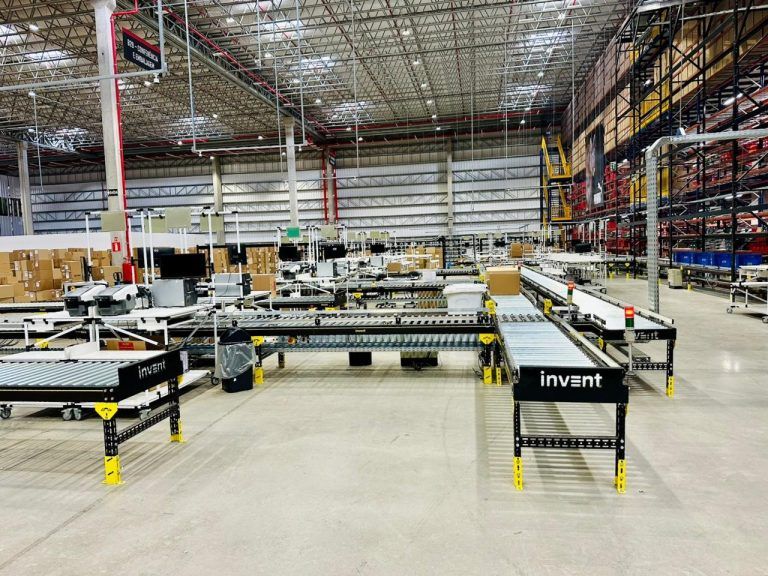
Nine out of ten companies (91%) report an increase in capital expenditure (CapEx) spend on order fulfillment automation over the past year, according to new research from Interact Analysis. The market intelligence specialist reveals in its new Voice of Market report that more than half of those investing more during the previous 12 months increased their spend by 6%-15%. Further investment is planned for the future, with 95% of survey respondents anticipating an increase during the coming year.
According to the latest Interact Analysis Voice of Market report, return on Investment (ROI) expectations are also rising, with 61% of respondents now expecting ROI from order fulfilment automation within 12 months. However, as CapEx grows, automation customers are willing to be more flexible about the criteria they consider when calculating ROI.
 Monica Sanchez, Senior Research Lead for Voice of Market at Interact Analysis, says, “Asking the right questions can enable suppliers of order fulfilment automation to incorporate a broader set of criteria (standardization, accuracy, demand flexibility, multi-shift operation) or factors can be weighted differently when suppliers partner with potential clients to truly understand the current operation and future needs.”
Productivity gains could improve with end-to-end automation
Interact Analysis experts reveal automation asymmetry may be restricting productivity. Many facilities now operate a hybrid model for order fulfillment in which core flows like conveyance, storage, and picking are at least partially automated, while critical peripheral processes (including cycle counting, inspection, and exception handling) remain manual or semi-manual. This means high-speed systems are constrained by slower, manual upstream/downstream operations, limiting overall throughput. Facility leaders report that there are two important ways in which OEMs and system integrators can add value:
- Help clients integrate automation end-to-end, rather than at one stage of a process
- Advise clients on harnessing further productivity by making simple process changes
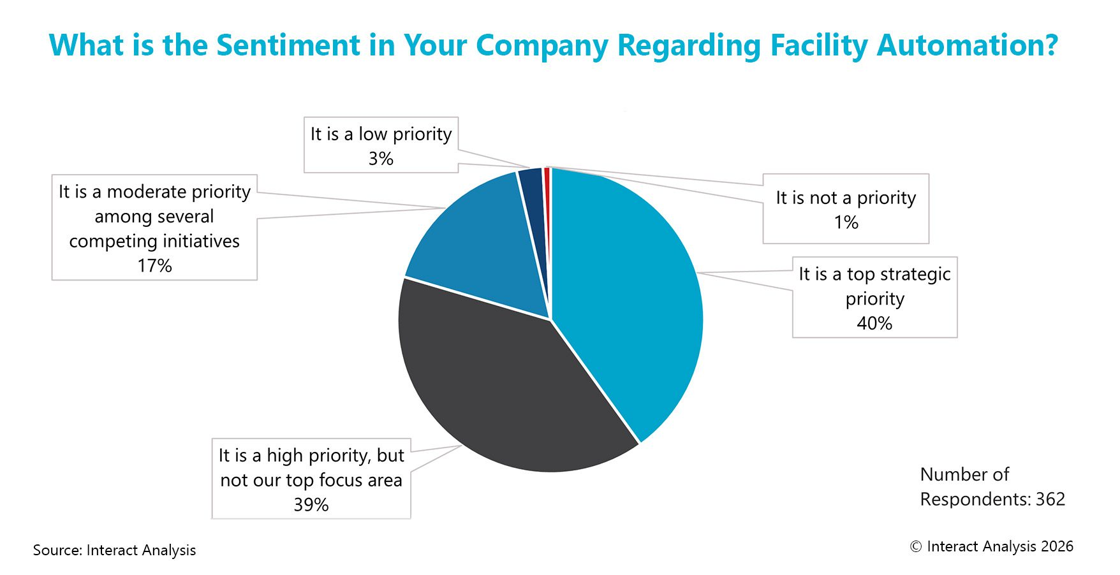
Facility automation is rapidly becoming a key priority for companies. Approximately 40% of respondents to the Voice of Market survey stated ‘facility automation’ is a top strategic priority, with decision-makers almost twice as likely to do so (50%) than influencers (29%). Respondents are reporting a decreasing reliance on labor due to high costs, shortages, and recruitment challenges, especially for processes with low ‘added value’ and high ‘repetitive stress or injury’.
|
“Order fulfillment automation can deliver significant benefits around quality, consistency and speed to the customer,” Monica Sanchez explains. “We expect robotic automation will lead the market over the next three to five years, particularly mobile robots, collaborative robots, and loading & unloading robots. With between 20% and 37% of operations currently fully manual, there is huge scope for adoption.
“Now that automation is an irreversible trend, the top barriers are practical integration complexity, internal capability gaps, and uncertainty around scalability. There is a strong desire, therefore, for vendors to partner more closely with vendors and system integrators from the start of a project and beyond go-live to ensure its success.”