Many businesses and workers share a global cautiousness about automation. Yet the reality of robotics and autonomous solutions, such as Automated Guided Vehicles (AGVs), presents a powerful opportunity to work smarter together.
Work redefined: collaborating not competing
This isn’t about machines stealing jobs; it’s about businesses strategically reallocating resources and empowering their workforce to focus on tasks that require human ingenuity, creativity, and critical thinking. We’re on the cusp of a new era of co-working where people and autonomous machines work in harmony, not in competition.
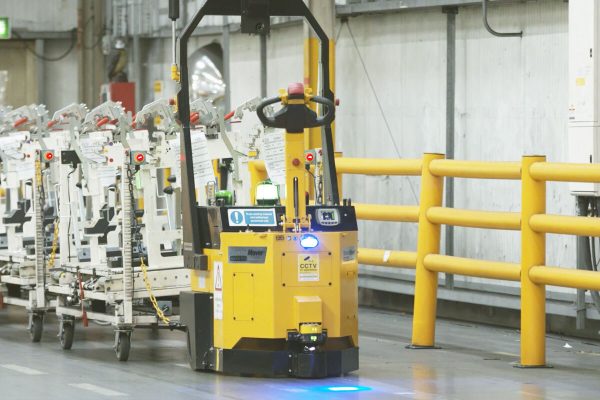 While automation is clearly changing the employment sphere, it’s mainly doing this by streamlining repetitive and physically demanding tasks. Take a warehouse worker who spends a significant amount of time moving boxes from point A to point B as an example; automation can handle this aspect of the job instead, freeing that worker to focus on more complex tasks like inventory management and quality control.
Increased automation investment
Persistent labor shortages are gripping many sectors throughout the U.S. which is having an impact on the speed at which businesses are adopting automation.
With an ongoing skills shortage, companies are turning to robotic solutions to maintain operational efficiency. Collaborative robots (cobots) and mobile robotics such as AGVs and AMRs are proving to be a solution that helps to bridge an operational gap as businesses struggle to source labor. The manufacturing sector currently has hundreds of thousands of unfilled positions, so companies are now expediting their longer-term plans to move towards automated assembly lines and robotic arms sooner.
This isn’t just a reactive measure to fill the immediate labor gaps though; it’s a growing recognition that automation can offer long-term strategic advantage, allowing companies to become more agile, responsive, and competitive. For example, in logistics and distribution industries where e-commerce demands have surged, automated guided vehicles (AGVs) are becoming commonplace to support changing demands, with machines working alongside existing workforces to boost productivity.
The key for workers and businesses navigating this shift lies in understanding that automation isn’t about replacing people. It’s about augmenting their capabilities. It’s about creating a work environment where humans can thrive, allowing us to focus on and hone the skills that make us uniquely human, the skills that can’t be replaced. This means investing in training and development, equipping workers with the skills they need to collaborate effectively with machines. Fostering a culture of adaptability and learning will empower employees to embrace change and see automation not as a threat but as an opportunity.
Let’s consider the manufacturing sector again, perhaps the clearest example of an industry impacted by automation. While robots may easily handle assembly line tasks and automated guided vehicles may take on lineside deliveries, this frees workers up to focus on higher-value tasks. These areas drive innovation and create long-term value. This same principle applies across industries, from logistics and retail to healthcare and pharmaceuticals.
Investing in people and technology
It’s vital for businesses to look at ways of strategically embracing automation. This means carefully assessing which tasks are best suited for automation and which require human intervention. It means investing in the right technology and ensuring that it’s integrated seamlessly into existing workflows. And crucially, it means investing in people, providing them with the support and training they need to adapt and thrive in this new age of human-machine collaboration.
The future of work isn’t about robots versus humans. It’s about robots and humans. Working together to achieve more than either could alone by leveraging the speed and precision of machines alongside the creativity and problem-solving skills that only humans can handle.
Adopting a collaborative approach to automation will allow businesses to unlock new levels of productivity, innovation, and success while simultaneously creating fulfilling environments for their employees. The automation revolution isn’t taking over; it’s taking us to the next level.
About the Author:
James Jones is a Partner and Director at MasterMover, a global manufacturer of electric tuggers and tow solutions designed to improve safety and operational efficiency when moving heavy, large, or unconventional loads. MasterMover focuses on innovation, research, and development to provide the widest range of electric tugger products on the market.