
Episode 355: StreetDrone

The New Warehouse welcomes Mark Preston, Co-Founder, and Chief Strategy Officer at StreetDrone, to discuss autonomous driving in logistics. Mark has a background in mechanical engineering, Formula 1, and designing dangerous goods containers. Mark leverages this unique background to solve the complex challenges of autonomous driving. Be sure to tune in to learn about StreetDrone’s autonomous solutions and to hear Mark’s thoughts on when we will see self-driving technology at scale. Key Takeaways Initially, StreetDrone used a combination of autonomy and teleoperation for integration with a pilot site for Nissan. Mark adds there is still a need for interaction between operators who can help vehicles move around mixed-mode traffic sites like ports or public roads. However, these technologies will continue to develop over time, allowing us to travel alongside them one day soon. StreetDrone focuses primarily on first-mile logistics – feeding into factories, ports & regional distribution centers. These routes are often well-known, defined, and controlled, making them ideal for SmartDrone’s Smart 1 Terminal Tractor. Truck drivers from Nissan involved throughout the process are now evangelists for this technology as it increases safety measures onsite and alleviates the lack of available workers globally. StreetDrone’s last-mile solution is the golf cart-sized Pix-E. The Pix-E is a low-speed vehicle designed to perform last-mile deliveries in densely populated areas. Mark explains that they are always learning in development, and as they learn and improve, they can navigate to less-controlled environments. The New Warehouse Podcast EP 355: StreetDrone
How to select a Lithium-ion Battery Supplier: OEM eight questions to ask
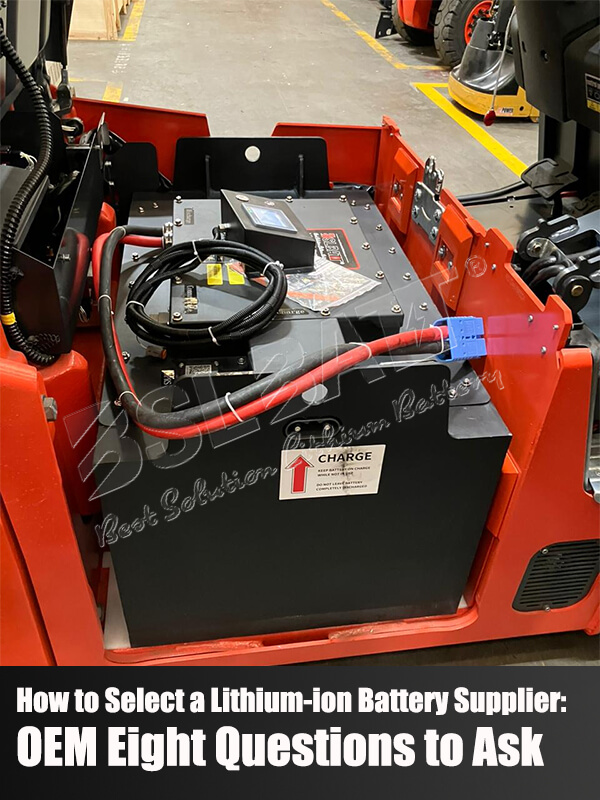
Making the Decision: Lithium-Ion Battery Supplier The lithium-ion battery market is in a state of flux. Lithium-ion is a relatively new technology that has taken off in the last five to 10 years and demand for these batteries is high and growing. This has attracted many OEMs and created something of a buyer-beware market for OEMs. Many critical factors must be considered when deciding on a forklift battery supplier. Choosing the wrong lithium-ion battery for a forklift can impact the entire operation of an OEM’s business, from procurement to production. An OEM’s day-to-day operations depend on forklift transportation, and a forklift’s day-to-day operations rely heavily on the battery. Choosing a lithium-ion forklift battery supplier is the first step in determining the success of an OEM’s daily processes. OEMs need suppliers who can meet JIT shipping demands, lead technical innovation, and provide extended technical service. Without that, you may end up with a lithium-ion supplier instead of a lithium-ion partner who will be with you for the long run. That can lead to dissatisfied customers and lost time and money. Ask the manufacturers these questions: To get an idea of how established the company is ask how long they have been in business, how long they have been serving the material handling industry, and whether they have supplied batteries to major OEMs. You could also ask if they offer a full portfolio of batteries including flooded lead-acid, AGM, and lithium-ion. You may want to move on if the manufacturer is a start-up, has been serving the material handling industry for just a few years, or has not supplied batteries to OEMs. Older, more seasoned companies that understand the material handling industry and manufacture and sell a full line of forklift lithium battery products generally know the issues that can damage batteries and shorten their lifespans. They often engineer solutions to these problems in their products. How long have you been working with lithium-ion technology? Again, the company probably has a lot to learn if the answer is just a few years. What kind of customer support do you provide? Make sure the company has a U.S.-based and Europe customer support line staffed by real people who can answer questions and help your technicians troubleshoot issues. Ask if support is available 24/7 and if the staff includes representatives dedicated to lithium-ion products. Many newcomers to the market simply don’t have the infrastructure to provide that level of service. How do you support the dealers who carry your products? You don’t want to work with a supplier who sells products and then forgets about you. To avoid phone tags and long hold times, look for a manufacturer with a systematic approach to communicating with dealers. Ask if the manufacturer has an authorized dealer network through which it trains dealers to sell its products and provides them with the information and materials they need. How do you sell your batteries? Many battery manufacturers sell directly to dealerships and are unable to provide the follow-up services dealers may need. Look for a supplier who sells their batteries through a network of trained distributors. These distributors generally know and stand by their products, adding value to your purchase. How is your battery different from others in terms of design and engineering? Look for products with UL2580 certification and at least an IP67 rating. This helps protect the battery from damage from vibration, water, and dust and can extend its life. Make sure the battery is embedded and modular expandable. Ask how the battery is designed to move the damaging heat it generates away from the cells. Most manufacturers do this through inexpensive components called heat sinks because they are easy to make and add on. But heat sinks should not be the only method of heat management. Well-made batteries reduce the heat generated and allow for natural cooling in the design. This requires more engineering expertise, but it boosts efficiency, improves safety, and prolongs battery life. What range does your battery get? To help OEMs, BSLBATT has developed 43 standard modules for lithium batteries of different capacities, which can form parallel building blocks in forklift battery compartments. Up to 20 of these modules can be stacked in parallel, and the total capacity can be tailored to forklift OEM needs. It’s also worth mentioning that OEMs must check usable capacity, not advertised capacity. The stated capacity may be based on the sum of the individual cells within the battery, which does not take into account internal losses like usable capacity. Real-world test data and customer testimonials are the best way to understand the usable range of a battery. This is especially important in the high-capacity, high-current, and relatively low-voltage batteries used in MHE. What safety features are built into your battery? Look for a battery with lithium-iron-phosphate cells, one of the most stable lithium-ion battery chemistries. Make sure the BMS features several levels of safety redundancy. That way, if one level fails another will step in, catch the issue, and turn the battery off, protecting you and your property. Ask about UL certifications. Is the entire pack UL-certified or does the manufacturer rely solely on the cell provider’s UL listing? BSLBATT is the first forklift lithium battery in China to obtain UL2580 certification for its complete product line. Stocking batteries on pricing alone is a big mistake that can impact your bottom line. Be sure to compare the manufacturers’ experience, support services, and products. Investing a little time in your decision can have big payoffs in your sales, service, and customer satisfaction. BSLBATT -Your trust OEM Lithium-Ion Battery Supplier in China BSLBATT battery has owned 10 years of OEM battery pack experience for Material Handling, Paper, and Packaging, Food and Beverage, Refrigerated Storage, Manufacturing Industry, Fresh Produce, Wine Industry, Distribution, and 3PL industries applications. What makes the BSLBATT the Superior Lithium Battery for your Motive Power needs? The answer is quality at every step. The BSLBATT Battery has been validated to over 60 industry quality and safety checks. It has multiple layers of monitoring, safety, and backup redundancies
KEEN Utility Reno delivers a lighter and faster work boot in an outdoor tradition

New for Spring 2023, KEEN Utility’s Reno delivers a lighter, faster work boot steeped in outdoor tradition, but designed for the demand of the modern work site. This versatile boot features KEEL BELLOWS FLEX technology, an ergonomically engineered system designed to offer multidirectional flexion making bending, squatting, kneeling, and knee-down work up to three times easier. Other products highlights include a KEEN ReGEN midsole that returns 50% more energy than standard EVA foam, a KEEN KonnectFit heel capture system to lock the heel down for sure-footed stability, and an ankle-heights engineered mesh upper and KEEN DRY waterproof, breathable membrane to provide dependable indoor/outdoor performance. At the same time, the Reno does not sacrifice when it comes to safety, offering asymmetrical carbon-fiber toes as well as an EH-rated, oil-and-slip-resistant rubber outsole to provide dependable footing. Built for the industrial athlete, the Reno is available for men and women in several colorways and collar heights.
Why organizations lie to themselves

As a leader, one of the jobs you have is to identify organizational gaps. Whether it be operational, resource-based, process-centric, or sales-driven. But what happens when you overlook or completely dismiss gaps that you know exist? Some might say that’s negligence, but the real question is, what’s the cause of that negligence? Is it laziness? Ignorance? Or avoidance? We all know (especially if you are on the front lines) of problems within our organizations where there are risks of failure or collapse (just consider the recent debacle with Southwest Airlines). We’re not talking about high-level sales trends or the entrance of new competitors, but the nuts and bolts of the company. However, leaders are often either intimidated, already overwhelmed, or don’t feel these problems are of high-level importance. For instance, here are two frequently seen examples: The same process has been in place and executed by the same person for many years – others have only a vague idea about the details of that process until the person retires. A legacy system has been spitting reports faithfully until one day they break after a seemingly unrelated change. A developer has to read the code to figure out what it is that the report cannot handle, since the rules behind the report became so obscure that nobody can remember them anymore and/or went undocumented for years. Why are these two examples important? First, the legacy process in place is a “one point of failure”. Depending on the area or department, workflows could completely grind to a halt once the individual retirees. Second, the legacy system falls in the same category, but also impacts effective decision-making, and likely isn’t the only “legacy system” patched together by band-aids and twist-ties. These are complicated problems. They have far-reaching implications. It’s far easier to train one person to handle a process when the retiree leaves. It’s far easier to simply have one person fix the report-generating system and move on to the next thing. But these systemic problems aren’t something that leaders should push to the bottom of the list, cover-up, or park indefinitely. The reality is, we do it every day and tell ourselves everything will be ok – until it’s not. Why do we lie to ourselves as organizations about these types of issues? In short, it’s not because they are unknown, or that they are unfixable. There are usually softer, more abstract reasons why they aren’t tackled: 1. There’s No Owner and/or No One Wants To Own It 2. There’s an Embedded Culture of Avoiding or Hiding Anything which could be perceived as Negative 3. There’s an Internal Perception (or reality) Where Issues or Problems are Assigned Blame to an Individual or Department 4. There’s a Perception the Cost to Fix it is Uneconomical and/or Will Take too Long to See a Benefit and/or Too Big to Tackle (when it’s not actually reality) 5. There’s a perception that it’s not Really a Problem, that Employees are Being Overly Dramatic, are Seeing the Problem as Bigger than it is, or are simply inefficient 6. There are Some Manufactured Internal Optics where if the Problem is Addressed, it will have Downstream Internal Political Ramifications 7. There’s a Hope that the Problem Won’t Come to a Head Until after You Leave the Company or Retire These are all avoidance behaviors and culturally-driven causes – not monetary, not process, not a resource, and not skillset issues. And these causes of inaction are completely and totally changeable. As leaders, we need to be drivers of change, and set an example – avoiding problems encourages your team to do the same. If unsexy, difficult, complex, and simply un-fun problems are consistently hidden or avoided, you’re not really being a leader or leading the organization. Smart leaders aren’t afraid, to be honest about hard truths, and understand that the most difficult topics and conversations, especially about organizational issues or problems, are the most important ones to address. All of the above are smoke signals of potential failure. But when you ignore these signals, it’s only a matter of time before they manifest into a reality that is catastrophic. It’s essential that leaders remove the rose-colored glasses and face the realities of what’s working well and what isn’t working well within the business, and place honesty on the table for all to see. Only then can a clear plan of action be created to correct it, and prevent the inevitable. About the Author Andrea Belk Olson is a keynote speaker, author, differentiation strategist, behavioral scientist, and customer-centricity expert. As the CEO of Pragmadik, she helps organizations of all sizes, from small businesses to Fortune 500, and has served as an outside consultant for EY and McKinsey. Andrea is the author of three books, including her most recent, What To Ask: How To Learn What Customers Need but Don’t Tell You, released in June 2022. She is a 4-time ADDY® award winner and host of the popular Customer Mission podcast. Her thoughts have been continually featured in news sources such as Chief Executive Magazine, Entrepreneur Magazine, Harvard Business Review, Rotman Magazine, World Economic Forum, and more. Andrea is a sought-after speaker at conferences and corporate events throughout the world. She is a visiting lecturer and startup coach at the University of Iowa, a TEDx presenter, and TEDx speaker coach. She is also an instructor at the University of Iowa Venture School. More information is also available on www.pragmadik.com and www.andreabelkolson.com.
February Gordon Report a new series: “You Can’t Click for Brains”

This new series explores the consequences of failing to recognize that maintaining and advancing computer technology is dependent upon raising the education and skill levels of more Americans. The widespread illusion that your electronic device provides all the data or answers you will ever need is causing many to question the value of obtaining a good education, when, in fact, it is human intelligence that produces technological innovation. If education falters, so eventually will technology. Part I: “A Ticket to Nowhere” Claudia Chacon’s two boys attend Fairfax High School in Los Angeles. While they get good grades in English and math on their report cards, she was chagrined to learn that neither of them met grade-level standards in these subjects on California’s state-wide achievement tests. She is worried that their report cards inflate what they actually have learned. Claudia thinks that her sons aren’t fully prepared for college or any other type of post-secondary learning. Rather than equipping them for the future are they in fact being given a ticket to nowhere? The Los Angeles Times compared district-wide spring 2022 grades in the city with the results of California’s Smarted Balanced test scores. These findings were reported in a December 22, 2022, article: 73% of 11th-graders received grades of A, B, or C in math; only 19% tested at grade level. 79% of 8th-graders received grades of A. B, or C in math; only 23% tested at grade level. 85% of 6th-graders received grades of A, B, or C in English; only 40% tested at grade level. 82% of 7th-graders received grades of A. B. or C in English, and only 43% tested at grade level. It appears that report card grades are a smokescreen hiding serious gaps in student learning skills and knowledge. Los Angeles it not an outlier; grade inflation is rampant throughout the United States. Social promotion or advancing students by age rather than through achieving appropriate grade-level academic attainment has become common in U.S. elementary and secondary schools. What does this mean for the overall state of education across America? Our public and private schools are central to developing the critical education mass need to support the skill demands of the Fourth Industrial Revolution. A Persisting Problem Forty years ago, President Ronald Reagan’s administration produced a report entitled “The Nation at Risk.” It warned that U.S. schooling was producing “a rising tide of mediocrity.” Has anything really changed? Since 1990 the U.S. Department of Education has conducted the National Assessment of Educational Progress (NAEP) commonly called the Nation’s Report Card. It tests 4th, 8th, and 12th grade students in core academic subjects at 13,600 public and private schools in all 50 states. From 1990 to 2022 most student test scores have been flat or rising very slowly. In reading and math, only 33 to 37 percent of U.S. students are at or above their appropriate grade level. This means that about 66 percent of students are not meeting grade-level standards in reading and math. This was true even before COVID-19 closed most schools across the nation. The 2022 NAEP testing of 4th and 8th graders in reading and math showed scores declined in both subjects at both grade levels. A Stanford University report estimated that learning losses could lower current students’ income over their lifetime by as much as 6 percent. All of these test results indicate that a significant proportion of U.S. students are not equipped for success in any type of post-secondary education including certificate or apprenticeship programs, and 2- or 4-year college degrees. Annually about 67 percent of high school graduates enroll in these programs However, only about 33 percent graduate. Higher Education Dysfunction Our colleges and universities are facing a demographic decline in the number of students at the traditional age for beginning college studies. Therefore, the competition to enroll and retain students has become more intense especially because federal funding is linked to enrollment in credit-earning courses. For the past 40 years, most colleges and universities offered remedial reading, writing, and math programs to help poorly prepared students gain the skill levels needed for the successful completion of college-credit courses. As federal funding does not cover remedial courses, some institutions have curtailed or eliminated them which means that such students are now immediately enrolled in credit courses. Our informal survey of college professors across the country indicates that many of these students are failing in entry-level courses. Often college administrators are pressuring professors to pass the students with a D-grade so they continue to pursue studies at that institution. Also, courses are being dumbed down due to skill deficiencies. What We Face Today and Tomorrow The degrading of educational standards at the K-12 and post-secondary levels is having profound consequences. Employers in many types of industries are reporting that finding people with the skills needed to fill their vacant jobs is their greatest problem. At the same time, there is a significant number of people aged 18 to 65 who are not employed or seeking employment. Often in localities where the unemployment level is high, there is an elevated level of criminal activity. Better education of students and training in the workplace is not a total solution to these issues. However, people with poor educational preparation or no opportunity to be retrained with the skills needed for new technologies often give up hope for a better future. In his seminal book, Future Shock, Allen Toffler warned us about this problem. He predicted that the hardest part of adapting to major technological change will be a societal acceptance of the need for higher educational standards. We have now reached that crossroads. About the Author: Edward E. Gordon is the founder and president of Imperial Consulting Corporation in Chicago. His firm’s clients have included companies of all sizes from small businesses to Fortune 500 corporations, U.S. government agencies, state governments, and professional/trade associations. He taught in higher education for 20 years and is the author of numerous books and articles. More information on his background
AutoStore releases new research report: “Five challenges for Warehouse Management and Fulfillment in 2023”

A survey of 300+ C-level executives finds that reducing costs and investing in automation technology are top priorities Today AutoStore™ launches a new benchmark report with insights from over 300 C-level business leaders in warehouse management and fulfillment. Survey participants identified the top three current challenges facing organizations as rising energy costs (32%), increasing labor costs (27%), and supply chain and shipping constraints (26%). “There is a need to operate more efficiently, which is perhaps why nearly 9 in 10 organizations either have or are planning to install, automation technology in their warehouse in 2023,” said Ellen Brune, Head of Global Strategic Accounts at AutoStore. “The intention to meet a challenging macro environment with a technology uptake is good news for customers who want their products quickly.” AutoStore surveyed executives from North America, Europe, and Asia Pacific for the report. European respondents (44%) cited energy costs as a top challenge, compared to North American and Asia Pacific respondents (24%). Conversely, rising labor costs are more of a concern in APAC (34%) and North America (27%), compared to Europe (22%). Efficiency-Enhancing Technology According to the industry business leaders, the most important focus areas for 2023 are improving customer satisfaction levels (34%), investing in automation technology (31%), sustainable solutions (31%), greater workforce efficiency (31%), and delivering goods-to-person faster (30%). A large majority of respondents (88%) shared that they will implement an automated storage and retrieval system by 2024. Thirty-two percent have some sort of automation technology in place already and 56% are making plans to deploy it in the next 12 months. “Automation technology has shifted to where it is no longer a ‘nice to have’ in the warehouse, but an absolute must-have,” said Marcus Mogéus, Chief Marketing Officer at AutoStore. “This report shows that the investment plan for companies when it comes to automation technology has increased dramatically from previous reports.” Push for Space Efficiency The report shows that approximately one in three industry business leaders cite sustainability as a key priority for 2023. Energy efficiency (55%), reducing waste (46%), employee well-being (43%), reducing storage footprint (39%), and recycling (36%) were the most important initiatives. Conversely, when asked what brands are looking for from AS/RS providers, sustainability decreased in priority (13%). In comparison, respondents cited reliability (24%), simplicity (22%), and space utilization (20%) as more important attributes. In fact, 43% said space saving/utilization will be mission critical to their business and 49% cited it as a very important business priority. “Space is critically important for organizations. We help businesses reduce costs, become more efficient, and deliver a complete ROI in one to three years while reducing a warehouse footprint by 75% when compared to conventional storage,” said Brune. “Optimizing space closely aligns with the challenge of rising costs.” For more information about the report, go to https://www.autostoresystem.com/insights.
Flight Systems celebrates 55th anniversary

Flight Systems Industrial Products (FSIP) established in 1968, celebrates its 55th anniversary. In the early years, FSIP designed and manufactured aviation electronics for aircraft and runways. Today, they are recognized for electronic manufacturing, remanufacturing, electrification design, as a distribution channel, and offering solutions for battery equipment. The products offered serve numerous markets including material handling, golf cars, ATVs/UTVs, mining, boating, cleaning, go-karting, ground support equipment, and more. FSIP is committed to providing its customers with products and services that are the best in the electric vehicle industry. They employ technical expertise, efficient manufacturing practices, and OEM relationships to provide cost-effective, reliable solutions across EV markets. Battery Management – Chargers, load banks/dischargers, modules, regeneration, & watering systems Parts/Components -Contactors, controllers, conversion kits, displays/gauges, joysticks, motors, and test equipment, etc. Services – Manufacturing, Remanufacturing, Distribution, Electric System Design, and Battery Solutions Company General Manager, Pamela Jones stated “We have achieved this landmark anniversary through the hard work and dedication of our organization. Our focus is on culture, outstanding customer service, responsiveness, and innovation. We aim to fully satisfy our customer’s requirements and expectations while always keeping an eye on the future and working to service the fast-changing products and markets that we serve”. For more information about Flight Systems Industrial Products visit shop.fsip.biz. For product inquiries, contact Sales Support at 1-800-333-1194 or email: [email protected] Our team members are available between 8:00 -5:30 ET.
Secretary Mike Pompeo addresses Wholesale Distribution Industry at Executive Summit 2023
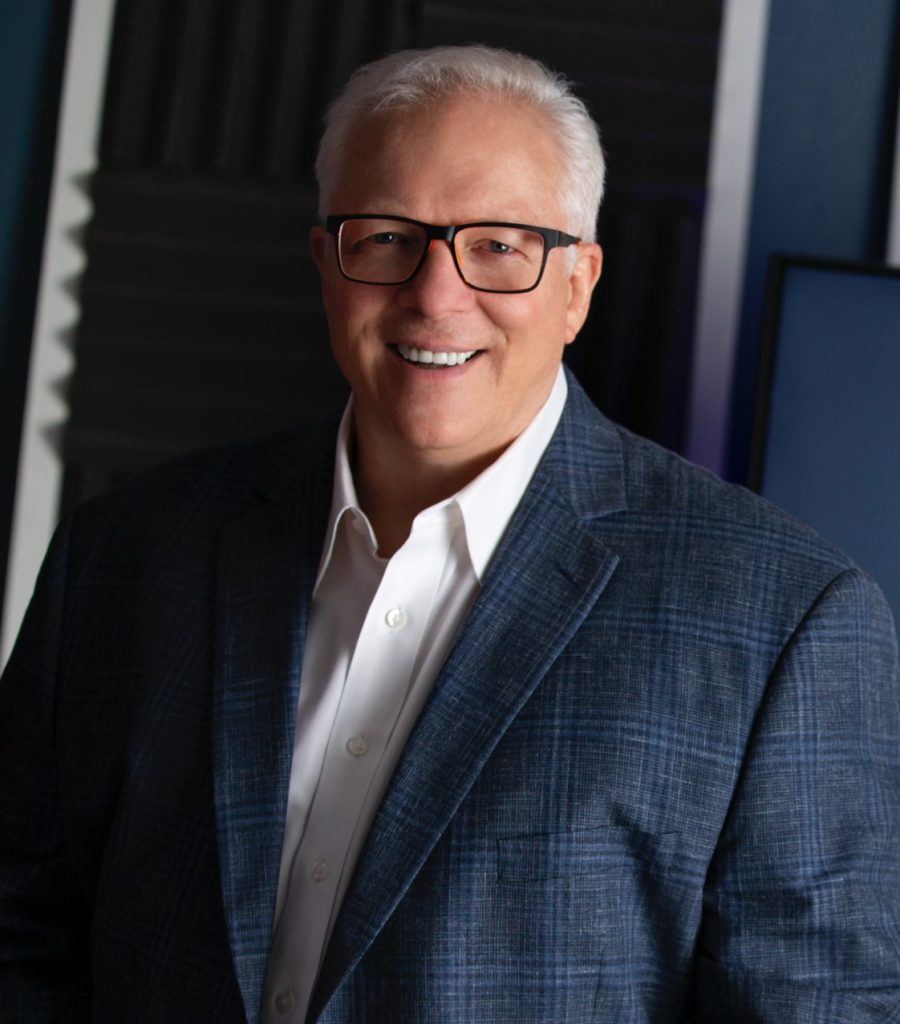
Secretary Pompeo joined NAW’s CEO Eric Hoplin for a fireside chat The National Association of Wholesaler-Distributors (NAW) today announced that Secretary Mike Pompeo and NAW CEO Eric Hoplin sat down for a fireside chat at Executive Summit 2023– the premiere event for the wholesale distribution industry. “It was an honor to host Secretary Pompeo for a fireside chat at Executive Summit 2023,” said NAW CEO Eric Hoplin. “We enjoyed hearing about his years spent as a public servant, but we also appreciate hearing about his time as a businessman and leading two manufacturing companies. We learned a great deal from Secretary Pompeo’s experience as we discussed the global and domestic challenges that are impacting the wholesale distribution industry,” concluded Hoplin. “Wholesaler-distributors are essential to the US economy and keep our supply chain safe and operational,” said Mike Pompeo. “It was great to sit down with Eric and other leaders from the industry to hear more about the issues they are facing and learn how we can best support this vital industry,” concluded Pompeo. Each year, the wholesale distribution industry gathers in Washington, DC for NAW’s Executive Summit to hear from top executives and thought leaders from across the industry on topics such as innovation, supply chain visibility, profitable growth strategies, regulation, the economy, branding, and the value in investing in a happy workforce. NAW is one of America’s leading trade associations, representing the $8.1 trillion wholesale distribution industry. Founded in 1946, NAW is comprised of national, regional, and state employers of all sizes, industry trade associations, partners, and stakeholders spanning all sectors of distribution. Our industry employs more than 6 million workers throughout the United States and accounts for 1/3 of the U.S. GDP. There are 35,000 wholesale distribution companies that operate in nearly 150,000 places of business across North America, including all 50 states. NAW’s mission is to deliver world-class programs and services, designed to help the most dynamic companies in wholesale distribution succeed. Our programming is tailored for the CEOs, senior executives, and rising leaders at our member companies and associations. Members engage with NAW through our offerings in: Thought Leadership, Networking, Executive Education, Benchmarking/Research, Shared Resourcing, Partnerships, Government Relations, and Public Affairs.
Seven myths and mistakes to avoid when accelerating your business growth
As a business owner, you understand the importance of growth. Without it, your business may struggle to survive in a competitive marketplace. But with so many different strategies and approaches, it can be difficult to know where to start. Unfortunately, there are also a number of myths and mistakes that can hold you back from achieving the growth you desire. In this article, we’ll discuss four myths and three mistakes of the most common myths and mistakes to avoid when working to accelerate your business growth. Breathe Life into Your Business First, let’s consider the metaphor of oxygen. Just as oxygen is essential for the survival of living organisms, growth is essential for the survival of your business. Without growth, your business will struggle to thrive. And just as oxygen can be difficult to come by in certain environments, growth can be difficult to achieve in certain markets. But just as oxygen can be found in abundance with the right tools and techniques, growth can be achieved with the right strategies and approaches. #1: More customers are always better. – Myth Many business owners believe that the more customers they have, the better their business will be. But this isn’t always the case. While it’s true that more customers can lead to more revenue, it’s important to remember that acquiring new customers can be expensive. Instead of focusing solely on acquiring new customers, it’s important to also focus on retaining and nurturing existing customers. This can lead to repeat business and positive word-of-mouth marketing. #2: Cutting costs is always the best way to improve profits. – Myth Cutting costs can indeed lead to increased profits, but it’s important to remember that cutting costs can also lead to decreased revenue. It’s essential to strike a balance between cutting costs and investing in the growth of your business. #3: You can’t do it alone. – Myth Many business owners believe they need to have a large team or a lot of resources to achieve growth. But this isn’t always the case. While it’s true that having a team and resources can be helpful, it’s important to remember that you can also achieve growth as a solo entrepreneur. You can achieve growth without a large team or resources by focusing on your strengths and outsourcing tasks that you’re not as skilled at. #4: The bigger the risk, the bigger the reward. – Myth Many business owners believe taking big risks is the only way to achieve big rewards. But this isn’t always the case. While it’s true that taking risks can lead to big rewards, it’s important to remember that taking big risks can also lead to big losses. Instead of focusing solely on taking big risks, it’s important to focus on taking calculated risks. This means carefully evaluating the potential rewards and risks before making a decision. #5: Not having a clear vision for your business. – Mistake Many business owners believe that they know what they want for their business, but don’t take the time to put it clearly and concisely. Without a clear vision, it’s difficult to set goals, measure success, and make decisions that align with the overall growth of your business. #6: Not measuring your progress. – Mistake Many business owners believe that they’re making progress, but don’t take the time to measure it. Without measuring your progress, it’s difficult to know if your strategies and tactics are working or if adjustments need to be made. #7: Not being adaptable. – Mistake Many business owners believe that once they’ve found a strategy that works, they should stick with it. But this is a mistake. The business environment is constantly changing, and what worked yesterday may not work today. It’s essential to be adaptable and constantly reassess your strategies and tactics to ensure they are still effective. This means being open to new ideas and trying new approaches, even if they may seem risky. In conclusion, achieving business growth can be challenging, but avoiding these common myths and mistakes can increase your chances of success. Remember to focus on retaining and nurturing existing customers, strike a balance between cutting costs and investing in growth, and take calculated risks. Have a clear vision, measure your progress, and be adaptable to the ever-changing business environment. Following these guidelines can ensure a steady flow of oxygen to your business, breathing new life into your growth. About the Author: Ford Saeks, the Business Growth Expert and Hall of Fame Keynote Speaker, is the go-to expert for organizations looking to take their growth to the next level. As host of The Business Growth Show Podcast, he shares a wealth of expertise on trends, innovation, and success. #Fordify #BusinessGrowth #Marketingtips and visit his website www.ProfitRichResults.com
AAR reports Rail Traffic for January and the week ending January 28, 2023

The Association of American Railroads (AAR) has reported U.S. rail traffic for the week ending January 28, 2023, as well as volumes for January 2023. U.S. railroads originated 923,696 carloads in January 2023, up 2.2 percent, or 19,827 carloads, from January 2022. U.S. railroads also originated 919,928 containers and trailers in January 2023, down 8.1 percent, or 81,443 units, from the same month last year. Combined U.S. carload and intermodal originations in January 2023 were 1,843,624, down 3.2 percent, or 61,616 carloads and intermodal units from January 2022. In January 2023, 12 of the 20 carload commodity categories tracked by the AAR each month saw carload gains compared with January 2022. These included: crushed stone, sand & gravel, up 14,694 carloads or 22.6 percent; coal, up 11,953 carloads or 4.6 percent; and motor vehicles & parts, up 6,293 carloads or 13.4 percent. Commodities that saw declines in January 2023 from January 2022 included: chemicals, down 15,641 carloads or 11.4 percent; all other carloads, down 2,273 carloads or 10.3 percent; and lumber & wood products, down 1,939 carloads or 14.5 percent. “Rail traffic began 2023 much the same way we ended 2022 -demonstrating reasons for both optimism and caution,” said AAR Senior Vice President John T. Gray. “For example, this was the best January for carloads of crushed stone and sand on record, largely due to the growth in domestic natural gas production and the need for frac sand. Automotive traffic, although not yet at pre-pandemic levels, had a healthy improvement over 2022. Negatively, it was the worst January for intermodal since 2013 with major retailers cutting back on inventories and consumer spending — especially on goods — having contracted.” Excluding coal, carloads were up 7,874 carloads, or 1.2 percent, in January 2023 from January 2022. Excluding coal and grain, carloads were up 5,518 carloads, or 1.0 percent. Total U.S. carload traffic for the first month of 2023 was 923,696 carloads, up 2.2 percent, or 19,827 carloads, from the same period last year; and 919,928 intermodal units, down 8.1 percent, or 81,443 containers and trailers, from last year. Total combined U.S. traffic for the first four weeks of 2023 was 1,843,624 carloads and intermodal units, a decrease of 3.2 percent compared to last year. Week ending January 28, 2023 Total U.S. weekly rail traffic was 473,650 carloads and intermodal units, down 3.9 percent compared with the same week last year. Total carloads for the week ending January 28 were 236,018 carloads, down 0.1 percent compared with the same week in 2022, while U.S. weekly intermodal volume was 237,632 containers and trailers, down 7.4 percent compared to 2022. Five of the 10 carload commodity groups posted an increase compared with the same week in 2022. They included nonmetallic minerals, up 2,068 carloads, to 29,774; petroleum and petroleum products, up 1,328 carloads, to 10,952; and motor vehicles and parts, up 836 carloads, to 13,742. Commodity groups that posted decreases compared with the same week in 2022 included chemicals, down 3,508 carloads, to 31,569; forest products, down 640 carloads, to 9,465; and coal, down 534 carloads, to 68,374. North American rail volume for the week ending January 28, 2023, on 12 reporting U.S., Canadian, and Mexican railroads totaled 340,616 carloads, up 2.3 percent compared with the same week last year, and 317,248 intermodal units, down 6.2 percent compared with last year. Total combined weekly rail traffic in North America was 657,864 carloads and intermodal units, down 2.0 percent. North American rail volume for the first four weeks of 2023 was 2,551,044 carloads and intermodal units, down 0.9 percent compared with 2022. Canadian railroads reported 81,541 carloads for the week, up 9.7 percent, and 63,013 intermodal units, down 3.5 percent compared with the same week in 2022. For the first four weeks of 2023, Canadian railroads reported a cumulative rail traffic volume of 557,879 carloads, containers, and trailers, up 7.3 percent. Mexican railroads reported 23,057 carloads for the week, up 2.7 percent compared with the same week last year, and 16,603 intermodal units, up 1.8 percent. Cumulative volume on Mexican railroads for the first four weeks of 2023 was 149,541 carloads and intermodal containers and trailers, up 0.8 percent from the same point last year. To view the weekly traffic charts, click here.
Episode 354: ICPMobile
Jeff Scott, CEO of ICPMobile, joins The New Warehouse Podcast this week to discuss wearable devices for warehousing and fulfillment. Infinite Peripherals provides hardware and software solutions for healthcare, retail, supply chain, logistics, and more. In this episode, Jeff gives a sneak peek of their new HaloRing Scanner that just recently released. Key Takeaways The NexusConnect device from ICPMobile uses the Otterbox uniVERSE rail system allowing it to work with Android and IOS devices. With the IP65 rating, long and short-range scanning, and wireless charging, NexusConnect transforms familiar mobile devices into powerful, ergonomically friendly warehouse scanning devices. The HaloRing Scanner is the first wearable device from ICPMobile and has recently just become available. The all-in-one Android device weighs only three ounces, has an OLED display, and allows the user to scan and take action instead of requiring an additional device. Jeff discusses how this scanner is a more natural motion ergonomically for users and frees up both hands to perform tasks. Jeff shares how ICPMobile began performing point-of-sale receipt printers nearly thirty years ago, which evolved into capturing signatures, collecting mobile payments, and eventually inventory management. In 2009, Infinite Peripherals developed a device for Apple that could scan barcodes, read card payments, and had a protective case and battery backup for extended use. Interestingly, Apple found that stores using the easy devices from Infinite sold more accessories and Apple Care through the easy payment solution. Jeff and Kevin discuss the benefits of leveraging existing technology, such as smartphones, to reduce training and simplify everyday tasks. Jeff shares a story of replacing an antiquated hole punch system with staff having an average tenure of thirty-five years. Replacing a one-hundred-year-old process came with resistance, but at the end of the pilot, none of the participants wanted to return the devices that made their jobs easier. Jeff explains how the relationships with ICPMobile and its customers provide valuable insights regarding what the customer wants. These insights lead Infinite to take on creating software in addition to hardware devices. He adds that customers want one device for multiple capabilities, such as collecting payments, performing cycle counts, or inventory management. The New Warehouse Podcast EP 354: ICPMobile
Women In Trucking Association announces its February 2023 Member of the Month
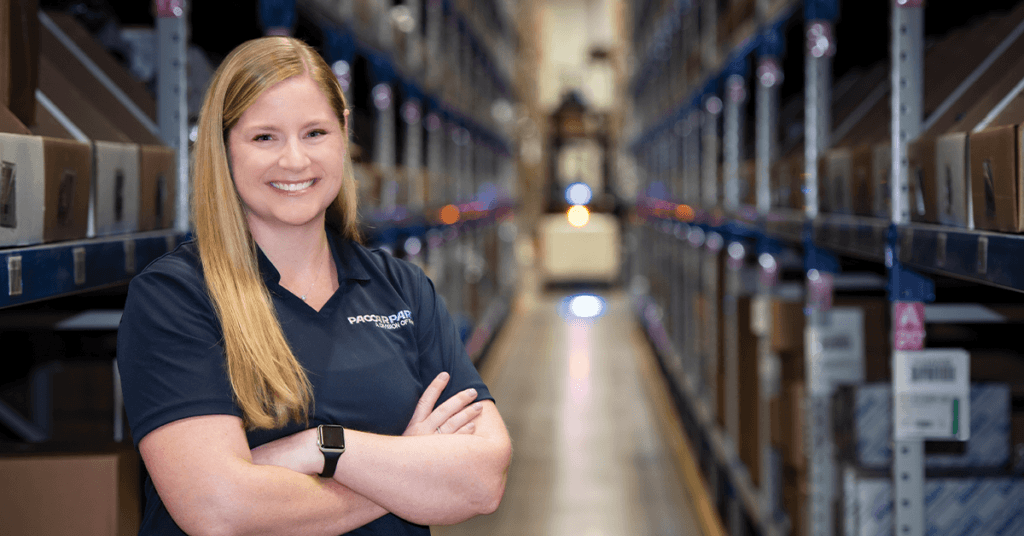
The Women In Trucking Association (WIT) has announced Cara Howes as its February 2023 Member of the Month. Cara is a parts distribution center manager at PACCAR Parts, a division of PACCAR Inc. Cara has been interested in the trucking industry for as long as she can remember. Her mother was a PACCAR employee, and Cara has fond memories of “bring your daughter to work day” as a child. Her grandfather owned a tanker business in Oregon and was a longtime Kenworth customer. Cara loved spending summers with her father, befriending Kenworth truck drivers, and making trucks her playground. One of her favorite games growing up was playing “name that truck” on family road trips. For Cara, joining PACCAR was an easy decision. Cara has worked at PACCAR for almost 15 years and has held key positions, including assistant director of customer service and assistant director of materials before switching to the operations side of the business. The way stuff moves have always fascinated Cara. She loves coordinating the movement of truck parts from point A to point B and takes pride in getting things where they need to be when they need to be there. Cara believes working in operations and logistics requires creative thinking and problem-solving as no two issues are the same. While there are guidelines, every situation is unique and requires perseverance regardless of obstacles. She motivates herself and her team with the mantra that a truck is a driver’s home, and it’s critical they have access to the parts they need to stay on the road. She understands the direct impact PACCAR employees have on a driver’s life. In addition to Cara’s impressive professional career, she also serves in the United States Navy Reserve as a supply corps officer and was recently selected for the rank of commander. She serves as officer-in-charge for the Fuels Detachment supporting Fleet Logistics Center San Diego. Cara deployed to Afghanistan from 2011 to 2012 as part of a Logistics Mobile Training Team focused on training the Afghan National Army and Afghan National Police on logistics best practices across the country. Her personal awards include two Navy Commendation Medals, an Army Commendation Medal, and five Navy Achievement Medals. Cara’s husband also works at PACCAR Parts as a supplier quality manager. They met while playing on the corporate softball team in 2007. Now, they stay busy raising their seven-year-old twin daughters. The girls know that mom and dad work for PACCAR, the company that owns Kenworth and Peterbilt. Cara has passed down “name that truck” to her daughters with an “is it a Kenworth or a Peterbilt” twist. They cannot wait to work at PACCAR when they are older. Cara’s advice to women wanting to break into the trucking industry is, “just do it. Take your comfort zone and smash it because growth comes from new challenges!”
Combat rising IT security costs with IT Asset Management

Pity the poor Chief Information Security Officer (CISO). On one hand, their needs are real: emergent cybersecurity threats are increasingly sophisticated and numerous. On the other hand, the cost of defending against these threats follows the same trajectory. Every organization’s resources are finite, but not investing in the right technology or tactics could place the organization in the same inauspicious gallery as Hollywood Presbyterian[1], Riviera Beach[2], or Colonial Pipeline[3]. Then again, what other value-add IT services should be cut? There is one group inside the department that is in a position to help: IT Asset Management (ITAM). Few CISO and cybersecurity professionals realize the “hand in glove” relationship ITSec and ITAM should have. In 2016, an article published in a technology research magazine insisted up to thirty percent (30%) of a corporation’s software budget could be cut by implementing a software asset management (SAM) program[4]. The article identifies three best practice activities that must be performed to achieve this remarkable return: Optimize Software Configurations — make sure to use the features and tools you pay for, and avoid paying for features and tools you do not use Recycle Software Licenses — remove unneeded software installations so the corresponding software license can be applied somewhere else Use SAM tools — invest in specialty license management systems that can accurately calculate complex software license rules and point out cost-saving opportunities In many organizations, software-related expenditures make up a significant portion of the overall IT budget. Any reduction in that line item would fund a number of other projects, so IT Security needs to present a good case to justify redirecting some of those funds to them. Interdepartmental budget strategy sessions can be cutthroat, but most will respect the “Little Red Hen” rule: you only get the bread if you help with the baking. If our intrepid CISO is going to ask for a part of the savings ITAM can deliver, they need to demonstrate how their team, tools, or data are actively helping in those three SAM practices. Most ITSec professionals are familiar with the ISO/IEC 27000 standards, which require an “asset inventory” to be made of the corporate computing environment. The trouble is, the methodology of ISO 27000 focuses on information security management and does not provide the necessary details and data attributes for effective SAM. But, dig deeper into the supporting standards and you will find ISO/IEC 19770[5], which specifically addresses ITAM and SAM process requirements. Last updated in 2017, it contains a maturity model constructed of three tiers: Tier 1: Trustworthy Data — knowing what you have so that you can manage it Tier 2: Life Cycle Integration — achieving greater efficiency and cost-effectiveness throughout the asset life cycle (i.e., purchasing, inventorying, using, recovering, and disposing of) Tier 3: Optimization — achieving greater efficiency and cost-effectiveness across functional management areas Fig.1 — ITAM Tiers In typical fashion, the ISO/IEC standards do not describe how “trustworthy data” is obtained or derived, but do describe four processes where ITAM will find “trustworthy data”: Change Management Data Management License Management, and Security Management This makes sense; if IT Security is maintaining an asset inventory (as mandated by ISO 27000), why not harvest reliant parts of their data to build out an asset inventory for a SAM tool just like the one prescribed in the aforementioned Gartner article? Is that enough, though, for a typical CISO to claim a portion of the ITAM savings for their own expenditures? Maybe not, but let’s consider the second cost-saving source from the Gartner article: recycling software licenses. Typical security vulnerability tools are licensed by either the software agents deployed and installed on objects discovered within the computing environment or by total found objects discovered in a passive sweep of IP address ranges. Unfortunately, IT Security might not catch and remove retired, duplicated, or incorrect records from its own asset inventory lists. That, in turn, risks an over-count of needed licenses and an over-charge to IT Security’s budget. However, if IT Security partners with ITAM and purges recovered and disposed asset inventory records from its vulnerability tools, the overall total cost of ownership for IT Security’s tooling can be significantly reduced. And those savings will unarguably return to IT Security. The final factor — optimizing software configurations — might seem like a stretch, but IT Security does have a say in the matter. Consider this example: while advising a client a few years ago, the IT Security department identified a number of high-risk security vulnerabilities in the corporate-standard PDF viewer. The CISO recommended removing the standard-issued software outright before the next phishing attack successfully exploited the known bugs within the tool. The IT Service Support team resisted, arguing re-platforming to the IT Security recommendation would be too costly and could be rejected by the end-user community. The ITAM team stepped in, and identified a comparable tool with more features than currently offered (satisfying the end-users), with a better vulnerability score (satisfying IT Security’s concerns), and at a total-cost-of-ownership of 60% less than the current PDF standard (more than covering the cost of deploying the new tool). The moral of the story: simply by engaging ITAM, the CISO was able to improve the security position of his organization without incurring any extra cost to his department or the rest of the organization. Modern IT Security initiatives are necessary and expensive. Smart CISOs should always be on the lookout for cost-reduction and spend-justification opportunities. Both best business practice proponents and independent researchers identify the IT Asset Management team as a willing partner. By working together, ITAM and ITSec can improve the overall organization’s security position and simultaneously reduce the overall cost of ownership for IT. About the Author: Jeremy L. Boerger, the ITAM Coach, founded BOERGER CONSULTING with the idea of helping organizations “cut their software budget without buying less software”. He also speaks professionally to pass along his 20+ years of experience to the next generation of ITAM and SAM professionals. His book, “Rethinking Information Technology Asset
OZ Lifting launches Aluma-Lite Davit Crane
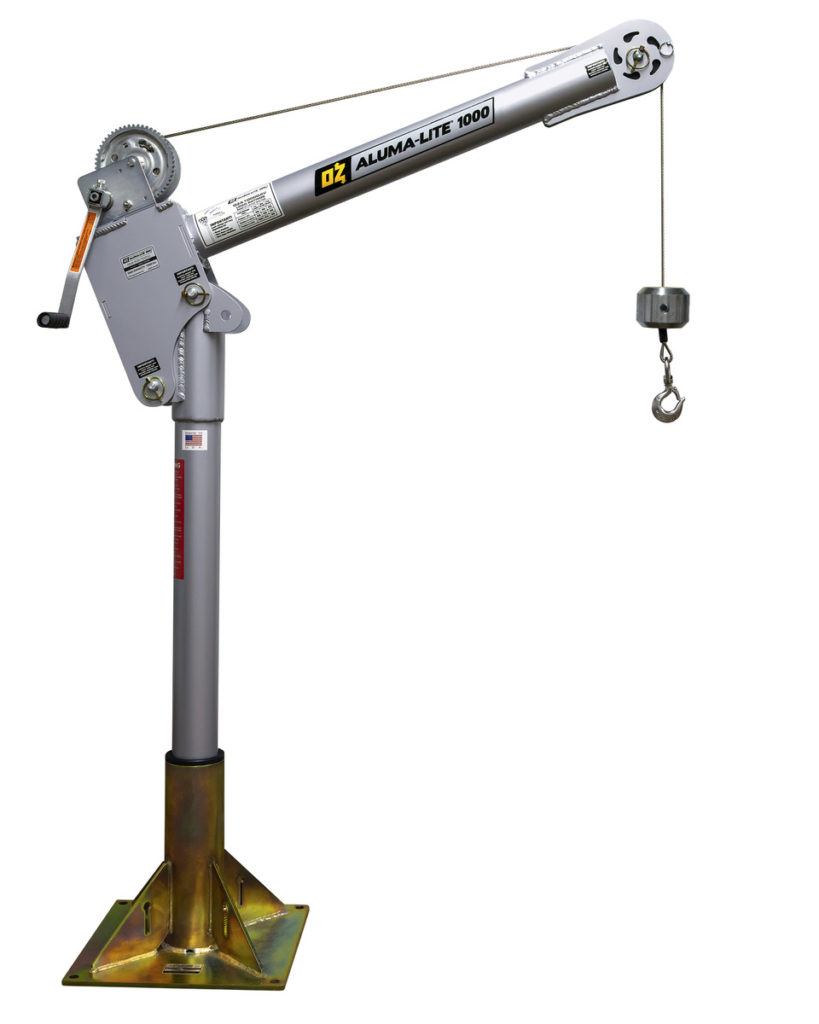
Winona, Minnesota-based OZ Lifting Products LLC has launched the Aluma-Lite series of ultra-portable davit cranes, available in 500 lbs. and 1,000 lbs. capacities. The new aluminum series is targeted at applications where portability is beneficial, including those in wastewater and water; boats; utility terrain vehicles (UTVs), and other trucks, etc, where anti-corrosion materials are also desirable. Each model is available with three bases: a pedestal, socket (flush-mount), or wall mount. The Aluma-Lite 500 weighs in at 24 lbs. It offers a capacity of 275 lbs. at horizontal; 330 lbs. at 22.5 degrees; and its full capacity at 45 degrees. Aluma-Lite 1,000, meanwhile, weighs in at 47 lbs. It offers a capacity of 550 lbs. at horizontal; 650 lbs. at 22.5 degrees; and its full capacity at 45 degrees. The units’ light weight means that they will commonly be moved from one base to another. Both fold flat for easy storage or transportation; are made of aerospace / military grade aluminum; and are available with manual winch (including drill drive adapter), AC or DC electric winches. Further, they have a durable, powder-coated finish; no tools are needed for assembly/disassembly; and they are made in the USA. Steve Napieralski, president at OZ Lifting, said: “The Aluma-Lite can be used any place where carrying the crane could be an issue and the properties of aluminum happen to suit the product to many applications where it might be moved around, perhaps most notably in the water sectors. Our 500-lbs. capacity steel davit weighs 50 lbs., so the aluminum version is basically half the weight.” As Napieralski mentioned, the Aluma-Lite expands OZ Lifting’s davit crane family, which includes the Tele-Pro, that allows users to leverage the benefits of other lifting technologies in its range, while telescoping the boom in and out under load; various composite models, made from carbon fiber and pultruded fiberglass; and steel davits. The Aluma-Lite capacity range may be widened in time but there are no immediate plans to do so. However, Napieralski admitted that it will continue to add to the davit crane family more broadly. “We have another [crane] on the horizon that will add some additional features not found in our current range,” he said. He also reiterated that, regardless of the type of crane or application, without a base, a davit crane is not usable. The pedestal base is bolted to the floor where users need to make a lift and move the crane from base to base. Socket bases are used mainly in the back of trucks or in an area where the installer will pour cement around the base to keep the surface area flat and offer high mounting strength. The wall-mount base allows a davit crane to be attached to the wall of a facility to save floor space. In all cases, it is important to check the capacity of the mount and its compatibility with the crane/s selected. Aluma-Lite will make its trade show debut at AHR Expo (Booth B128), which attracts heating, ventilation, air-conditioning, and refrigeration (HVACR) professionals to the Georgia World Congress Center, Atlanta, February 6-8, 2023. A month or so later (March 20-23), ProMat (Booth S122) engages all segments of the material handling, logistics, and transportation industry, from traditional, manual equipment to computerized, automated systems and smart, connected supply chain technologies. Napieralski added: “Business continues to be strong; we are optimistic for 2023.”
Hinowa acquisition complete and now part of JLG

Two market leaders have joined forces to broaden JLG’s product portfolio JLG Industries, Inc., an Oshkosh Corporation company and a global manufacturer of mobile elevating work platforms (MEWPs) and telehandlers, has completed its acquisition of Hinowa® S.p.A., adding the market-leading brand to the company’s Access segment. This expansion of the JLG® product portfolio enables the company to strengthen its specialty applications offerings and increase its presence in niche industries, including agricultural, landscape, and vegetation management. Founded in 1987 in Nogara, Italy, Hinowa became well-known in the industry for its innovative track designs and as an early adopter and leader in the advancement of lithium-ion battery technology in mobile elevating work platforms (MEWPs). Hinowa’s 200+ team members and two facilities, a 250,000 sq. ft. manufacturing facility and a 50,000 sq. ft. parts facility, are now part of the Oshkosh Corporation Access segment, and the Hinowa brand will be retained on its well-respected line of track-based aerial work platforms, mini dumpers, lift trucks and undercarriages products. JLG-branded compact crawler booms, which Hinowa has produced since 2010 and includes electric-, hybrid- and diesel-powered models, will continue to be offered. “The acquisition was about growing the company and growing our capabilities,” says Frank Nerenhausen, Oshkosh executive vice president and JLG president. “JLG and Hinowa are both strong brands. Joining forces allows us to unlock more potential globally. This is a very positive time for the business, and we are excited to welcome the Hinowa team to the JLG family.” Hinowa’s products, including a JLG-branded compact crawler boom lift, will be on display in booth #W44066 at CONEXPO-CON/AGG 2023 in Las Vegas, NV, March 14-18.
Keep forklift safety simple; no need for a 360° view

Forklifts are an essential tool for countless industries around the globe; however, they also present a significant risk to workplace safety. 78 people lost their lives to forklift accidents in the United States in 2020, and 36% of those were pedestrians. Thankfully, pedestrian detection sensors for forklifts effectively address the potential fatal interactions between equipment and people by alerting operators when a person has entered a hazardous zone around equipment. Unfortunately, while many available options can help reduce the potential for serious incidents, some overcomplicate what should be a relatively simple task. Some sensors offer technology and features that sound good on paper but ultimately make them harder to use and increase the time and cost of purchase, implementation, and maintenance. As a result, instead of sensors making life easier for companies by solving a significant issue, they create new problems. Some pedestrian detection sensors offer a 360-degree view around equipment paired with Artificial Intelligence to detect people. The downside is that these systems also require expensive hardware, multiple cameras, and complicated software. Also, while a 360-degree view of equipment sounds great, most forklift accidents happen behind the forklift while reversing. This fact means companies that implement this type of sensor rarely receive the return on investment that they intend. Unfortunately, these systems have questionable reliability. They are very sensitive and often alert even when there isn’t a threat. The negative repercussions of these constant nuisance alarms are that operators and pedestrians quickly lose faith in the product and its ability to detect real threats. As a result, operators and pedestrians no longer respect the alerts and don’t take evasive action when there is a genuine threat to safety. In addition, these high-tech systems are often delicate and extremely sensitive and struggle to operate in harsh environments. Considering that many industries operate in extreme conditions, this fragility and sensitivity make these pedestrian sensors a less-than-ideal option for many. Finally, a persistent issue with many pedestrian detection sensors is that they detect obstacles and pedestrians but offer no additional insight into accidents and near misses. This lack of data makes it harder for management to demonstrate the return on investment of sensors and prevents them from learning from incidents that could improve overall workplace safety. SEEN Safety can help SEEN’s safety sensors focus on the critical risk zone behind a reversing machine. By focusing on the area with the most risk, detections only occur when there is a real risk of accident and injury to pedestrians and the machine. But preventing accidents is only half the battle to create a safer workplace; companies also need to know where to focus their attention to prevent reoccurrence. Increased visibility and data into incidents and near misses help reduce complacency and guide leaders toward where to invest additional resources, training, and safety measures. Visual proof is the most powerful tool to achieve this goal. Every time a pedestrian detection sensor goes off; there is the potential for a severe or fatal accident. Seeing the exact circumstances surrounding an event can help prevent that risky situation from happening again. SEEN Insight which includes an IoT camera and app provides visibility and evidence of detection events. The camera snaps a picture and films a short video every time SEEN’s sensor detects a potentially harmful interaction and sends that critical information to the SEEN Insight app. Within the app, key stakeholders can dig deeper into detection incidents and gain greater insight into why they occurred while identifying areas of concern and where to focus their attention for improvement. SEEN insight provides leaders with strong visual evidence and robust analytics that give them the information and the proof they need to begin implementing real, effective change that improves safety. Schedule a demo today and see whether Seen’s pedestrian detection sensors and the new accessory, SEEN Insight are the right fit for your workplace. Get Started with SEEN.
Bluewater Battery Logistics and OneCharge announce a strategic partnership

OneCharge Inc., Garden Grove, CA, and Bluewater Battery Logistics, Santa Barbara, CA, has entered into a strategic partnership to recycle and repurpose advanced lithium-ion (Li-ion) batteries at the end of useful life. Lithium forklift batteries provide an efficient and economically viable alternative to older lead-acid batteries. Lithium technology also enables the switch to electric power from propane and diesel engines in power-hungry applications where companies could not electrify their fleets with lead-acid batteries being limited by capacity and indoor-only requirements. The proliferation of lithium batteries requires safe and environmentally friendly recycling and re-purposing, especially as we expect the influx of end-of-life used lithium batteries. Forklift lithium batteries can be repurposed for less demanding applications, such as energy storage in solar power generation systems. With this new partnership, OneCharge offers its customers the most sustainable and responsible way to utilize their end-of-life batteries and capitalize on the advanced lithium technology to reduce waste and improve the sustainability of their operations. “Bluewater Batteries Logistics is proud to partner with OneCharge, Inc.,” said Ben Firestone, CEO of Bluewater Batteries Logistics. “The share of Li-ion power supply in the forklift industry is growing at a rapid rate and even though Li-ion battery packs last times longer than lead-acid, we anticipate large numbers of end-of-life batteries accumulate in the coming years. With lithium technology, it is possible not only to recycle but in many cases to repurpose these batteries and dramatically reduce waste.” “We’re happy to partner with Bluewater Battery Logistics, an innovative and dynamic company that shares our drive for cleaner and more sustainable materials handling operations. Repurposing lithium batteries before recycling allows us to extract more value from every battery cell, and reduce waste. OneCharge customers can rely on us for the most sustainable and innovative disposal process,” said Tim Karimov, President of OneCharge. ESG requirements for materials handling operations are becoming more important for all companies as the world faces climate change and the issues of the ongoing energy transition. Lithium battery technology allows OneCharge customers to reduce energy use and carbon footprint, as well as reduce waste through prolonged battery life and repurposing of cells before recycling. Renewable energy generation facilities can grow faster with a decreased cost of energy storage units built with repurposed lithium battery packs.
After 100 years of innovation Raymond continues to lead
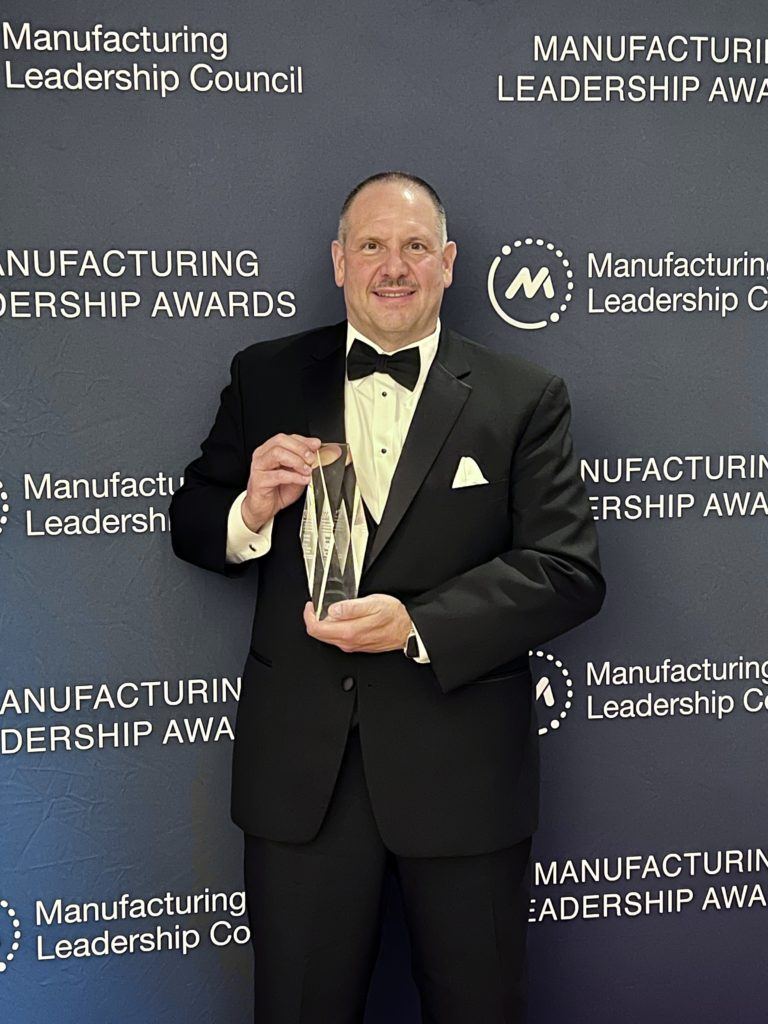
One hundred years after its founding, and with the same customer-first approach that led to the introduction of the double-faced wooden-sided pallet and the hydraulic hand pallet jack, The Raymond Corporation continues its unquestioned industry leadership with a host of awards and recognitions from the Logistics Hall of Fame, IndustryWeek, the National Association of Manufacturers, and other organizations. “For 100 years, the customer has been at the heart of our business,” said Michael Field, president and CEO of The Raymond Corporation. “Recognition by these leading organizations affirms our dedication to building a business that starts and ends with helping customers optimize, connect and automate.” Among the honors Raymond has recently received are: Logistics Hall of Fame — George Raymond Sr. Developed in the 1930s by founder George Raymond Sr. and colleague William House, the double-sided wood pallet fundamentally changed the way products are stored and moved, offering operations new levels of performance and efficiency. “It’s incredible to see the lasting impact my grandfather had and how his spirit of innovation lives on today at The Raymond Corporation,” said Steve Raymond, retired president of Raymond Handling Concepts Corporation and grandson of Raymond’s founder. “One hundred years later, the double-faced wooden pallet remains an industry standard.” IndustryWeek Best Plants — Greene, New York. Lean management techniques, as well as defect reduction initiatives, visual management, and 44 active quality control circle activities, have helped double production volume at Raymond’s Greene, New York, plant while providing for a 35% increase in overall quality over the past three years. The Best Plant Awards program recognizes excellence in manufacturing facilities and aims to encourage other manufacturers to adopt world-class practices, technologies, and improvement strategies, increase customer satisfaction and offer rewarding work environments for employees. R&D 100 Award Winner — iW.RTLS. Long considered a benchmark of excellence, the R&D 100 Awards program recognizes new commercial products for their technological significance. Raymond is honored to have its iWAREHOUSE® Real-Time Location System (iW.RTLS) chosen as a winner in the Process/Prototyping category for its ability to control personnel, equipment, and asset movement through its geofencing, zoning, and tracking capabilities. SDCE Women in Supply Chain — Jennifer de Souza. This Supply & Demand Chain Executive award recognizes female supply chain leaders who are setting a foundation for women at all levels of a company’s supply chain network. With management responsibility for energy storage solutions as well as Raymond’s alternative energy initiatives, Jennifer de Souza, vice president of energy solutions, procurement, and leasing, is a passionate advocate for the productivity, profitability, and sustainability benefits offered by alternative energy solutions. “Continuing to mentor and educate individuals and companies about the benefits of alternative energy solutions,” she said, “will lead to a more efficient workforce and sustainable future.” Manufacturing Leadership Award — Greene, New York. The National Association of Manufacturers Manufacturing Leadership Council recognized Raymond’s Greene, New York, facility for its ongoing culture of continuous improvement. “The plant’s commitment to innovation and optimization continues to allow us to serve our customers better and provide them with innovative end-to-end intralogistics solutions,” said Tony Topencik, vice president of operations, quality, environmental health, and safety. Other awards and recognitions received by Raymond® products, initiatives, and personnel include: Food Logistics Rock Stars of the Supply Chain — Derrick Miller, regional sales manager SDCE Top Supply Chain Projects — Crossroads Community Services Inbound Logistics 75 Green Supply Chain Partners (list inclusion, G75) Plant Engineering Product of the Year, Bronze Award — iW.RTLS FSA Top Food Chain Technology (list inclusion) — The Raymond Corporation FSA Top Food Chain Provider (list inclusion) — The Raymond Corporation Food Logistics Top Software & Technology Providers — The Raymond Corporation International Forklift of the Year (finalist) — Raymond 8910 end rider pallet jack 2022 Central New York Business Journal Legends – The Raymond Corporation “Listening to our customers and helping them optimize their storage and distribution operations with innovative products and services is a core component of our company’s success,” Field said. “So while the most meaningful award we receive is the continued trust of our customers around the world, we’re immensely proud to have our products, our facilities, our people, and our commitment to innovation, quality, and service held up as examples for the industry.”
Episode 354: ICPMobile
Jeff Scott, CEO of ICPMobile, joins The New Warehouse Podcast this week to discuss wearable devices for warehousing and fulfillment. Infinite Peripherals provides hardware and software solutions for healthcare, retail, supply chain, logistics, and more. In this episode, Jeff gives a sneak peek of their new HaloRing Scanner that just recently released. Key Takeaways The NexusConnect device from ICPMobile uses the Otterbox uniVERSE rail system allowing it to work with Android and IOS devices. With the IP65 rating, long and short-range scanning, and wireless charging, NexusConnect transforms familiar mobile devices into powerful, ergonomically friendly warehouse scanning devices. The HaloRing Scanner is the first wearable device from ICPMobile and has recently just become available. The all-in-one Android device weighs only three ounces, has an OLED display, and allows the user to scan and take action instead of requiring an additional device. Jeff discusses how this scanner is a more natural motion ergonomically for users and frees up both hands to perform tasks. Jeff shares how ICPMobile began performing point-of-sale receipt printers nearly thirty years ago, which evolved into capturing signatures, collecting mobile payments, and eventually inventory management. In 2009, Infinite Peripherals developed a device for Apple that could scan barcodes, read card payments, had a protective case and battery backup for extended use. Interestingly, Apple found that stores using the easy devices from Infinite sold more accessories and Apple Care through the easy payment solution. Jeff and Kevin discuss the benefits of leveraging existing technology, such as smartphones, to reduce training and simplify everyday tasks. Jeff shares a story of replacing an antiquated hole punch system with staff having an average tenure of thirty-five years. Replacing a one-hundred-year-old process came with resistance, but at the end of the pilot, none of the participants wanted to return the devices that made their jobs easier. Jeff explains how the relationships with ICPMobile and its customers provide valuable insights regarding what the customer wants. These insights lead Infinite to take on creating software in addition to hardware devices. He adds that customers want one device for multiple capabilities, such as collecting payments, performing cycle counts, or inventory management. The New Warehouse Podcast EP 354: ICPMobile
Toyota Material Handling sweeps TMHG Global Skills Competition
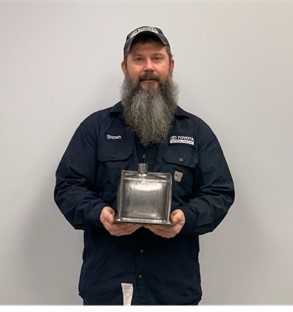
Shawn Dickmeyer earns Gold in the welding category and joins Kim Douglass (gold, Assembly) as the first two TMH gold medalists in international competition Shawn Dickmeyer, a Toyota Material Handling (TMH) associate, is being celebrated by his colleagues for a historic win at the 2022 Global Skills Competition hosted by the Toyota Material Handling Group (TMHG) in Takahama, Japan, last month, earning a gold medal in the Welding category. Dickmeyer beat competitors from other Toyota group companies based in China, France, Italy, and Sweden, as well as additional U.S. participants during the annual international competition. Dickmeyer earned the distinct honor of becoming the first TMH representative to ever win gold in the Welding category. Fellow TMH associate Kim Douglass took home the gold for Assembly, meaning TMH swept the highly competitive event for the first time in company history. “Shawn came out on top against some of the most skilled competitors in the world, showcasing on a global stage the character, skill, and talent our associates possess at Toyota Material Handling,” said Tony Miller, TMH Senior Vice President of Operations, Engineering & Strategic Planning. “We are all very proud of the hard work Shawn invested in preparation for this competition and the manner in which he represented our organization. Shawn and Kim have set a new standard for excellence that will be hard to match, but one we hope will motivate others for years to come.” Dickmeyer credits veteran TMH competitors, Phil Roberts and Leon Moore, as the inspiration behind his victory. Of his nearly 13 years at TMH, Dickmeyer spent the last three in the training department working alongside Roberts and Moore, helping them prepare for their competitions, conducting welding tests for new hires, and processing materials for the welding dojo. Roberts and Moore eventually convinced Dickmeyer to compete, supporting and coaching him for hours each day for an entire year prior to the competition. Before advancing to the global competition and a nine-day trip to Japan, Dickmeyer first proved his superior skills against other hopeful competitors from other Toyota group companies in North America during a regional competition. Despite the confidence he gained from his initial win, Dickmeyer saw himself as more of an underdog than the favorite in a “stacked” competition. “Competing next to the other contestants in Japan created a lot more pressure than I had anticipated,” Dickmeyer recalls. “I tried to use music and chewing gum to help calm my nerves.” Rather than get sidetracked by anxiety, Dickmeyer threw himself into the familiar routine he had practiced over the previous 12 months, determined to block out distractions and stay focused on the end goal: welding a vessel and a complicated joint in less than 40 minutes. Competitors are judged on criteria such as weld size, position, appearance, and testing the vessel up to a certain level of PSI pressure. While the time Dickmeyer spent behind the torch remains somewhat of a blur, the experience that followed will likely never fade. “When they announced I had won gold, the feeling was indescribable. The flood of different emotions was pretty intense,” Dickmeyer said. “Winning gold was pretty special, but for both Kim and I to win gold in the same year was incredible. That was the goal going in, but we knew it would be tough to achieve. I’m so thankful we were able to do it together.” In honor of their historic achievement, TMH dedicated a special day to celebrate each of their returning champions, complete with congratulatory signs and banners, a cafeteria offering based on their favorite meals, and gold cookies with red, white, and blue ribbons attached to them. Dickmeyer said he was overwhelmed by the countless congratulatory messages he received from his colleagues. “It was humbling to have TMH take the time to put together a day in my honor. Toyota is and always has been a special place to work because they truly care for the people that work here,” Dickmeyer said. “It also brought awareness to the TMHG Global Skills Competition, which I think is important because it truly is a life-changing opportunity. It was a unique privilege to experience the Japanese culture. It is such a beautiful place, and I would tell anyone thinking of competing in the future to just go for it. It is the trip of a lifetime, and this process will definitely help you grow in more ways than you could ever imagine.” Dickmeyer and Douglass’ wins are a testament to TMH’s industry-leading reputation of dedication to innovation, quality, and service. The full-line material handling solutions provider and North America’s leading manufacturer of forklifts maintains a constant focus on delivering the highest quality and believes in the concept of ‘Kaizen’, or continuous improvement, in every aspect of its business. “I am so thankful to everyone who helped me throughout this process, especially Brad Cater, who consistently critiqued my practice sessions and pushed me to be the best I could be,” Dickmeyer said.