
NAW vehemently opposes Acting Secretary Su’s renomination for Secretary of Labor
The National Association of Wholesaler-Distributors (NAW), representing the 8.2 trillion-dollar wholesale distribution industry and 6 million American workers, strongly opposes President Biden’s renomination of Julie Su for Secretary of Labor. Brian Wild, Chief Government Affairs Officer at NAW, issued the following statement: “Ms. Su’s time as Acting Secretary has been marked by a disregard for the diverse needs of both businesses and workers, evidenced in her flawed and harmful policies that threaten jobs, stifle growth, and undermine essential freedoms. The proposed overtime pay rule, with its unprecedented hike in the salary threshold, stands as a prime example. This rule, demonstrably harmful to the wholesale distribution industry – the very backbone of our nation’s supply chain – would limit employee development opportunities, diminish workplace autonomy, and restrict flexibility for millions of employees. This is not an isolated misstep. We see Acting Secretary Su’s influence on other alarming policies, like today’s new Labor Department rule redefining independent contractors, a biased regulation that threatens the flexibility and earning potential of millions of Americans. Furthermore, Ms. Su’s oversight of the Department of Labor has yielded flawed proposals like OSHA‘s proposed walkaround rule, a rule that not only fails to advance workplace safety but also violates property rights, imperils trade secrets, and endangers businesses to increased liability risks. This pattern of harmful decisions is simply unacceptable for a leader entrusted with managing an agency that has such a profound impact on our economy. NAW unequivocally calls upon President Biden to withdraw his renomination of Julie Su. We urge the President to appoint a leader who will work tirelessly to build a future where both businesses and workers can thrive.”
ELOKON promotes Mark Stanton to president & General Manager for North America

Material handling specialist to lead overall operations throughout the U.S., Canada, and Mexico for the automated forklift safety and fleet management system company, with Alex Johns taking over as vice president of sales ELOKON, Inc., an innovator in automated forklift safety and fleet management systems, has promoted senior vice president of sales Mark Stanton to the new position of president and general manager for the North American region, effective immediately. Alex B. Johns, ELOKON’s national sales director since 2021, will become the new vice president of sales for the region. Stanton joined ELOKON in May 2023, bringing more than 25 years of experience in the materials handling industry, a deep knowledge of forklift fleet management and forklift safety systems, and an impressive track record of driving growth and innovation. During the 8 months Stanton has been with the company, ELOKON has increased sales by approximately 30 percent and doubled the size of the ELOKON Inc. team. “We expected big things from Mark when we brought him on to lead our sales team in North America last May, and he most definitely delivered,” said Alexander Glasmacher, CEO, ELOKON. “His extensive knowledge of forklift fleet management and safety systems, combined with strong leadership skills and an unparalleled strategic vision, has already resulted in higher sales and stronger employee morale. Mark is the best person to run our growing business in the U.S., Canada, and Mexico.” Johns poised to grow sales, increase workplace safety and productivity in expanded sales role ELOKON’s cloud-based forklift fleet management solutions and forklift safety systems are used by some of the world’s largest companies to make their warehouses, distribution centers, and manufacturing plants safer and more efficient. North America is the largest addressable market for ELOKON’s solutions, growing steadily over the last three years with Johns playing a pivotal role in the positive growth trajectory. “Alex’s performance as our sales director in the U.S. has been simply stellar, with exceptional engagement with customers large and small,” said Stanton, who works from the company’s U.S. headquarters in Atlanta. “He’s a truly supportive team leader who inspires new sales members as well as current and new customers as we help them to become safer and more productive throughout their warehouses, distribution centers, and manufacturing plants.” Prior to joining ELOKON in May 2021, Johns served as the director of sales for Advanced Mechatronics Solutions in Atlanta, following sales leadership and marketing roles at companies such as Acuity Brands, RAIT88, and Adams Beverages of NC, LLC. He holds a bachelor’s degree from Auburn University’s Harbert College of Business.
Machinery Manufacturer Norwalt continues to invest for career path program for aspiring college students
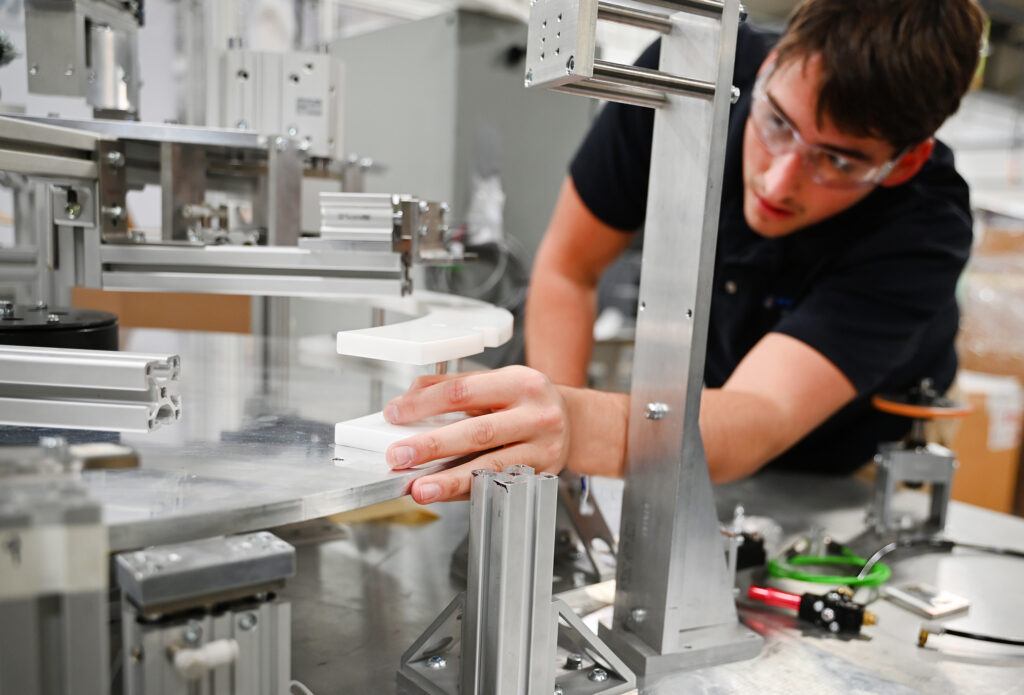
‘The Collegiate Automation Program’ helps prepare students for careers in machine design and manufacturing. Norwalt, a specialist in custom-built automation and line integration machinery for complex manufacturing applications, continues to expand on its immersive education program for college students interested in careers in machine design, manufacturing, and other automation-adjacent niches. The company’s Collegiate Automation Program (CAP) forges partnerships with the University of Delaware and other colleges to give aspiring students real-life experiences that bolster their learning in the classroom. For example, at the University of Delaware, Norwalt is assisting with facets of the school’s engineering curriculum, and providing funding for hands-on junior- and senior-level projects that complement classroom instruction. Norwalt also offers internship programs and conducts recruitment seminars offering opportunities to join its machine design team. Financial donations and close collaboration with the school’s education administrators round out Norwalt’s CAP program. In recent years, Norwalt has also reached out to the County College of Morris, and several other community colleges with machinery component donations, helping these educational facilities maintain equipment vital for comprehensive student instruction. With facilities in Randolph, New Jersey, and Tampa, Florida, Norwalt is a supplier of concept-to-completion manufacturing equipment solutions. The company’s engineers design, construct, validate, and install premium production equipment whose functionalities include – but are by no means limited to – packaging and product assembly, post-mold automation, modular automation cells, and robotics systems. Norwalt serves customers in a wide array of sectors, from medical devices and food & beverage applications to personal care and household items. “It is highly rewarding to have the opportunity to nurture and mentor the machine designers and engineers of tomorrow,” said Mike Seitel President at Norwalt. “Our partnership with the University of Delaware is already showing tremendous promise, as we strive to provide real-life machining experience that positively influences the overall education process. Supplementing classroom instruction with hands-on scenarios is vital in a field such as ours, and we’re grateful to do our part.”
Two division directors appointed at Port of Long Beach

Promotions OK’d for Program Management, Central Procurement Services The Long Beach Board of Harbor Commissioners on Monday approved the appointment of directors for the Port of Long Beach’s Program Management Division and the newly created Central Procurement Services Division. Monique Lebrun, who has served as the Port’s assistant director of Program Management since December 2022, will become Director of Program Management. She joined the Port in September 2008 and has worked in several roles within the Design and Program Management divisions. The Program Management Division, part of the Port’s Engineering Services Bureau, oversees improvements to harbor, wharfs, terminals, railroads, bridges, roadways and utilities. Terra Van Andel, the Port’s Streamlines project manager since 2022 within the Finance Division, will become the Port’s first Director of the Central Procurement Services Division, which was formed to standardize purchases and contracts across the Long Beach Harbor Department’s 19 divisions. The Central Procurement Services Division will centralize how external contracts and purchases are initiated, processed and executed in an effort to heighten consistency, transparency and efficiency. Lebrun is a registered professional engineer and holds a Master of Science Degree in civil engineering from UC Berkeley and Bachelor of Science degrees in both civil engineering and architectural engineering from the University of Miami. Prior to joining the Port, she worked as an engineer in the private sector for five years. Van Andel joined the Port’s Finance Division as the contract compliance manager in 2020 and has spent the past year assisting with the Port’s transition to a centralized procurement system. She previously served two years as the business process improvement officer in the City of Long Beach Department of Financial Management after working 13 years in the City Auditor’s Office, where she rose to deputy city auditor. Van Andel earned Bachelor of Science degrees in both accounting and in management with an emphasis in leadership from Arkansas State University. The appointments are effective Jan. 13. The Port of Long Beach is a global leader in green port initiatives and top-notch customer service, moving cargo with reliability, speed and efficiency. As the premier U.S. gateway for trans-Pacific trade, the Port handles trade valued at $200 billion annually and supports 2.6 million jobs across the United States, including 575,000 in Southern California. In 2023, industry leaders named it “The Best West Coast Seaport in North America” for the fifth consecutive year. During the next 10 years, the Port is planning $2.2 billion in capital improvements aimed at enhancing capacity, competitiveness and sustainability.
The perfect medium-duty glove is better than ever

Brass Knuckle® SmartCut™ BKCR303 triples up with better fit, dexterity, and A2 cut protection The perfect medium-duty glove is now even better. Brass Knuckle® SmartCut™ (BKCR303) offers triple-threat benefits with A2 cut protection, amazing dexterity, and superior grip. Now improved with better tactile sensitivity, better fit, and the same great protection. OSHA estimates that over 70 percent of hand and arm injuries could be prevented with the proper protective equipment. That means considering form and fit as well as function. A glove that fits well promotes compliance. It’s one that workers will want to wear. BKCR303 starts with ultra-high-molecular-weight polyethylene fiber for ANSI cut resistance level A2 protection and thinner, 13-gauge material for dexterity. A non-sticky polyurethane (PU) coating on the palm and fingers creates a solid-gripping glove. Polyurethane also delivers enhanced puncture protection and abrasion resistance, all without adding bulk or reducing sensitivity. The glove is designed specifically to provide enhanced flexibility and deliver the right balance of protection, performance, and comfort for medium-duty jobs. SmartCut BKCR303 is the natural choice for material-handling applications requiring cut resistance and dexterity. The polyurethane palm and finger coat delivers excellent grip even against oils, fats, and greases. An uncoated back and wrist improves ventilation, while a seamless and stretchable full knit wrist provides a snug fit and prevents dirt, debris, and cold from getting inside the glove. Color-coded cuffs easily indicate glove size.
Motion names new SVP Strategy and Markets

Motion Industries, Inc., a distributor of maintenance, repair and operation replacement parts, and a premier provider of industrial technology solutions, named Chris Cleland to Senior Vice President of Strategy & Markets, effective immediately. Mr. Cleland’s career spans over 25 years in consulting, strategy, marketing, branding, e-commerce, business development, and transformation. In his previous role as Principal Consultant at Cummings Creative Group (CCG), for the past 20 years, he led multiple successful initiatives across several industry verticals, driving growth and innovation for clients—including 12+ years consulting with Motion on marketing and strategy projects. Prior to his time with CCG, Mr. Cleland gained valuable experience as President/Owner of LithoSigns and as a Sales Manager with Citadel Broadcasting. In his new role, Mr. Cleland will lead the Company’s strategy development for its business groups, plus the e-commerce and digital teams. He will report to James Howe, Motion’s Executive Vice President – Chief Commercial Officer/Chief Technology Officer. “Chris brings a wealth of experience and expertise to our team,” said Mr. Howe. “His impressive track record in innovation and transformation makes him a perfect fit for guiding our companywide strategic planning process and shaping our future growth and success. We look forward to an exciting journey ahead.” Mr. Cleland graduated from The University of Alabama at Birmingham (UAB), earning a Bachelor of Science in Business.
Siemens expands its SIMATIC MICRO-DRIVE servo-drive system

Siemens is extending its drive portfolio in the extra-low-voltage range for 24–48V EC motors with its new SIMATIC MICRO-DRIVE. The new product line with UL- and CE-marked components consists of the PDC (Profidrive Control) servo drive in conjunction with a flexible range of motors and connecting cables from product partners, along with the TM (technology module) format with servo and stepper drives in compact 20mm width that can be used in conjunction with distributed or open controllers. Simple connectivity to Siemens programmable logic controllers (PLCs) helps significantly reduce the engineering workload, while integration into Siemens automation technology via its TIA Portal makes for simple commissioning and servicing. Attributes such as smart encoders and one-button tuning add to its plug-and-play startup. Communication takes place over PROFINET using PROFIsafe and PROFIdrive profiles. The new Safety Integrated function SLT (Safely Limited Torque) limits torque by monitoring motor current in running operation. To address its customers’ requirements with maximum flexibility, Siemens utilizes product partnerships with companies such as Dunkermotoren, ebm-pabst, Harting and KnorrTec when it comes to the motors and cables used with MICRO-DRIVE. Other third-party motors can also be utilized with support for various encoder types. SIMATIC MICRO-DRIVE PDC focuses on higher performance applications with 100W and 600W units that permit side-by-side rail mounting. They are available in standard (hardwired Safe Torque Off (STO)) and fail-safe versions. STO, SS1, SLT, SLS, and SSM Safety Integrated functions are available with the MICRO-DRIVE PDC100F variant. SIMATIC MICRO-DRIVE TM units are designed for basic performance in industries with a focus on compactness and simple safety requirements. They are available in 280W-rating and come standard with hardwired Safe Torque Off (STO) safety functions. In addition to servo, TM units feature new modules to control stepper motors with or without incremental encoders. Machine builders and users will benefit from a compact design, easy wiring and installation to ensure top performance. Both SIMATIC MICRO-DRIVE PDC and TM systems are suited to a wide range of diverse applications such as automated guided vehicles (AGVs), conveyors, shuttles, storage and retrieval machines for warehousing systems, diverters, assembly machines, and industrial positioning applications. The Siemens Totally Integrated Automation (TIA) Portal is used to configure drives and motors quickly and easily including the activation of safety functions with a Fail-safe PLC via PROFIsafe. Machine operating data can be transmitted directly to the controller from MICRO-DRIVE and transferred to Cloud-based platforms such as MindSphere over MindConnect.
American Logistics Aid Network (ALAN) announces new Board Chair

The American Logistics Aid Network (ALAN) has announced that it has named Robert O. Martichenko chairman of the board. Martichenko assumes his new role from current ALAN board chair and co-founder Mark E. Richards. “As ALAN enters a new year, I’m delighted to hand off the baton of leadership into Robert’s very capable hands,” said Richards. “His combination of heart, compassion, creativity and logistics experience makes him the ideal choice to guide ALAN as it continues to forge innovative paths in disaster response.” An ALAN board member since 2019, Martichenko is a longtime industry thought leader and active member of the business community. Passionate about the people side of enterprise excellence and the future of workforce development, he co-founded TrailPaths Inc. in 2022, a people development and technology company whose purpose is to create Meaningful Employment Environments™. Prior to that, he spent 15 years as founder and CEO of LeanCor Supply Chain Group. He is an award-winning author of five business books, multiple articles related to Lean, enterprise excellence, supply chain management and leadership, and one novel, Drift and Hum, which won multiple awards, including the IBPA Benjamin Franklin Gold Winner Award for Best First Book-Fiction. He’s the recipient of numerous prominent industry awards, most notably the Council of Supply Chain Management Professionals’ Distinguished Service Award. He is also a popular speaker and active participant/volunteer on multiple advisory boards, including the Association for Manufacturing Excellence (AME). “It is extremely humbling to step into Mark’s current role,” said Martichenko. “Both he and ALAN Executive Director Kathy Fulton are visionary leaders whose passion and work ethic have earned ALAN an upstanding reputation throughout the supply chain industry. I look forward to working side by side with them as ALAN continues to show how meaningful logistics is to the disaster relief community.” “Over the years, Mark has guided us so capably through everything from hurricanes and tornadoes to global pandemics, all with incredible calmness, intelligence and humanity,” said Fulton. “However we’re delighted to know that we have such a capable successor in Robert. We’re looking forward to the amazing talent and new energy and ideas he’ll bring to this role.”
Material Handling Wholesaler is hiring

Material Handling Wholesaler is now accepting applications for a rare sales position opening. Click here for details and to apply.
December 2023 Logistics Manager’s Index Report® LMI® at 50.6
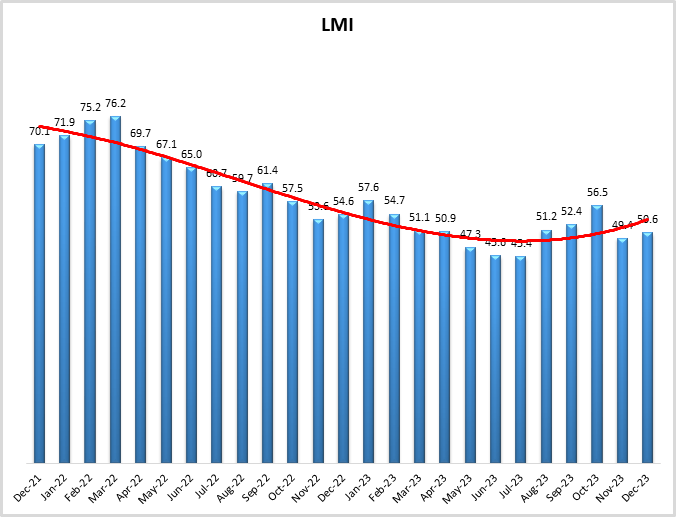
Growth is INCREASING AT AN INCREASING RATE for: Warehousing Utilization, Warehousing Prices, Transportation Capacity, and Transportation Utilization Growth is INCREASING AT AN DECREASING RATE for: Inventory Costs and Warehousing Capacity Inventory Levels and Transportation Prices ARE DECREASING The Logistics Managers’ Index moved back into expansion territory in December. This movement back to growth was led by increased activity among the three warehousing metrics. Warehousing Capacity is tighter (-5.5) while Utilization (+7.4) and Prices (+1.2) are both expanding at increasing rates. Inventory Levels continued to decline at a steady pace (although they were breaking even Downstream – likely indicative of JIT practices products selling briskly). This movement is likely the catalyst behind Transportation Utilization moving back into expansion (+4.6). Despite this, freight continues to struggle, with Transportation Prices decreasing at an increasing rate (-1.1). Finally, it is worth noting that Inventory Costs are growing at 55.8 (-6.3) but at the lowest level recorded in the history of the index. It will be interesting to continue monitoring this metric to see if it continues to moderate given the clear push towards JIT inventory management. Researchers at Arizona State University, Colorado State University, Florida Atlantic University, Rutgers University, and the University of Nevada, Reno, and in conjunction with the Council of Supply Chain Management Professionals (CSCMP) issued this report today. Results Overview The LMI score is a combination of eight unique components that make up the logistics industry, including: inventory levels and costs, warehousing capacity, utilization, and prices, and transportation capacity, utilization, and prices. The LMI is calculated using a diffusion index, in which any reading above 50.0 indicates that logistics is expanding; a reading below 50.0 is indicative of a shrinking logistics industry. The latest results of the LMI summarize the responses of supply chain professionals collected in December 2023. The LMI read in at 50.6 this month, up (+1.2) from November and back into mild expansion. As is always the case in December, movements in the logistics industry were driven by holiday shopping. The strength shoppers showed over cyber week continued throughout the holiday shopping season, with U.S. retail sales up 3.1% from November 1st to Christmas Eve. Online retail – which requires more trucks and warehouses located close to consumers – was a major part of this activity, with growth of 6.3%. Interestingly, sales per day was down slightly in December from November ($13.8B from $14.9B). This is reflective of both consumers increasingly spending earlier in the holiday season to avoid stock-outs, and the longer than usual 31-day gap between Black Friday and Christmas caused by an early Thanksgiving[1]. This spending was spurred in part by inflation continuing to drop. The personal-consumption expenditures (PCE) index was down 0.1% in November, which is the first drop in the PCE since the height of covid lockdowns in April of 2020. Wallstreet has taken this as a sign that interest rates will almost assuredly come down over the next year as all major indexes have now been up for eight consecutive weeks[2]. A significant portion of deflation can be traced to shifts in the logistics market. Aggregate Logistics costs (measured on a scale of 0-300, with 150 as the “break-even level) read in at 164.4, which is down (-6.2) from November’s reading of 170.6 and well below the readings during the heavy inflation period of 2022 which were often over 250.0. This is consistent with the San Francisco Fed’s measure of contributors to inflation, which showed supply costs as deflationary for both core and headline PCE inflation in November[3] – a direct reflection of decreased inventory costs inherent to the move back to JIT practices. The impact of JIT on this deflation is evidenced by Inventory Costs, which read in at 55.8 (-6.3) – their lowest level in the history of the index. The costs are particularly low Upstream, where they read in at 50.8 which is very close to no movement at all. This metric has never contracted in the history of the LMI. It will be interesting to see if that changes in the new year or if this is the low point and manufacturers and wholesalers will begin building inventories up again. An Upstream rebuild is expected among respondents, who predicted Upstream Inventory Levels will increase at a rate of 56.2 over the next 12 months. This stands in contrast to high-turnover program with our Downstream respondents. Downstream Inventory Levels are 50.0 in December and are expected to be 50.0 over the next 12 months – the clearest sign yet that retailers are looking to get back to JIT and get off the inventory roller coaster they have been riding over the last few years. For this to happen there will need to be some restocking as current Inventory Levels read in at 44.3, which is a level of contraction that is identical to what we saw in November. Some of the strategy behind the designs on JIT can be seen in the shift in how U.S. firms are importing goods. Sailings from China to the West Coast of the U.S. remains subdued[4]. While this is consistent with seasonal trends, it is still notable, and perhaps reflective of the continued shift in manufacturing from China to sources closer to the U.S. Conversely, over $105 billion of goods have been diverted away from the Red Sea due to attacks by Houthi Pirates. Between the instability in the Red Sea and the low water levels at the Panama Canal, moving goods from Asia to Europe or the East Coast of the U.S. – or vice-versa – has become difficult. This is reflected in container prices from Shanghai to the U.K. jumping to $10,000 for a 40-foot container – up from $2,400 in mid-December[5]. Conversely, more of the manufacturing base continues to nearshore to Mexico to take advantage of low-cost labor, technical expertise, proximity to the U.S., and the free border crossings allowed by the USMCA. Reflective of the increased freight volume coming in from Mexico, U.S. Customs and Border Protection is
AIT Worldwide Logistics welcomes Richard Lee as vice president of global project management office, contract logistics

AIT Worldwide Logistics has welcomed freight forwarding industry veteran Richard Lee, who has joined the organization as vice president of global project management office (PMO) and contract logistics. In this new role, Lee will apply his decades of industry experience by focusing on strategic, efficient resource management services, while also streamlining the process to integrate recently acquired companies. He reports to Chief Business Officer, Greg Weigel. “As AIT continues to expand our footprint across the globe, both organically and via acquisition, Rick’s extensive background and his visionary approach to consultative contract logistics relationships make him a valuable addition to our leadership team,” Weigel said. “We are confident his guidance will help the company continue to deliver increasingly beneficial solutions to our customers.” Across leadership positions with CEVA Logistics, SEKO Logistics and Avaya, Lee has a proven track record of collaboration, strategic planning, seamless acquisitions, and development of customized, integrated solutions for a diverse array of sectors and regions. Lee said he believes his deep supply chain experience – including an extensive quality management background, more than two decades of global contract logistics experience, and support for more than a dozen acquisition integrations in a span of just three years – will bring value to AIT’s vast global network. “I’m excited to work alongside the industry leaders here at AIT and look forward to collaborating across operations and borders,” Lee said. “With AIT still expanding into new markets around the world, this role is a great opportunity to help extend and build upon the company’s mission to earn customers’ trust by delivering quality driven, exceptional solutions.” Lee studied business at the University of New Haven in West Haven, Connecticut. Based out of AIT’s global headquarters in Itasca, Illinois, he enjoys woodworking, cooking and playing golf in his spare time.
Container xChange unveils January’24 Container Market Forecaster

“The red sea situation is acute, but not chronic for shipping” says Christian Roeloffs, cofounder and CEO of Container xChange Shipping industry looking forward to up their game in ‘risk assessment and scenario planning’, ‘diversification of routes and suppliers’ & ‘regulatory compliance’ in 2024 as a response to geopolitical risks Shipping professionals see ‘associated costs’ as biggest headache in ‘24 due to geopolitical unrest BRICS expansion to lead polarisation of global trade Container xChange, a online container trading and leasing platform, releases its New Year’s Edition Container Market Forecaster, shedding light on the escalating geopolitical risks set to reshape the landscape of global trade in 2024. In response to these geopolitical risks, majority of shipping professionals surveyed in the month of December 2023, by Container xChange, are gearing up to enhance resilience through strategic initiatives like – ‘risk assessment and scenario planning’, ‘diversification of routes’ and ‘suppliers and regulatory compliance’. The biggest ‘headache’ resulting from geopolitical upheaval is the ‘associated costs’ that they will have to bear on top of the rising operating costs that they have to already face. Key Highlights: Strategic Focus Areas: In response to geopolitical risks, shipping professionals are prioritizing ‘risk assessment and scenario planning,’ ‘diversification of routes and suppliers,’ and ‘regulatory compliance’ in 2024. Rising Concerns: Survey findings reveal that the biggest concern stemming from geopolitical upheaval is the ‘associated costs,’ compounding the challenges posed by soaring operating costs. Many customers are worried about the rising costs resulting from the Red Sea situation like compliance charges, insurance premiums and war risk charges, etc. The operating costs have already been rising soon after the rates crashed in 2022, and demand failed to recover. On top of the rising costs, these additional surcharges will only add to the worries of shippers and forwarders. BRICS Expansion: The inclusion of new economies in the BRICS bloc, including Saudi, Iran, UAE, Egypt, and Ethiopia, sets the stage for potential polarization of global trade, impacting geopolitical compliance. Technology Utilization: Despite challenges, 82% of industry professionals acknowledge the importance of technology for resilience in 2024, with predictive analysis and forecasting tools taking center stage. Sanctions Compliance: Amidst geopolitical developments, sanctions compliance becomes critical for supply chain professionals, adding another layer of complexity to global trade. Fluctuating Freight Rates: freight rates will increase in the short to midterm, but not in the long run as demand and supply is still highly imbalanced with no clear signs of a strong revival. Talking about the Red Sea situation, Christian Roeloffs said, “The Red Sea is a vital artery for global trade which is currently blocked. Thankfully, there are ways to circumvent that artery and keep the global trade moving and therefore, the trade is not stopped. Therefore, the red sea situation is acute but not chronic in the long term for the shipping industry.” There are still many geopolitical risks that have the potential to significantly impact shipping trade in 2024. We have the Israel – Hamas war, the related situation in the Red Sea, the Russia Ukraine war with no end in sight, tensions between China and Taiwan and an increasing enlargement of the BRICS block. BRICS expansion “What can have a far- reaching and long-term impact on the global supply chain is the BRICS inclusions of more economies.” Roeloffs added. There is a host of countries being added in the BRICS block, namely, Saudi, Iran, UAE, Egypt, Ethiopia, while Argentina declined inclusion. BRICS has been viewed as a counterbalance to the Western-led world order. “If the block starts to increasingly align political decisions and geopolitical stances, then there could be added complexities to the global trade order with rising polarisation of global trade. Ultimately this might lead to a situation where one block is not allowed to trade with the other block and eventually, geopolitical compliance becomes more complex and difficult.” he added. The expansion of BRICS will bring further interesting developments worth noting. Iran and Saudi are now in the same organisation despite a strained relationship. Egypt has close commercial ties with Russia and India but also with the US. India and China together account for ~2.5bn people and could heavily influence global policymaking if they are more aligned. And finally, Russia and Iran being able to jointly influence “trade” policymaking within the BRICS group could lead to a “sharpening” of trade rethink of US-allies vs BRICS. Amidst these developments, sanctions compliance will become critical for supply chain professionals for doing business. Any geopolitical unrest has a direct and causal impact on global trade which results in market volatility. Classic case in point is the Gaza Strip and the resulting actions by Houthis in Jemen. This leads to trade rerouting, ultimately resulting in rising operating costs, delays, and service disruptions.” said Roeloffs.
OZ Lifting chain hoists lower $250k car

The vehicle was center of a holiday-season display in the jewelry section of the store, which is below street level. Getting it there took an overnight operation that involved four 3-ton capacity OZ Premium hand chain hoists, with a lifting height of 30 ft.; beam clamps attached to 30-ft. long beams; and a customized lifting platform. The 5,600-lb. car combined with the platform for a total load of 10,000 lb. To facilitate the lift (lower), four exterior doors were removed, an escalator bank was stripped, and the car was driven to the makeshift freight elevator. The store’s pillars were utilized to anchor the platform in preparation for the 28-ft. journey down to the vault level. OZ Lifting’s equipment was utilized at the point of use by the project’s rigging contractor, Concord Painting, which sourced it from OZ dealer, Eastern Rigging Supply. A steel fabricator was subcontracted to provide the lifting platform. Bob Eberheim, of Eastern Rigging, said: “The work was completed upon closure of the store one evening; it took 10 hours even when the Sapphire was in the store, such was the complexity of the job and the constant requirement to complete such lifts as safely as possible.” He added: “The yellow straps you can see in the photos were used to secure the vehicle in place, and the beams were supported by shoring towers.” The OZ Premium hand chain hoists are part of a range that spans 0.5-ton to 10-ton capacity. They offer minimal load lifting effort; double reduction gearing provides easy operation. A unique hand-wheel design enables the hand chain to successfully feed directly into the wheel sprocket from many directions and angles. Thus, the operator can use the hoist while standing to the side of, or even above, the load without fear of the hand chain jamming. All-steel construction features a long-lasting powder coat finish, while providing a long and dependable service life in harsh environments. An enclosed and protected Weston-style load brake stays clean and dry during the entire load operation. Hoists are also equipped with a unique twin pawl design for additional reliability. A sealed roller bearing provides smooth, controlled operation of the gears and shafts, which ensures maintenance-free lubrication. An article published in the New York Post reported, ‘…it’s probably the biggest stunt the store has pulled off since 1935’.
Episode 450: The power of intelligent slotting with Fulfilld

Michael Pytel is the co-founder and CTO of Fulfilld, a pioneering company introducing a new warehouse management system (WMS) to the industry. In this episode, Michael and Kevin dive deep into the concept of intelligent slotting within the warehouse environment, exploring its significance, challenges, and how Fulfilld’s technology is making a tangible impact. Understanding Slotting: The Backbone of Warehouse Efficiency Pytel explains, “Slotting is super important for the warehouse management system and for slotting tools to understand the physical space, the physical world to optimize how employees flow through the building.” He emphasizes the complexity of manual processes, especially in vast warehouses with thousands of products. By leveraging technology, Fulfilld aims to optimize product placement, significantly impacting warehouse flow and efficiency. Transforming Slotting with Technology: A Leap Towards Optimized Operations Pytel discusses the limitations of traditional methods and how Fulfilld’s intelligent slotting application revolutionizes this by creating a digital twin of the warehouse and understanding physical space. “By understanding physical space, creating that digital twin of the warehouse, we can more efficiently route and optimize labor inside the warehouse and robots,” says Pytel. Future-Proofing Warehouses: The Road Ahead for Fulfilld’s Slotting Innovations Looking ahead, Pytel shares its vision for integrating more labor information and predictive analytics into its application. This forward-thinking approach aims to enable more strategic shift planning and optimize warehouse capacity, addressing the dynamic needs of modern warehouses. Key Takeaways on Slotting Slotting directly impacts the flow of your warehouse and metrics like picks per hour. Proper product placement drastically improves your outbound and inbound flow of goods. Traditional methods are time-consuming and less efficient; technology can significantly enhance this process. Fulfilld’s intelligent slotting application creates a digital twin of the warehouse, understanding physical space for better optimization. The New Warehouse Podcast Episode 450: The Power of Intelligent Slotting with Fulfilld
Who’s your brand’s rival?

Everyone likes a good rivalry story. They inspire, build emotional connections, and create a deep level of authenticity with the characters involved. Your brand has rivals too, and capitalizing on those rivals can help you position your identity in a way that differentiates you from the herd. Rivals also play an essential role in storytelling and messaging. A rival is the main enemy of the protagonist. Their actions and motivations are typically opposed, creating conflict and driving the proverbial plot forward. Consider your brand’s story – do you have a rival that you can position your organization against? The trick with rival positioning is that your rival isn’t your typical competitor – it’s the single thing that your customers struggle to overcome that you and only you can help address, allowing you to connect on a deeper, more emotional level. Consider a few well-known brands that have identified non-traditional rivals that allow them to stand out uniquely from the competition: Nike Fighting Self-Doubt: The renowned “Just Do It” campaign connects with people’s struggle against self-doubt and procrastination. This positions Nike as a companion and motivator, helping emotionally connect by encouraging people to overcome their fears and pursue their goals. Dove Fighting Unhealthy Beauty Standards: Dove’s “Real Beauty” campaign pushes against the unrealistic and unattainable beauty standards perpetuated by the media. This positions Dove as an advocate for authentic beauty, emotionally connecting by celebrating diversity and self-acceptance. Patagonia Fighting Environmental Abuse: Patagonia is deeply rooted and highly focused on “environmental activism and sustainability”. This positions Patagonia as a steward of the environment and emotionally connects through the battle against pollution and the overuse of natural resources. How you position your organization doesn’t end with marketing, branding, and messaging. That distinct position should permeate all areas of your organization, guiding decision-making, and aligning those decisions with the core positioning. For instance, Patagonia uses its rival position to drive decisions on material purchasing, factory design, charitable contributions, and even organizational hires. As you consider your brand, examine the opportunity a rival positioning can bring.By broadening your horizons beyond a traditional competitor, and focusing on people’s emotional drivers, you can not only connect with customers on a deeper level but also create a market position that will be incredibly unique and even harder to contest. About the Author Andrea Belk Olson is a keynote speaker, author, differentiation strategist, behavioral scientist, and customer-centricity expert. As the CEO of Pragmadik, she helps organizations of all sizes, from small businesses to Fortune 500, and has served as an outside consultant for EY and McKinsey. Andrea is the author of three books, including her most recent, What To Ask: How To Learn What Customers Need but Don’t Tell You, released in June 2022. She is a 4-time ADDY® award winner and host of the popular Customer Mission podcast. Her thoughts have been continually featured in news sources such as Chief Executive Magazine, Entrepreneur Magazine, Harvard Business Review, Rotman Magazine, World Economic Forum, and more. Andrea is a sought-after speaker at conferences and corporate events throughout the world. She is a visiting lecturer and startup coach at the University of Iowa, a TEDx presenter, and TEDx speaker coach. She is also an instructor at the University of Iowa Venture School. More information is also available on www.pragmadik.com and www.andreabelkolson.com.
Kenco acquires The Shippers Group

Acquisition expands Kenco Warehousing footprint by 3.8M square feet Kenco, a North American third-party logistics company, has announced the acquisition of The Shippers Group, a Dallas-based third-party warehousing company. This strategic partnership adds to Kenco’s capabilities by providing increased capacity, broader geographic reach, and an expanded suite of services for the benefit of customers. Terms of the acquisition are not being disclosed. Founded in 1901 as a regional warehousing company, The Shippers Group has evolved into a nationally recognized leader in the warehousing, co-packaging, fulfillment, and transportation management space. Its century-long legacy of strengthening supply chains through innovative solutions distinguishes the company as a reliable partner. The Shippers Group is led by majority owner and CEO Graham Swank and supported by a tenured leadership team committed to upholding the company’s collaborative, innovative, and growth-oriented culture. “Kenco and The Shippers Group have highly complementary capabilities and share a culture of excellence,” said Denis Reilly, CEO of Kenco. “Together, we bolster the combined suite of capabilities with increased scale and reach in key growth markets, enabling us to capitalize on market momentum, while continuing to deliver exceptional service to our customers. I have long admired The Shippers Group’s management team and look forward to working together in the next chapter of their growth.” The acquisition of The Shippers Group bolsters Kenco’s multi-client capabilities and North American presence through the addition of 3.8 million square feet of space across eight sites in Florida, Georgia, and Texas. Kenco customers will benefit from access to The Shippers Group’s facilities, increased transportation capacity, as well as co-packaging know-how and processes. “Today marks a pivotal moment in The Shippers Group’s journey to optimize supply chains for the benefit of our customers,” said Rob Doyle, President at The Shippers Group. “Kenco has built an exceptional platform from which to scale, and I am confident that our customers will welcome access to Kenco’s proven operating systems. Our alignment with Kenco’s culture, values, and commitment to innovation, coupled with Kenco’s infrastructure, positions us well to achieve new levels of performance and execute upon our growth opportunities.” Scott Mayfield, Chief Administration Officer of Kenco, added, “We knew Shippers Group would be a fit from the start. We have had a long-standing relationship with their owners and key executives. This strategic partnership signifies a milestone for Kenco and The Shippers Group, combining our strengths to deliver even greater value to our customers and further excel in the dynamic logistics landscape.”
The U.S. Plastics Industry in 2023 in seven charts

Assessing the plastics industry landscape in 2023 reveals a year marked with nuanced shifts across various sectors. From the fluctuations in production levels and shipments to the intricate interplay between labor constraints and export dynamics, the plastics industry encountered challenges and opportunities. Notably, the year witnessed divergent trajectories: while certain segments, such as plastics material pricing and resin manufacturing, grappled with equilibrium adjustments, others, like the mold for plastics trade, mirrored global economic oscillations. Unpacking these trends and projections explains a complex narrative of the industry’s path ahead into 2024. 1. Plastic Products Manufacturing 2023 saw a notable pullback from the production levels of 2022. The initial increase starting in March did not maintain momentum for the rest of the year. A significant decline occurred in July, followed by another downturn in August. While September witnessed a slight increase, it was followed by successive declines through November. There is a likelihood that production increased marginally in December. It is anticipated that the rate of decline in plastics production in 2024 will be lower than that observed in 2023. 2. Plastics and Rubber Shipments In 2023, the shipments of plastics and rubber remained relatively stable, hovering between $24.4 billion and $24.9 billion. Although there was an initial decline in the first four months, they rebounded until August before stabilizing, with minimal fluctuations projected for November and December. Despite robust economic growth, primarily fueled by personal consumption accounting for 87% of plastics production, inventories remained elevated, prompting a decrease in plastic shipments. Initial projections for 2024 indicate a tepid rise in shipments of plastics and rubber, signaling a modest increase. 3. Plastics Manufacturing Employment The U.S. plastics industry grappled with persistent labor supply constraints throughout 2023, echoing the challenges experienced across the broader manufacturing sector. From January to December, there was a probable 1.7% decrease in the workforce engaged in plastics product manufacturing. According to the U.S. Bureau of Labor Statistics, an estimated 608,000 employees were working in plastics products manufacturing in November, likely declining to 607,500 by December. The ongoing disparity between job openings and actual hires in manufacturing is anticipated to have persisted throughout November and December. These persistent imbalances in labor demand and supply, including within the plastics industry, are forecasted to extend into 2024. 4. Molds for Plastics Trades The slowdown in U.S. manufacturing and weakened economic conditions in export markets became evident in the molds for plastics trade. Projections suggest a notable 8.8% decrease in exports based on dollar value for 2023. Although the decline in inflation might indicate a lower dollar value of exports, year-to-date exports until October dwindled by 13.2% compared to the same period in 2022. Exports of molds for plastics fluctuated monthly, ranging between $37.0 million and $57.3 million. October indicated a potential 2.9% rise in export value, but these gains might have been tempered in December, historically a weaker month for exports compared to other months. Anticipating a global output slowdown in 2024, particularly in advanced economies, while stabilizing in emerging and developing economies, it’s likely that any improvements in molds exports will be weaker compared to the preceding two years. 5. Producers Prices in Plastics Material and Resin Manufacturing Plastics material and resin prices hit their peak in April this year, then gradually fell as demand and supply rebalanced. Reduced U.S. plastics production tempered resin demand, while supply increased from July to October compared to the previous year. November saw a 0.4% price hike, but December may mark a 0.2% decrease. Barring unexpected disruptions like adverse weather affecting resin production, it is unlikely we will see a reversal in the recent path of resin prices in 2024. 6. Capacity Utilization Rates in Plastics and Resin Manufacturing The capacity utilization rate in plastics product manufacturing declined throughout 2023, averaging 83.1% monthly in the preceding year and dropping to an average of 77.4% for the year, with an anticipated rate of 76.6% for December. This decline aligns with the observed decrease in plastics conversion activity during the year. Conversely, capacity utilization in plastics material and resin manufacturing experienced an uptick, notably increasing in the latter half of the year. December might have seen a slight decrease in both capacity (0.1%) and utilization rate (0.4%). The imbalance between resin supply and demand contributed to the decrease in the Producer Price Index for plastics material and resin manufacturing in 2023. Projections for 2024 suggest an anticipated increase in capacity utilization for resin manufacturing, albeit possibly at a slower pace compared to 2023. 7. Plastics Machinery Imports The U.S. imported plastics machinery amounting to $1.8 billion, with projected import values of $129.4 million in October and $150.1 million in November. This year’s total imports have decreased by 4.4% compared to the previous year. As a primary importer of plastics equipment, this data serves as a key indicator for understanding plastics manufacturing. Typically, an upsurge in plastics machinery imports signifies robust plastic conversion. The reduced imports of plastics equipment this year correlate with the decline in plastics product manufacturing. The possibility of an uptick in plastics equipment imports in 2024 relies on increased plastics production, provided there is a limited inventory of plastics equipment available. About the Author: The Plastics Industry Association (PLASTICS) is the only organization that supports the entire plastics supply chain, including Equipment Suppliers, Material Suppliers, Processors, and Recyclers, representing over one million workers in our $548 billion U.S. industry. PLASTICS advances the priorities of our members who are dedicated to investing in technologies that improve capabilities and advances in recycling and sustainability and providing essential products that allow for the protection and safety of our lives. Since 1937, PLASTICS has been working to make its members, and the seventh largest U.S. manufacturing industry, more globally competitive while supporting circularity through educational initiatives, industry-leading insights and events, convening opportunities and policy advocacy, including the largest plastics trade show in the Americas, NPE2024: The Plastics Show.
U.S. Rail Traffic for December and the week ending December 30, 2023

The Association of American Railroads (AAR) has reported U.S. rail traffic for the week ending December 30, 2023, as well as volumes for December 2023. U.S. railroads originated 876,881 carloads in December 2023, up 7.3 percent, or 59,804 carloads, from December 2022. U.S. railroads also originated 982,383 containers and trailers in December 2023, up 10.2 percent, or 90,881 units, from the same month last year. Combined U.S. carload and intermodal originations in December 2023 were 1,859,264, up 8.8 percent, or 150,685 carloads and intermodal units from December 2022. In December 2023, 16 of the 20 carload commodity categories tracked by the AAR each month saw carload gains compared with December 2022. These included: chemicals, up 14,636 carloads or 13.1 percent; coal, up 13,971 carloads or 5.9 percent; and motor vehicles & parts, up 7,212 carloads or 14.1 percent. Commodities that saw declines in December 2023 from December 2022 included: crushed stone, sand & gravel, down 2,781 carloads or 4.1 percent; nonmetallic minerals, down 1,105 carloads or 9.8 percent; and all other carloads, down 625 carloads or 3.3 percent. “Total U.S. rail carloads were up 2.0 percent in the fourth quarter of 2023 over the fourth quarter of 2022, while U.S. intermodal was up 5.5 percent over the same period. That means Q4 was clearly the best quarter of 2023 for U.S. rail volumes on a year-over-year basis,” said AAR Senior Vice President John T. Gray. “It appears that intense rail efforts to improve service quality are paying off. Railroads are hopeful that gains in the fourth quarter will carry over into the first quarter of 2024 and beyond.” Excluding coal, carloads were up 45,833 carloads, or 7.9 percent, in December 2023 from December 2022. Excluding coal and grain, carloads were up 40,036 carloads, or 8.0 percent. Total U.S. carload traffic for the first 12 months of 2023 was 11,701,875 carloads, up 0.7 percent, or 81,504 carloads, from the same period last year; and 12,667,354 intermodal units, down 4.9 percent, or 657,165 containers and trailers, from last year. Total combined U.S. traffic for the first 52 weeks of 2023 was 24,369,229 carloads and intermodal units, a decrease of 2.3 percent compared to last year. Week Ending December 30, 2023 Total U.S. weekly rail traffic was 370,800 carloads and intermodal units, up 3.4 percent compared with the same week last year. Total carloads for the week ending December 30 were 182,062 carloads, up 4.1 percent compared with the same week in 2022, while U.S. weekly intermodal volume was 188,738 containers and trailers, up 2.7 percent compared to 2022. Six of the 10 carload commodity groups posted an increase compared with the same week in 2022. They included chemicals, up 6,273 carloads, to 30,543; farm products excl. grain, and food, up 2,370 carloads, to 15,310; and petroleum and petroleum products, up 1,537 carloads, to 8,936. Commodity groups that posted decreases compared with the same week in 2022 included motor vehicles and parts, down 1,705 carloads, to 7,712; miscellaneous carloads, down 1,493 carloads, to 5,317; and nonmetallic minerals, down 898 carloads, to 18,723. North American rail volume for the week ending December 30, 2023, on 10 reporting U.S., Canadian and Mexican railroads totaled 270,807 carloads, up 5.0 percent compared with the same week last year, and 254,475 intermodal units, up 3.8 percent compared with last year. Total combined weekly rail traffic in North America was 525,282 carloads and intermodal units, up 4.4 percent. North American rail volume for the first 52 weeks of 2023 was 34,105,519 carloads and intermodal units, down 2.1 percent compared with 2022. Canadian railroads reported 75,463 carloads for the week, up 9.9 percent, and 56,220 intermodal units, up 6.4 percent compared with the same week in 2022. For the first 52 weeks of 2023, Canadian railroads reported cumulative rail traffic volume of 8,299,862 carloads, containers and trailers, down 2.4 percent. Mexican railroads reported 13,282 carloads for the week, down 8.1 percent compared with the same week last year, and 9,517 intermodal units, up 13.1 percent. Cumulative volume on Mexican railroads for the first 52 weeks of 2023 was 1,436,428 carloads and intermodal containers and trailers, up 2.1 percent from the same point last year. To view the traffic charts, click here.
Episode 449: Leveraging AI to optimize last-mile delivery with Senpex

In this episode of the New Warehouse Podcast, Anar Mammadov, the Technical Co-Founder of Senpex, shares how Senpex uses artificial intelligence for route optimization to tackle persistent challenges of last-mile delivery. Mammadov shares his extensive experience and Senpex’s solutions to streamline logistics operations. The Genesis of Senpex: A Journey Led by Innovation Anar Mammadov recounts his journey into the logistics industry, “I’ve worked and managed different enterprise solutions. In supply chain, I have more than 18 years of experience.” He highlights the inception of Senpex as a response to glaring gaps in the U.S. logistics sector. “I did a lot of different projects and implemented different solutions and I just decided, why not try and solve this problem in the supply chain and find a way for people to receive their product from different verticals within an hour.” The Core of Senpex: Last-Mile Delivery Revolutionized Mammadov discusses Senpex’s mission, “We’re helping warehouses or 3PLs make proper planning of their routes from their warehouse to their customers efficiently with less resources.” He explains how Senpex specializes in optimizing routes for the timely delivery of various products, emphasizing the high costs and complexities of last-mile delivery. The Role of AI in Enhancing Logistic Efficiency Mammadov illuminates the transformative power of AI in logistics, emphasizing that despite advancements like drone and autonomous deliveries, the demand for direct-to-home services is surging. Mammadov elaborates on the emerging trend of ‘dark warehouses,’ which allows brands to distribute products closer to consumers, enhancing efficiency and speed. He believes dark warehouses will be crucial in this rapidly growing sector, enabling brands to establish a presence near their customers and facilitating faster deliveries through partners like Senpex. This approach not only maintains brand integrity but also significantly reduces delivery times. “We’re committed to optimizing routes and improving service reliability through AI. Our goal is to become the Shopify of last-mile logistics, continually innovating and addressing industry challenges,” Mammadov asserts, reflecting his ambition to lead in the logistics space through advanced AI applications. Key Takeaways Senpex leverages AI for route optimization, significantly improving last-mile delivery. The company focuses on efficient, timely delivery, addressing the high costs and complexities inherent in the logistics sector. Predictive analytics and data-driven strategies are pivotal in enhancing delivery services and reducing failure rates. The New Warehouse Podcast EP 449: Leveraging AI to Optimize Last-Mile Delivery with Senpex
E Tech Group announces name change of recently acquired System Integrator, E-Volve Systems

E Tech Group announces the immediate renaming of E-Volve Systems to E Tech Group, following their strategic acquisition on February 23, 2023, emphasizing a unified vision, expanded services, and enhanced client and market value through this integration E Tech Group has announced that the brand formerly known as E-Volve Systems has now been renamed as E Tech Group. Effective immediately, the brand formerly known as E-Volve Systems will operate under the name E Tech Group, unifying the two entities under one market-leading brand. The transition to the new name will be seamless for clients and partners. All existing commitments remain in place, ensuring continuity and stability. “We’ve gained the ability to market and deliver large scale projects that may not have been available to us prior to the acquisition due to our size,” said Kevin Stout, previous E-Volve Systems founder and president and current vice president at E Tech Group. “We’ve also gained a tremendous network of team members whose skillsets seem to be limitless.” E Tech Group’s acquisition of E-Volve Systems was finalized on February 23, 2023. This strategic move allowed E Tech Group to significantly expand its range of services, thereby enhancing the overall value offered to its clients. The acquisition was a step towards integrating complementary strengths, consolidating market presence, and fostering innovation in service delivery. “The name change at this time is a formality as E-Volve Systems has been a part of the E Tech Group since late February 2023,” said Matt Wise, Chief Executive Officer of E Tech Group. “Their contributions have positioned E Tech Group to elevate its service offerings and reach with the added benefit of resources located throughout North America as well as a broader suite of services, allowing us to automate every facet of a facility, from process and discrete automation through cybersecurity and data intelligence services, leveraging a team of over 600 automation specialists.”