SIEMPELKAMP Machines & Handling GmbH has significantly increased its efficiency and sustainability by integrating Wiferion’s inductive charging solution. This partnership combines SIEMPELKAMP’s RundSchienen system with Wiferion’s innovative wireless charging technology, resulting in a significant improvement in production processes.
Identifying trends early on is an important credo for economic efficiency. However, foresight does not always lead to business success. For the SIEMPELKAMP Machines & Handling GmbH , a member of the , focusing on a second pillar around ten years ago proved to be forward-looking. Having grown in the field of press automation in the 1980s and 1990s, the provider of system solutions for transport and handling has now specialised in driverless transport systems (AGVs) and, in this context, expanded the range of its patented circular rail system.

“Market demand in the field of press automation has declined steadily over the last five years. The main drivers are the significant changes in the field of car body parts manufacturing,” says Dominik Schaffrinski, Head of Business Development & Marketing at SIEMPELKAMP. “Instead, demand in the field of intralogistics has risen steadily. Since we had already developed an unbeatable system for moving press tools with our round rails, we came up with the idea of using it for other areas of application as well. The decision to also build driverless transport vehicles (FTF) for our rail network was then an obvious one. Our new corporate focus is now on a complete system consisting of rails and automation that are perfectly coordinated with each other.”
Heavy loads made easy: SIEMPELKAMP’s AGV solution for high efficiency and ergonomics
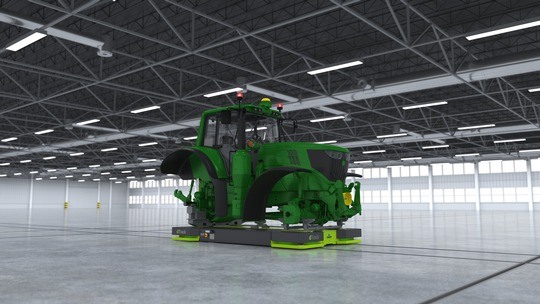
The company now supplies 18,000 metres of RundSchienen for around 100 new projects per year. SIEMPELKAMP serves a niche market by focusing on the last mile in production, where the entire value chain converges to form the end product, and specialising in heavy loads. Products weighing between 5 and 200 tonnes can be transported on the rail system using SIEMPELKAMP’s uTrack AGV – a particularly floor-friendly mode of transport. In addition to its high positioning accuracy, the uTrack rail guide is also characterised by its energy efficiency. Thanks to its low coefficient of friction, moving loads is ten times more energy-efficient than with other rail systems.
With a standard height of 260 mm, uTrack is an extremely compact AGV that improves ergonomics when working on and around vehicles. This exceptionally flat design is a unique selling point for the AGV worldwide. A very low failure rate also enables a high level of production reliability of 99.8 per cent. This is partly due to the closed contour of the round rail system, which, unlike conventional rails, has no large joints where dirt could fall and hinder transport. But even in the extremely rare event of a breakdown, it is no big deal, as Dominik Schaffrinski explains: “If a vehicle breaks down, it can be decoupled from its drive within five minutes and pulled along the track by an auxiliary mover, for example. With lighter loads, the vehicles can even be pushed from station to station by staff. Thanks to the low coefficient of friction, a single person can move up to five tonnes.” The result: the AGV remains on the track and production can be completed. Downtime and costs are thus reduced to a minimum.
High effort, low yield: the disadvantages of line induction
What a single person can move does not require a powerful battery system. Only two to four battery modules with a voltage of 48 volts and a charge storage capacity of 21 to 42 ampere hours are installed per uTrack. Due to the very low resistance when starting and braking, this power is completely sufficient. However, the type of energy transmission via line conductors embedded in the ground along the route proved to be a disadvantage in terms of efficiency.
With line induction, the track must be permanently energised, even when the vehicle is stationary and has no significant energy requirements. This significantly reduces efficiency and consequently increases operating costs and environmental impact. “The longer the route, the worse the carbon footprint,” says Dominik Schaffrinski. In addition, this type of energy transfer involves enormous installation costs. The line conductors must be precisely adjusted to the rail level along the entire route.
A highly efficient, technically sophisticated system and an inefficient energy supply? For SIEMPELKAMP, this is not an acceptable situation. The company has therefore been relying on Wiferion’s inductive point charging systems since 2022.
Charging only where necessary: Wiferion’s etaLINK 3000 increases efficiency
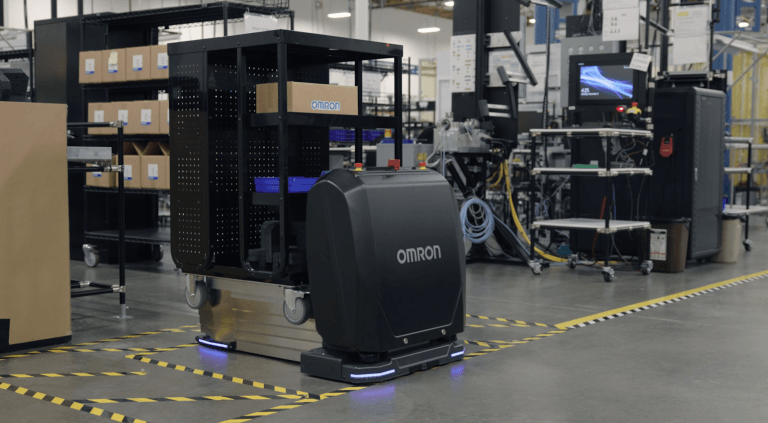
Wiferion offers inductive charging systems for autonomous AGVs that can be installed without major changes to the building structure. SIEMPELKAMP integrates these directly into the assembly line in the form of the Wireless Charging Protection System (WCPS) floor installation solution from Wiferion’s strategic partner PohlCon. Unlike a line induction system, which is installed along the entire line, etaLINK 3000 is only used at a few strategically important locations.
“SIEMPELKAMP saw great potential in a solution that would eliminate this additional energy and installation effort. The number of charging stations required in the line is determined based on the number of stations to be approached and the energy consumption, which is calculated from factors such as the weight, speed and cycle time of the AGVs. Wiferion’s 3kW system only provides energy where it is needed. This is a 1:1 added value for the end customer,” says Dominik Schaffrinski. “This has improved energy efficiency by more than 50%. So we offer the best of both worlds: our rail technology and Wiferion’s inductive charging technology, a highly efficient complete package.” The result: the reduced complexity of the charging structure significantly lowers the overall project costs. In addition, manufacturers of large and heavy products who rely on SIEMPELKAMP’s transport system benefit from a significantly more efficient carbon footprint.
Another advantage results from the interaction of the two technologies: the high positioning accuracy of the round rail system allows the ideal range of the Wiferion technology to be approached with pinpoint accuracy. This allows for a greater distance between the stationary charging plate in the floor and the mobile charging plate in the AGV. This reduces the risk of foreign objects getting in between and damaging the mobile charging plate – which in turn increases robustness.
A strong duo for the future of vehicle charging
Wiferion’s etaLINK 3000 is now an integral part of the standard system that SIEMPELKAMP delivers to customers who use stationary clocked production. For manufacturers who expect continuous vehicle operation and have no possibility of recharging, the old system with line induction is more suitable. A first series of 52 vehicles with integrated 3kW charging modules went into operation in Mexico in the middle of the year.
A second series of 28 vehicles for a major German customer is currently in production. And that is just the beginning, as several orders have already been received from other well-known major customers in the automotive and agricultural machinery industries.
“In Wiferion, we have found a powerful and compatible cooperation partner,” sums up Dominik Schaffrinski. “In addition to a high level of innovation, our systems have two other things in common: both are floor-level, efficient and maintenance-free. A match with future potential.”
Conclusion
The partnership between SIEMPELKAMP and Wiferion sets new standards in the efficiency and sustainability of production processes. With further projects planned and the continuous development of the technology, SIEMPELKAMP will remain a pioneer in the industry in the future.