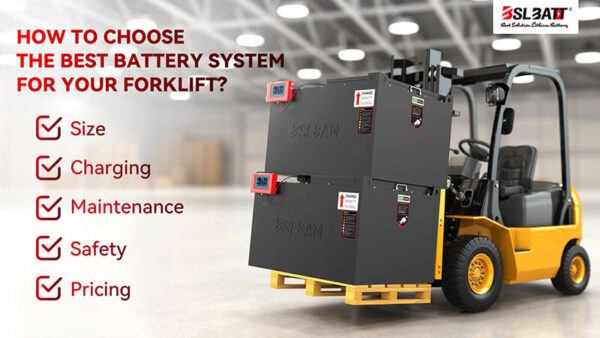
Material-handling electric vehicles use two types of batteries: lithium-ion (Li-ion) and lead-acid batteries. The main deciding factors when choosing the right battery for your forklift are maintenance, price, efficiency, sustainability, application, and TCO (total cost of ownership). With so many options available, choosing the best lithium-ion system for a forklift can be a challenge. Here’s a comprehensive guide to help you understand the considerations and choose the perfect forklift power solution.
Assess your power needs
Consider your power needs before diving into battery systems. With the right battery for your equipment, you can maximize your organization’s efficiency and save money. Estimate their power consumption (in watts) and average daily usage hours. Our expert sales engineers can assist you in determining your usage. As a result of this assessment, you will have a clear understanding of your energy needs and will be able to choose a battery system that meets your requirements.
Discover the types of batteries
Lead-acid and lithium batteries are the two main types of forklift batteries. Here are some pros and cons of each type:
Batteries made of lead acid have the shortest lifespan, the lowest depth of discharge, the heaviest weight, and the most frequent replacements. In traditional lead-acid batteries, there are two types: flooded lead-acid batteries (FLA) and sealed lead-acid batteries (SLA). Compared to FLA batteries, SLA batteries require less maintenance, such as checking the water level on a regular basis. Compared to traditional lead-acid batteries, absorbent glass mat (AGM) batteries offer lower maintenance costs and slightly better performance in cold temperatures.
Lithium batteries: Lithium-ion batteries offer high energy density, lightweight design, and long life in forklift power systems. Lithium batteries have a lifespan ten times longer than lead-acid batteries. Despite their higher cost, lithium batteries charge faster, discharge deeper, and have a longer cycle life than lead-acid batteries. Over time, lithium batteries can save significant amounts of money because they don’t need to be replaced as frequently as lead-acid batteries. In addition to having greater power and energy capacity, lithium batteries also take up less space than lead-acid batteries. Additionally, they do not emit toxic fumes, making them safer in a wider range of environments. Moreover, not all lithium batteries are the same. Compared with lithium cobalt-based battery chemistries like NMC, LCO, and NCA, lithium iron phosphate batteries like the BSLBATT are the most environmentally friendly and non-toxic.
Factors to consider
It would help if you considered the following factors when choosing a battery system for your forklift fleet:
Capacity: The capacity of a battery is measured in ampere-hours (Ah), watt-hours (Wh), or kilowatt-hours (kWh). A battery’s energy represents the power it can deliver over time. Ensure your battery system has enough capacity to meet your daily energy needs, as well as some buffer in case of unexpected circumstances. Lead-acid batteries often have a “rated” capacity that is much higher than their actual or usable capacity. The reason for this is that lead-acid batteries cannot be discharged more than 50% at a time, unlike lithium batteries, which can be discharged to around 100%.
Cycle life: Battery cycle life is the number of charge and discharge cycles a battery can withstand before its capacity is greatly reduced; it is important to understand this, especially for long-term forklift users. Lithium batteries have a longer cycle life than lead-acid batteries, making them an affordable choice over time. BSLBATT lithium batteries cycle 3,500 times or more, and higher discharge rates have little effect on cycle life. Lead-acid batteries, however, are generally only capable of 300-500 cycles, as higher discharge levels will significantly reduce their life span.
Size: Depending on the type of lift equipment and its intended use, weight, size, and voltage can vary greatly. For different types and sizes of electric vehicles, voltage options such as 24V, 36V, 48V, 80V, 96V, and 144V are available. Understanding your vehicle needs is therefore essential to selecting the right vehicle.
Recharge:Your business’ efficiency depends significantly on how quickly your vehicle can charge, and how long it takes to charge. Lithium-ion batteries, for instance, charge faster and easier than lead-acid batteries. The charging process for lead-acid batteries requires a dedicated space with ventilation and temperature control, whereas lithium-ion batteries can be charged on the spot.
Maintenance:How you maintain your vehicle plays a major role in choosing the right forklift battery. You should consider factors such as battery life and watering systems when making your decision. Lead-acid batteries require a watering system to function at maximum capacity, while lithium-ion batteries are sealed and do not require one. In addition to providing:
Safety: Better value for money, lithium-ion batteries last longer and have more cycles than lead-acid batteries.
Temperature performance: Keeping your team safe and minimizing workplace risks should always be a priority for every organization. Lead-acid batteries contain toxic sulfuric acid, which can cause spills when adding water, overheating, gas release, and health risks associated with old or corroded batteries. On the other hand, lithium-ion batteries are sealed, eliminating acid spills, corrosion, sulfation, and contamination risks.
Cost: You should choose a battery system that will perform effectively in a wide range of temperatures you may encounter during your travels. As an example, BSLBATT’s Cold Storage Series lithium batteries can charge at temperatures as low as -35°C. Choosing the right battery for your fleet is always influenced by price. Lead-acid batteries are often thought to be cheaper than lithium-ion batteries, but this is not true. Long-term, lithium-ion batteries are much cheaper than lead-acid batteries. In addition to not requiring water maintenance, lithium-ion batteries have a longer life, require less energy, and require less time to maintain, making them a more cost-effective investment than lead-acid batteries.
Lithium-ion forklifts with full integration
Currently, BSL’s lithium batteries are compatible with a variety of Toyota, Hyster & Yale, CLARK, Combilift, Heli, and Raniero forklifts designed specifically for fully integrated lithium-ion power. High-capacity electric forklifts reduce emissions, fuel consumption, and maintenance costs while providing ICE-like performance.
You should carefully consider your power needs, battery type, capacity, cycle life, charging source, size, safety, maintenance, temperature performance, and cost when choosing a battery system for your forklift. When you evaluate these factors and conduct thorough research, you can make an informed decision for a reliable and efficient power source. We can help you determine which battery system is right for your Electric Forklifts, 3-Wheel-Forklifts, heavy-duty-forklifts、Narrow Aisle Forklifts, Combilift Forklifts, Walkie Pallet Jacks, or other Electric Tow Tractors.