On the 23rd April 2026, Honeywell officially announced that it had sold its Warehouse & Workflow Solutions (WWS) division – consisting of Intelligrated and Transnorm – to private equity firm American Industrial Partners. This came just three days after Honeywell announced the sale of its Productivity Solutions and Services – its Automatic Identification and Data Capture (AIDC) arm – to Brady Solutions for $1.4 billion, representing a 1.3x revenue multiple and 8x trailing EBITDA (earnings before interest, taxes, depreciation, and amortization) multiple.
Honeywell acquired Intelligrated in 2016 for $1.5 billion, representing a 12x EBITDA multiple and a 1.6x revenue multiple. A few months earlier, KION acquired Dematic for $3.25 billion, representing a 19x EBITDA multiple and a 1.8x revenue multiple, suggesting a higher valuation for Dematic.
Fast forward to today, Honeywell’s WWS group has grown just 3.9%, from approximately $0.9 billion to $0.93 billion, while Dematic’s revenue has increased 86%, from roughly $1.8 billion to $3.3 billion. Adjusting for approximately 35% inflation between 2016 and 2025 — and considering that a portion of Honeywell’s WWS growth came through acquisitions such as Transnorm — Honeywell’s Intelligrated business is effectively generating less revenue in real terms than it was at the time of the 2016 acquisition.
The Covid-19 boom and bust
However, to analyze the group on such a long time horizon misses the bigger picture. As the chart below shows, Honeywell was caught squarely in the boom vs bust Covid-19 cycle. Our analysis shows that Honeywell’s strong vendor concentration with a small number of major e-commerce retailers (e.g. Amazon) was the main catalyst for the boom-bust cycle; as e-commerce sales cooled, so too did Honeywell’s WWS revenue growth.
|
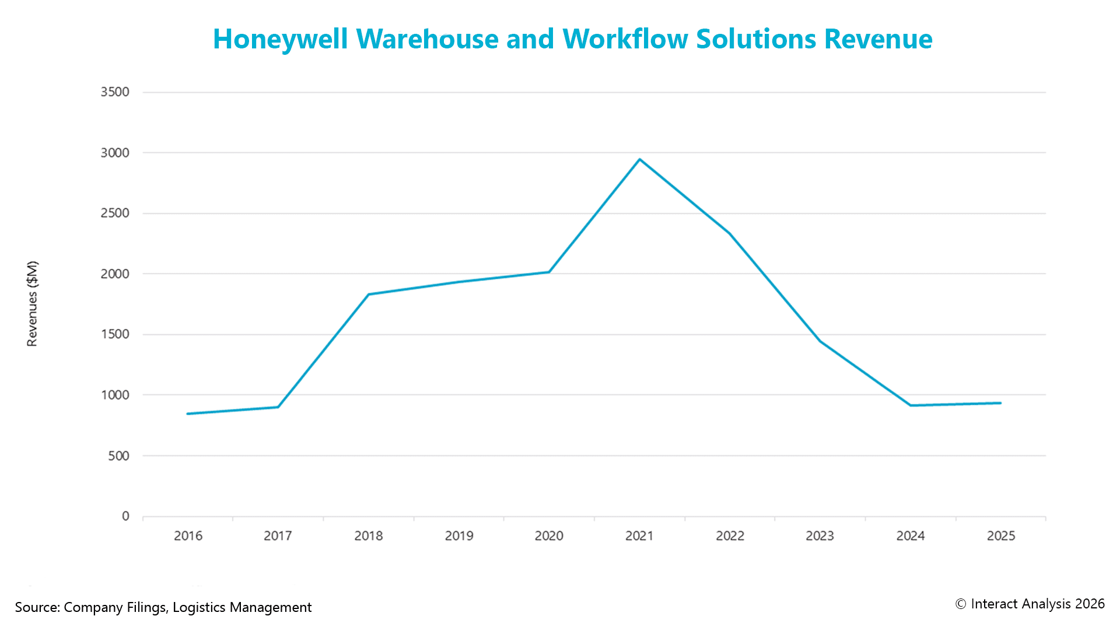
Honeywell therefore acts as a cautionary tale for over-reliance on key customers. Amazon has historically been one of the key customers for large conveyor companies, presenting both risks and opportunities. With Amazon’s new One MHS initiative, aimed at standardizing the hardware, software, and controls used in its fulfillment centers, automation vendors face even heavier commoditization. This approach eliminates lock-ins, proprietary software, and service opportunities (as Amazon technicians will be trained on a single operating standard, making it far easier to service in-house).
It’s not precisely clear what AIP paid for Honeywell’s WWS group. However, we can assume that AIP likely bought the WWS group at a discount given the significant growth contraction, coupled with the fact that the operating group was publicly stated as an ‘asset held for sale’, increasing AIP’s negotiating power. Furthermore, Honeywell reported an impairment charge related to the PSS and WWS to the tune of ~$350 million (although it’s unclear how much was attributed to WWS).
Going full circle
AIP’s previous acquisition of TREW Automation (TREW) was likely a key driver for the decision to acquire Intelligrated (and Transnorm). Ironically, TREW was founded by ex-Intelligrated employees and we’ve heard many Intelligrated employees have since jumped ship to join TREW.
TREW was founded in 2019, quickly acquiring Hilmot (a motorized roller conveyor manufacturer) and Tech King Operations (a warehouse software and controls specialist). The company positions itself as a pure-play system integrator, bringing together multiple third-party equipment (along with its in-house conveyors) using its proprietary software solutions.
|
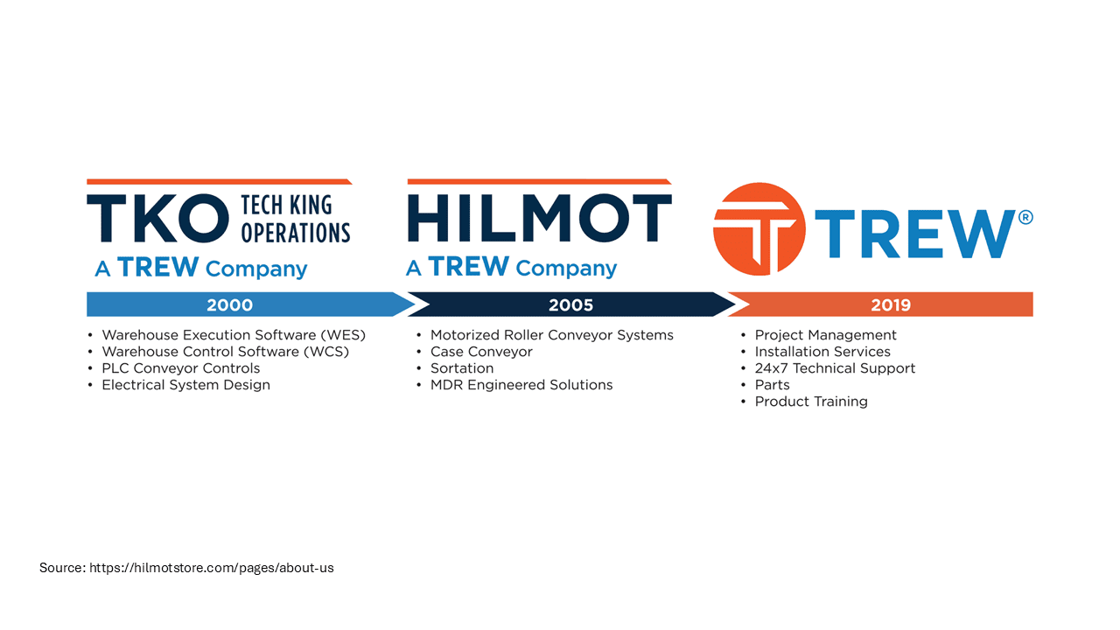
The merging of Intelligrated and TREW won’t necessarily fill portfolio gaps. Indeed, Intelligrated’s key offerings are its conveyor and sortation products, along with its Momentum software suite, mirroring both Hilmot and TKO’s core offerings respectively. Therefore, the key synergy is likely to be scale, particularly around the installed base, conveyor production, and integration capabilities.
How can AIP be successful?
For AIP to be successful, it can’t fall into the same trap that Honeywell did. This is particularly true around customer concentration, which we’ve heard anecdotally was a key issue for Honeywell Intelligrated. Amazon, for example, has significantly increased its spending on automation since 2024, but its spending volatility, coupled with its increased pricing pressure from the One MHS initiative, will be a significant risk to future growth and profitability.
Furthermore, with more plug-and-play equipment, integration is becoming commoditized as it becomes easier to install equipment, lowering the barrier to entry. Therefore, software is going to be the key differentiator. How well AIP is able to bring together TREW’s software and controls with Intelligrated’s Momentum suite is going to dictate the success of the synergy.
AIP could go one step further by acquiring or developing a pure-play/stand-alone WES solution that has a true resource agnostic/multi-agent approach. This would hedge against a future driven more by robotics than by mechatronics. Dematic, for example, recently announced it would be partnering with GreyOrange, integrating its GreyMatter software solution into its portfolio. While this is a partnership, it nonetheless highlights the direction of travel.
To this end, we believe AIP should separate software and steel for its go-to-market strategy. One of TREW’s core competitive advantages is its pure-play integrator model, with the ability to ‘stitch’ together multiple systems from different OEMs (illustrated by the diagram below).
|
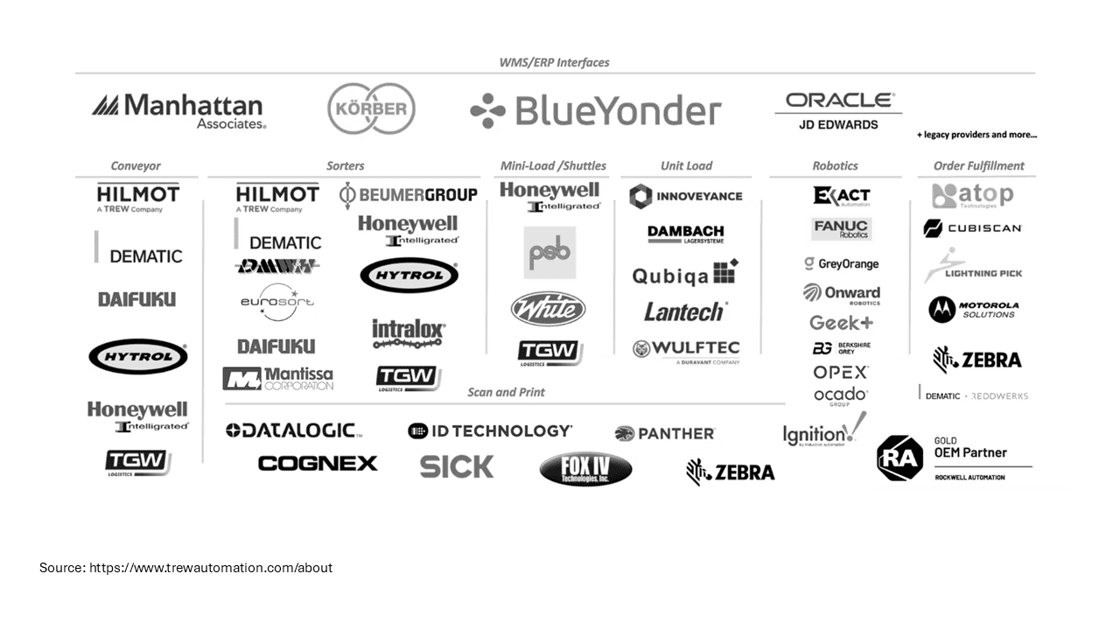
By acquiring Intelligrated, it has the potential to effectively dilute TREW’s agnosticism towards hardware. Through a separate go-to-market strategy (and potentially branding) for both its integration and software capabilities, as well as its hardware OEM business, the company could avoid any value proposition ambiguity. As an example, Momentum could transition to TREW, while Hilmot’s conveyor offering could be brought under the Intelligrated banner.
Final thoughts
Over the last three months, we’ve seen a flurry of M&A activity as the market recalibrates ahead of its next phase of growth. Understanding where the opportunities lie and where the traps exist is paramount for success.
Our extensive portfolio of research covering the warehouse automation market can help ensure you’re prepared for the next evolution of market development. To learn more about our research, contact us today.