
Felling Trailers appoints Klimek as Quality Assurance Manager
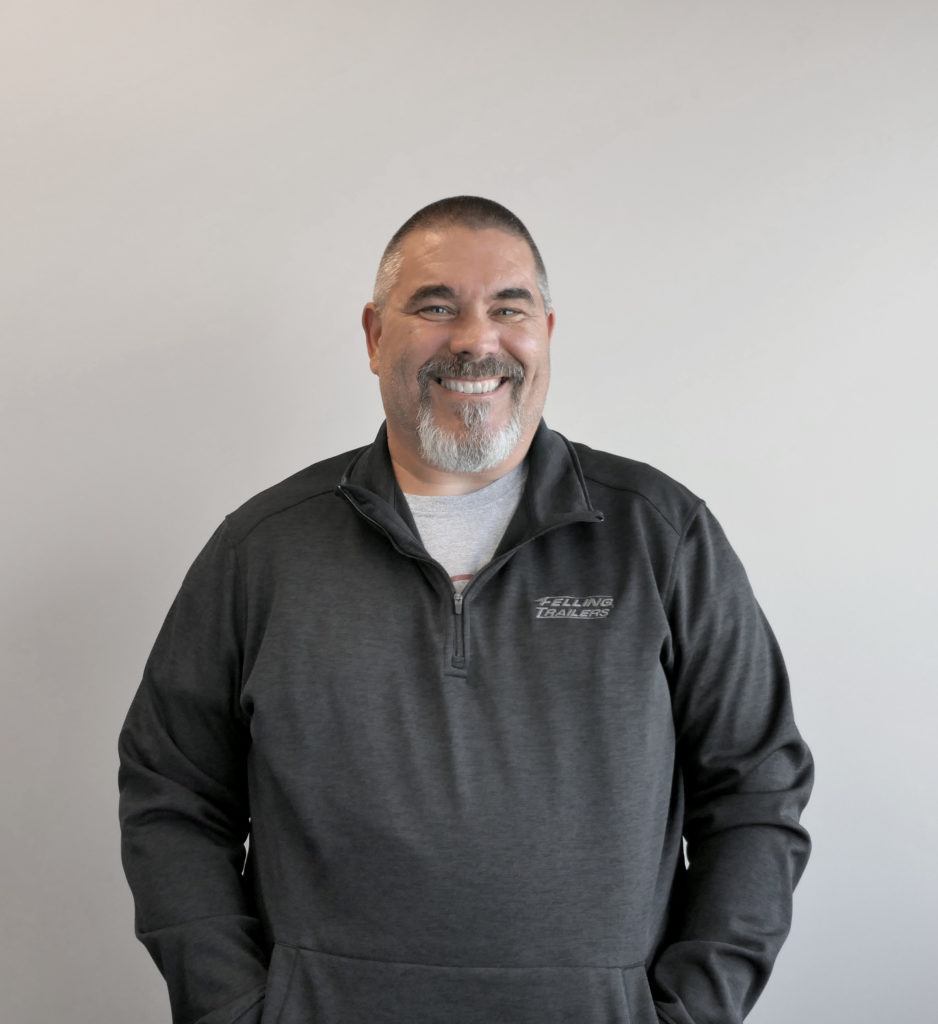
Felling Trailers Inc., a national manufacturer of industrial and commercial trailers, recently appointed Dan Klimek to the role of Quality Assurance Manager over both production facilities (Sauk Centre and Litchfield, MN). Along with Quality Management, he will oversee weld production for the Litchfield manufacturing facility as the Production Manager. As the Quality Assurance Manager, Dan will continue developing, directing, controlling, and managing the installation and maintenance of the company’s quality assurance programs. Felling Trailers, Inc. originally obtained its ISO 9001 Certification for Quality Management in 2017 and continues to maintain certification. Dan and his team of Quality Assurance Inspectors work diligently to ensure that all stages of the build process meet company quality standards to provide a final product that will exceed the customers’ expectations. In the role of Litchfield Production Manager, he will work with the production team to implement new processes and technologies to reduce lead time and increase team productivity. Klimek brings over 30 years of manufacturing, quality control systems, and processes to his position. Before accepting the Quality Assurance and Production Manager positions with Felling Trailers, Dan held a similar collection of roles with Polar Tank Trailers, LLC (Ople, MN) for over a decade. Most recently, he was the General Manager for Polar Tank Trailers’ Minnesota Trailer Operations (Production Manager and Quality Manager) for the last six years. “Dan brings an extensive background in quality control and lean manufacturing. We are excited to have him as part of the Felling Trailers’ team and to see the positive impact he will bring to our production and quality assurance processes,” said Brenda Jennissen, CEO/Co-Owner of Felling Trailers. “To be able to add an individual of Dan’s class and expertise is a huge win for Felling Trailers, I look forward to working with him,” said Paul Radjenovich, VP of Operations. “I am glad to be a part of the company in production and quality assurance capacities. I look forward to the journey ahead along with the challenges and successes it will bring,” said Dan.
U.S. Rail Traffic for November and the week ending December 3, 2022

The Association of American Railroads (AAR) has reported U.S. rail traffic for the week ending December 3, 2022, as well as volumes for November 2022. U.S. railroads originated 1,162,736 carloads in November 2022, down 0.9 percent, or 10,437 carloads, from November 2021. U.S. railroads also originated 1,230,291 containers and trailers in November 2022, down 5.4 percent, or 70,107 units, from the same month last year. Combined U.S. carload and intermodal originations in November 2022 were 2,393,027, down 3.3 percent, or 80,544 carloads and intermodal units from November 2021. In November 2022, eight of the 20 carload commodity categories tracked by the AAR each month saw carload gains compared with November 2021. These included: crushed stone, sand & gravel, up 8,726 carloads or 9.2 percent; motor vehicles & parts, up 5,372 carloads or 8.3 percent; and all other carloads, up 2,579 carloads or 10 percent. Commodities that saw declines in November 2022 from November 2021 included: chemicals, down 17,608 carloads or 10.3 percent; grain, down 3,757 carloads or 3 percent; and pulp & paper products, down 1,993 carloads or 7.2 percent. “Thanksgiving week is one of the lowest volume weeks of the year for rail traffic, which means November rail volumes frequently do not clearly demonstrate underlying sequential trends,” said AAR Senior Vice President John T. Gray. “As has been the case for months, some sectors continue to show strength while others face headwinds. For example, relatively slow lumber carloads are consistent with the weak market for new home construction. Conversely, rail hauled motor vehicles and vehicle parts volumes have been rising as automakers have increased output thanks to greater parts availability.” Excluding coal, carloads were down 12,153 carloads, or 1.4 percent, in November 2022 from November 2021. Excluding coal and grain, carloads were down 8,396 carloads, or 1.2 percent. Total U.S. carload traffic for the first 11 months of 2022 was 11,134,112 carloads, up 0 percent, or 4,475 carloads, from the same period last year; and 12,552,267 intermodal units, down 4.8 percent, or 637,473 containers and trailers, from last year. Total combined U.S. traffic for the first 48 weeks of 2022 was 23,686,379 carloads and intermodal units, a decrease of 2.6 percent compared to last year. Week ending December 3, 2022 Total U.S. weekly rail traffic was 495,472 carloads and intermodal units, down 6 percent compared with the same week last year. Total carloads for the week ending December 3 were 241,307 carloads, down 5.4 percent compared with the same week in 2021, while U.S. weekly intermodal volume was 254,165 containers and trailers, down 6.7 percent compared to 2021. Three of the 10 carload commodity groups posted an increase compared with the same week in 2021. They were coal, up 475 carloads, to 69,107; motor vehicles and parts, up 229 carloads, to 15,044; and farm products excl. grain, and food, up 94 carloads, to 17,709. Commodity groups that posted decreases compared with the same week in 2021 included chemicals, down 10,232 carloads (see below for details), to 28,290; grain, down 2,018 carloads, to 26,212; and forest products, down 901 carloads, to 9,666. Note: Chemical carloads in week 48 were impacted by a one-time make-whole adjustment by a major railroad that incorporated downward revisions in chemical carloads on that railroad for many previous weeks. The net result was a several-thousand reduction in chemical carloads in week 48 compared to a typical week. North American rail volume for the week ending December 3, 2022, on 12 reporting U.S., Canadian and Mexican railroads totaled 344,150 carloads, down 0.6 percent compared with the same week last year, and 333,927 intermodal units, down 2.8 percent compared with last year. Total combined weekly rail traffic in North America was 678,077 carloads and intermodal units, down 1.7 percent. North American rail volume for the first 48 weeks of 2022 was 32,505,576 carloads and intermodal units, down 1.9 percent compared with 2021. Canadian railroads reported 81,830 carloads for the week, up 15.1 percent, and 64,023 intermodal units, up 12.7 percent compared with the same week in 2021. For the first 48 weeks of 2022, Canadian railroads reported a cumulative rail traffic volume of 7,009,581 carloads, containers, and trailers, down 0.6 percent. Mexican railroads reported 21,013 carloads for the week, up 4.6 percent compared with the same week last year, and 15,739 intermodal units, up 9.8 percent. Cumulative volume on Mexican railroads for the first 48 weeks of 2022 was 1,809,616 carloads and intermodal containers and trailers, up 3.6 percent from the same point last year. To view the U.S. Rail Traffic charts, click here
November 2022 Logistics Manager’s Index Report®
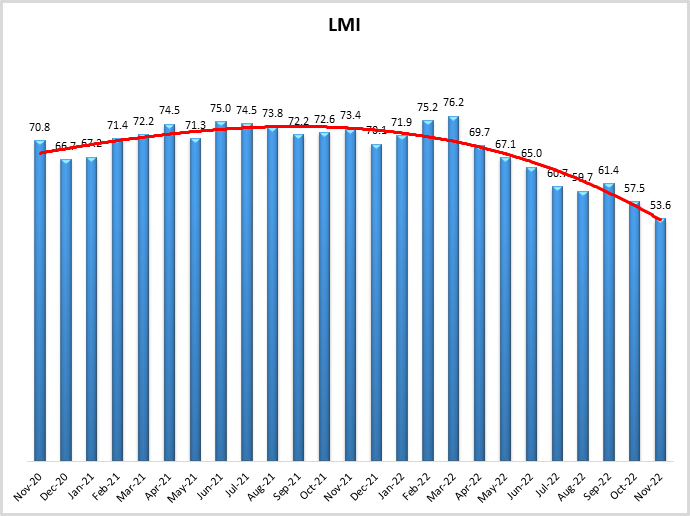
LMI® at 53.6 Growth is INCREASING AT AN INCREASING RATE for: NOTHING Growth is INCREASING AT A DECREASING RATE for: Inventory Costs, Inventory Levels, Warehousing Prices Warehousing Utilization, Transportation Capacity, and Transportation Utilization Warehousing Capacity and Transportation Prices are CONTRACTING The Logistics Managers’ Index reads in at 53.6 in November, down (-3.9) from October’s reading of 57.5. This is the third month out of the last four that the overall index has read in below 60.0. It is also the second lowest overall reading in the history of the index, only surpassing the reading of 51.3 from April 2020 at the height of COVID-19 lockdowns, however, as the rating is over 50.0, we do still register a very moderate rate of growth. In a change from what we have observed throughout 2022, inventory metrics are now settling into more sustainable rates of growth. Inventory Levels have decreased significantly, particularly for Upstream respondents. This is likely indicative of goods being positioned downstream for the holiday season, and more importantly for supply chains, being purchased by consumers. Despite the reductions in inventories, Warehousing Capacity remains tight, which in turn ensures continued expansion in Warehousing Prices. On the flip side, the transportation market continues to fall from the dizzying heights that had become the norm during 2021. This is epitomized by Transportation Prices, which read in at 37.4 – the most severe rate of contraction we have measured in the over six years of the Logistics Managers’ Index. Researchers at Arizona State University, Colorado State University, Rochester Institute of Technology, Rutgers University, and the University of Nevada, Reno, and in conjunction with the Council of Supply Chain Management Professionals (CSCMP) issued this report today. Results Overview The LMI score is a combination of eight unique components that make up the logistics industry, including inventory levels and costs, warehousing capacity, utilization, and prices, and transportation capacity, utilization, and prices. The LMI is calculated using a diffusion index, in which any reading above 50.0 indicates September and October, transportation metrics continue to be a drag on the logistics industry, while warehousing remains strong, and inventories finally begin to moderate away from the record levels reached earlier this year. The slowdown in the overall index is largely due to the long-anticipated wind-down in inventories. Our Inventory Levels metric, which came in over 80.0 in February, reads in at 54.8 in November, down (-10.7) significantly from October’s reading of 65.5. This is indicative of two things: the movement of goods downstream towards retailers, and the sale of those goods as holiday spending picks up. Spending growth remained strong to kick off the holiday season. Online consumers spent just over $35 billion during the period from Thanksgiving to Cyber Monday. This shows a significant level of growth from 2021, although it should be noted that “buy now, pay later” transactions were up considerably – perhaps underlying the ongoing inflation issues[1], [2], [3]. The growth was not limited to eCommerce, as an estimated 196.7 million shoppers headed back to stores in-person during the holiday shopping weekend. The National Retail Federation expects overall holiday sales to be up 6-8% from 2021, although some of that increase will certainly be fueled by inflation[4]. In general, consumer spending – long one of the primary drivers of the US economy – remains strong, with spending up 0.8% in October, representing the strongest increase since June. This spending may have been somewhat tempered by inflation, which while still down read in at 6% year-over-year for personal consumption expenditures[5]. This capped a third quarter in which the U.S. economy grew at a revised rate of 2.9%, a marked shift from the contraction observed in the first half of 2022[6]. At the same time, the cost of holding inventories is still expanding significantly at a level of 73.4, but at a slower rate (-7.5) than what we saw in October. This is likely the result of the shifting of inventories downstream. Some retailers like Lowe’s and Walmart have built their stores of goods up in anticipation of strong holiday spending. Some of the inventory shed by primary retailers has also trickled down to secondary market retailers like TJX and Burlington[7]. There has been a lot of effort in 2022 to run inventories down after the overages we saw early this year. It will be very interesting to observe whether or not inventories build up again in a significant way in 2023. If one was only to observe international imports, one may lean towards “not”. The slowdown in inventory imports is somewhat unprecedented. In the first week of December, the price of a 40-foot container going from East Asia to the North American West Coast cost $1,426. This is approximately a third of the cost shippers were paying as recently as mid-September, and only a fraction of the $20,000 per container average observed in 2021[8]. The PMI’s manufacturing index fell into contraction territory (at 49.0) for the first time since May of 2020. This drop was fueled by the continued drops in new orders. The PMI measure of manufacturer inventory grew at a very slow rate of 50.9[9], if this number drops below 50 and new orders continue to lag, it will be a sign that manufacturers are indeed expecting some type of slowdown. This slowdown has led to the official declaration of the end of the backup that plagued the Ports of Los Angeles and Long Beach over the last few years. January’s queue of 109 ships – ships that carried the inventory that led to this year-long glut – down to zero in the last week of November[10]. It should of course be noted that some of the slowdown in traffic in the San Pedro Bay is due to ships being re-routed to other East and Gulf Coast ports. There are also several orders that cannot be filled due to China’s zero-Covid policy. Both Volkswagen and Honda were forced to halt production at their Chinese plants due to forced lockdowns. The slowdown is being felt
Don’t fall for invoice fraud schemes

Middle-market businesses lose an average of almost $300,000 annually to invoice fraud, according to a recent survey by software company Medius and researcher Censuswide. Invoice fraud can be challenging to spot — and even more difficult to recover from — but your company can take steps to prevent it from happening. Common Types The most common type of invoice fraud is fraudulent billing. In billing schemes, a real or fake vendor sends an invoice for goods or services that the business never received (and may not have ordered in the first place). Overbilling schemes are similar. Your company may have received the goods it ordered, but the vendor’s invoice is higher than agreed upon. Duplicate billing is where a fraud perpetrator sends you the same invoice more than once, even though you’ve already paid. Employees sometimes commit invoice fraud as well. This can happen when a manager approves payments for personal purchases. In other cases, a manager might create fictitious vendors, issue invoices from fake vendors, and approve the invoices for payment. Such schemes generally are more successful when employees collude. For example, one perpetrator might work in receiving and the other in accounts payable. Or a receiving worker might collude with a vendor or other outside party. Four Steps To stop invoice fraud and perpetrators from succeeding in their schemes, take the following four steps: Conduct due diligence. Verify the identity of any new supplier before doing business with it. Research its ownership, operating history, registered address, and customer reviews, if they exist online. Also, try to find someone who has done business with the vendor and can vouch for its legitimacy. This could be a competitor or an employee who knows the supplier from working at another company. Review invoices carefully and methodically. Don’t “rubber stamp” invoices for payment. Look them over for any red flags, such as unexpected changes in the amount due or unusual payment terms. Manual alterations to an invoice require additional scrutiny, as do invoices from new vendors. If something seems wrong, contact the vendor that issued the invoice to confirm it’s legitimate. If the response lacks credibility or raises additional concerns, decline to pay until you’ve cleared up any confusion. Control the review and approval process. Implement and adhere to antifraud controls when processing invoices. For example, confirm with your receiving department that goods were delivered and check invoices against previous ones from the same vendor to ensure no discrepancies. Also, you may want to require more than one person to approve invoices for payment. Depend on technology solutions. Automating your accounts payable process can help prevent and detect invoice fraud. For example, using optical character recognition (OCR) to scan and read invoices can help ensure they’re paid on time and that the amounts and line items match the prices quoted and any documentation in your company’s financial records. OCR minimizes employee intervention and the potential to divert payments to personal accounts. It also makes collusion with vendors more difficult. If the Worst Occurs Even if you take all precautions, invoice fraud may occur. If you discover a scheme in progress, act quickly to minimize the damage. Notify your bank or credit card company to stop payment on invoices that haven’t yet been paid. And if you intend to file an insurance claim or want to pursue criminal charges, be sure to file a police report. About the Author: Steve Pierson provides clients with a wide array of technical accounting, tax, financial, estate and succession planning, employee benefits, and international tax planning expertise, as well as merger and acquisition transaction guidance. Pierson is an Executive Vice-President and Shareholder of Seldon Fox.
Propane Council hires new head of Business Development

Gavin Hale joined the Propane Education & Research Council as vice president in charge of business development, PERC President and CEO Tucker Perkins announced. In this role, Hale will help grow awareness of propane’s technological versatility in the material handling industry. “Gavin is a proven leader with a wealth of experience in new product development, a robust understanding of engine markets, and expertise in complete powertrain integration,” Perkins said. “We are excited to have him on board to help seize the opportunities ahead for our industry.” Hale arrives at PERC from Deutz Corporation, where he served as director of new power system business development and market and technology development. In this dual role, he developed and executed a five-year, $400 million business growth strategy and led an international team in developing Deutz’s first compact propane spark-ignited engine. Prior to his time at Deutz, Hale worked for Power Solutions International (PSI) as their vice president of sales. Before PSI, he had a long and successful career serving as manager for new business development at Caterpillar Machine Engines. A native of the United Kingdom, Hale has a degree in automotive engineering from Accrington and Rossendale College, Nelson and Colne Technical College, located in Nelson, Lancashire, England. He holds a Six Sigma Black Belt, as well as numerous vocational and business certifications. At PERC, Hale will bring his knowledge and experience to bear by leading business development efforts and directing the development of renewable fuel strategies for applications such as propane port tractors and forklifts. Hale will start his career at PERC working from his home in Monroe, Georgia.
JLT Mobile Computers unlocks greater operational efficiencies for warehouse forklift fleets with innovative software dashboard
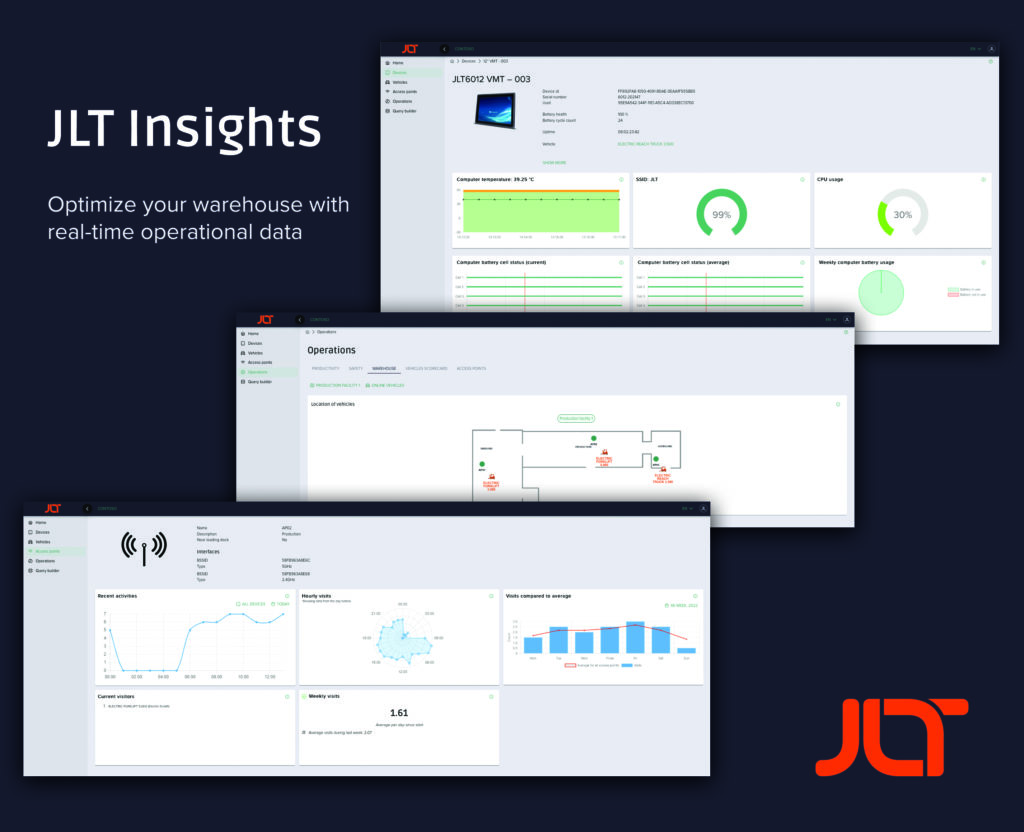
JLT Mobile Computers, a developer of reliable computing solutions for demanding environments, has launched JLT Insights, a new data-driven software dashboard for industries with warehouses. The customizable software solution enables warehouse and IT managers to monitor their vehicle-mount terminals (VMT) and gain greater operational insights. Based on various data points collected from within the IT device and its sensors, JLT Insights empowers customers to optimize the daily operations of their harsh work environments as well as their host vehicles. These new capabilities are made possible thanks to information delivered by sensors embedded in the JLT6012 Series VMTs. As well as informing users of the health of their IT assets, accelerometers and other sensors within the VMTs can deliver information relating to forklift movement, speed, acceleration, impact, location, and time. Access to this digital data opens huge possibilities for warehouse and IT managers to streamline and enhance their picking and logistic operations. By identifying bottlenecks, network connectivity issues, high-traffic areas, driving dynamics, accident-prone zones, and various IT health signals, uptime can be optimized, flow can be improved, and general operations enhanced with regards to both efficiency and safety. Impacts are a fact of life in forklift operations. But when you combine impacts with location data, you can ascertain higher safety risk areas and/or physical bottlenecks within logistic operations. Combine impacts with time and JLT Insights users can identify shift patterns, while time and location will highlight overly long local dwell times or indicate heavy traffic areas. According to Andreas Nivard, General Manager at JLT Software Solutions: “The JLT6012 Series VMTs from JLT Mobile Computers incorporate sensor technology similar to what you would find in a cellphone. By leveraging the data generated by these sensors, we are now delivering even more value-add features through software solutions. “The real power behind JLT’s new hard- and software-combined approach,” he continues, “comes from using JLT Insights to combine and contextualize the data captured via the sensors. This data can then be compared before displaying the results in an easy-to-use and -understand digital dashboard, full of useful information for warehouse and IT managers.” The software is configurable to the customer’s application. JLT engineers will help users to define which data is most useful to capture and formulate the queries which indicate the most relevant actionable information. The identified data points can be configured by JLT, local partners, or customers themselves to add the biggest operational value for continued improvement. There are multiple possibilities for operational improvement, but the primary driver behind the dashboard’s development is to increase uptime, by highlighting and predicting issues before they occur. This gives companies the ability to develop and deliver remedies before these issues turn into far more costly downtime. “The ability to spot problems before they result in downtime is a huge plus for us,” explains Fredrik Edvardsen, IT Manager at IV Produkt, a company based in Växjö, Sweden that develops and manufactures innovative solutions for air handling. “We now have proactive insights into many more operational features, including power supplies, disk space, forklift run times, and service intervals.” JLT Insights is available today for new and existing users of JLT6012 Windows 10 VMTs on a per-month and device-cost basis. “The dashboard comes in two tiers,” Andreas explains. “The first gives all the essential information from the IT and dynamics sensors, including event-based notifications, while the next tier up adds statistics and allows users to write queries that can compare and action one dataset versus another.” For new JLT6012 VMT buyers, the software will be preinstalled on the units. Existing owners can contact JLT via the website for downloading the software. In addition to the JLT6012 unit, JLT Insights can be used with other Windows 10 VMTs from JLT, albeit with limited functionality because previous generations do not include built-in sensors. Support for the Android-based JLT6012A™ VMT is in development and will be released in the first half of next year. Many more features are on the roadmap, and JLT is accepting suggestions from its user base. “We’ve worked closely with JLT in testing out the software and suggesting features as part of their pilot program,” says Martin Carlsson, Warehouse Manager at IV Produkt. “We feel like JLT has really listened to our needs and we now eagerly anticipate using JLT Insights over the next 6 months to make data-driven decisions to increase productivity in our warehouse.”
Seaga announces Chesney to step down as CEO, Freund accepts the reins

Seaga Manufacturing, Inc. (“Seaga”), a platform for innovative Automatic Retail Dispensing and Modular Intelligent Inventory Control Solutions, serving the Food and Beverage, Industrial, Water Filtration, and Healthcare Markets, announced today that its Founder and CEO, Steve Chesney, will step down as CEO. Chesney will remain Chairman of the Board of Seaga and its respective subsidiaries. Chesney founded Seaga in 1987 in a one-stall garage in Shannon, Illinois. He successfully produced and marketed an innovative vending machine design named the SuperVend 2000, which soon became an industry standard. After manufacturing thousands of vending machines in Shannon, Chesney moved its Corporate Headquarters and manufacturing facility to Freeport, Illinois, where it remains today. Seaga has grown to become a recognized leading platform for Automatic Retail Dispensing and Modular Intelligent Inventory Control Solutions, satisfying the Food and Beverage, Industrial, Water Filtration, and Healthcare markets. In 2004, Seaga acquired Karna Industries in New Delhi India, now known as Seaga India Private Ltd., positioning Seaga to supply its products to customers throughout the world. Seaga recently acquired Automated Merchandising Systems (AMS), a leading brand of Automatic Retail Dispensing equipment in North America. With this most recent acquisition, Seaga has four manufacturing facilities, in three countries, allowing it the scale to support the largest multi-national corporations in the world. “Steve has built an industry-leading company over the past 35 years which is positioned perfectly for innovation and growth, with a dedicated team of industry professionals spanning over two continents,” said Gary Partridge, President of Seaga. “Steve has been a mentor to many, and his influence has made an indelible impact on generations of professionals within Seaga and throughout our industry. I want to thank Steve for his vision to create and build a company with a lasting legacy that will prosper and excel within our marketplace.” Seaga’s Board of Directors unanimously elected Mike Freund to succeed Chesney as Chief Executive Officer of Seaga/AMS.
Waterfront shipping enters into Time-Charter Agreement with Trafigura for Methanol Dual-Fuel Vessel co-owned by Clean Sea

Waterfront Shipping, a subsidiary of Methanex, the world’s largest producer, and supplier of methanol, announced today it has entered into a time-charter agreement with Trafigura, one of the world’s largest physical commodity trading groups. Under the agreement, Trafigura will operate the co-owned Waterfront Shipping and Clean Sea medium-range product tanker, Mari Innovator, as part of its global network of vessels used in clean products trading routes. This agreement supports the parties’ efforts to help transition the marine shipping industry toward decarbonization and is another example of Waterfront Shipping’s leadership in supporting the growing demand for methanol as a marine fuel. “We’re pleased to partner with Trafigura to share our global experience and knowledge with operating and bunkering vessels using methanol fuel technology,” said Paul Hexter, President of Waterfront Shipping. “Trafigura plays a vital leadership role in the energy transition and for it to recognize that methanol marine fuel offers a clear pathway towards a low carbon shipping industry will help build the platform to drive change.” Waterfront Shipping is pioneering the use of methanol as a marine fuel and as the world’s largest operator of methanol dual-fuel vessels, has accumulated over 123,000 operating hours, demonstrating the simplicity and safe use of methanol as a cleaner burning marine fuel. Today, Waterfront Shipping has 18 methanol dual-fuel vessels, with one additional vessel arriving by the spring of 2023, representing approximately 60 percent of its 30-vessel fleet. Trafigura’s shipping and chartering operations are managed out of key regional hubs in Athens, Geneva, Houston, Lima, Montevideo, and Singapore, providing 24/7 coverage of freight and physical commodity markets. “We’re advocating for industry-wide action on shipping emissions and investing in new technologies and vessels to help achieve a more sustainable shipping industry,” said Andrea Olivi, Head of Wet Freight for Trafigura. We’re excited about the cooperation with Waterfront Shipping and Clean Sea as we explore and learn also how methanol technology can integrate with our fleet to achieve our carbon intensity reduction goal of 25 percent by 2030 across our entire chartering operation.” “As a cleaner-burning marine fuel, conventional methanol already meets the International Maritime Organization’s (IMO) pollutant emissions regulations, significantly reducing sulfur oxides by 99 percent, nitrogen oxides by up to 80 percent, and particulate matter by 95 percent compared to heavy fuel oil. Methanol is also liquid at ambient temperature, safe, easy to handle, widely available, fully compliant with IMO Tier III regulations, and can be produced from renewable sources—offering a clear transition pathway to decarbonization,” added Paul Hexter. Modi Mano, CEO at Clean Sea Transport, said, “The Mari Innovator is our third-generation dual-fuel vessel and offers a number of advantages to Trafigura including the flexibility to diversify fuel options or consume methanol for potential cost savings. It is equipped with the latest technological innovations and fuel consumption is particularly low for a medium-range tanker.”
Secro wins approval from the International Group of P&I Clubs
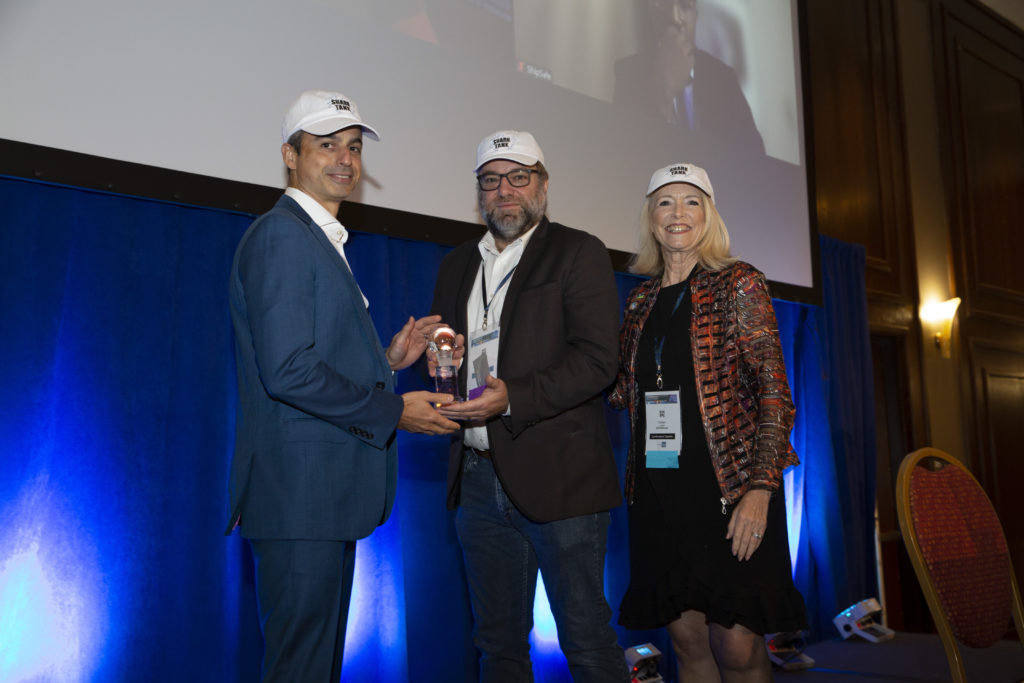
The transformational electronic platform provides speed and security The International Group of P&I Clubs (the Group) added Secro as an approved electronic bill of lading provider. Established in 2021, Secro is an independent technology company helping buyers and sellers of bulk commodities to digitize their core business workflows and optimize working capital. Approval by the Group ensures that liabilities arising with respect to the carriage of cargo under such paperless trading are covered. The legal documentation and terms of use associated with the use and operation of the Secro system, as well as the Secro electronic bill of lading, were reviewed and approved by the Group. Secro, which is a proud member of BIMCO, provides a frictionless digital trade documentation platform that is safe, trustable, and seamless. The customer is onboarded to the Secro platform with a nimble click-through process and can collaborate with its trading partners in minutes. Internal due diligence is simplified by robust yet concise terms of use and conditions of carriage. Further, the Secro platform enables the customer to invite its trading partners on the platform, for free, just by sharing a secure link at any given stage of the transaction, allowing unprecedented flexibility. Secro Co-Founder and CEO, Michele Sancricca stated: “Our customers asked us to build a platform to easily create securely exchanged electronic bills of lading with anyone in the world without the need for cumbersome private agreements. This innovative approach delivers the ease of adoption that legacy providers did not achieve.” Truly viable electronic bills of lading, able to replace traditional paper-based documents, have been a chimera for decades. Thanks to Secro proprietary technology’s compliance with the latest digital trade laws, for the first time the adoption of electronic bills of lading really offers speed, security, and cost savings. With Secro’s ease of use and the Group’s approval, traders, shippers, banks, and ship owners can digitally transact with confidence. Sancricca wants the maritime community to appreciate that this is just the beginning for Secro. “Secro E-bill of lading is only the first product we are launching in this arena. Customers will find in Secro a one-stop-shop to digitize their end-to-end trade workflows.” At SHIPPINGInsight 2022, Secro received the organization’s Innovation Award by securing the most support from investors and shipowners in the SHARK TANK. Secro is currently available to selected customers with the public launch expected during Q1 2023.
MHS Lift receives President’s Award from UniCarriers

MHS Lift, Inc., a provider of warehousing and distribution solutions across the U.S. and Canada, was recently honored with the highly coveted 2021 UniCarriers President’s Award. The President’s award is presented annually to the No. 1 performing UniCarriers dealer throughout the Americas. This year’s celebration was held in Sea Island, Georgia. MHS Lift is also a three-time winner in three years (2019, 2020, 2021) of the UniCarriers Premier Club Award, which is given annually to the Top 10 UniCarriers dealers throughout the Americas. Recipients of the Premier Club Award were evaluated based on six categories – new equipment sales, market penetration, aftermarket parts sales, service expertise, overall performance, and professionalism. “We’re beyond proud to receive this prestigious award, and credit our dedicated team of associates for delivering exceptional service to our growing customer base,” said Andy Levin, President and Co-Owner, MHS Lift. “What an honor it is to be singled out by UniCarriers!” said Brett Levin, Vice President and Co-Owner, MHS Lift. “Despite the ever-changing economy, MHS Lift continues to go above and beyond as a dependable UniCarriers dealer.”
Episode 338: UgoWork at MODEX 2022
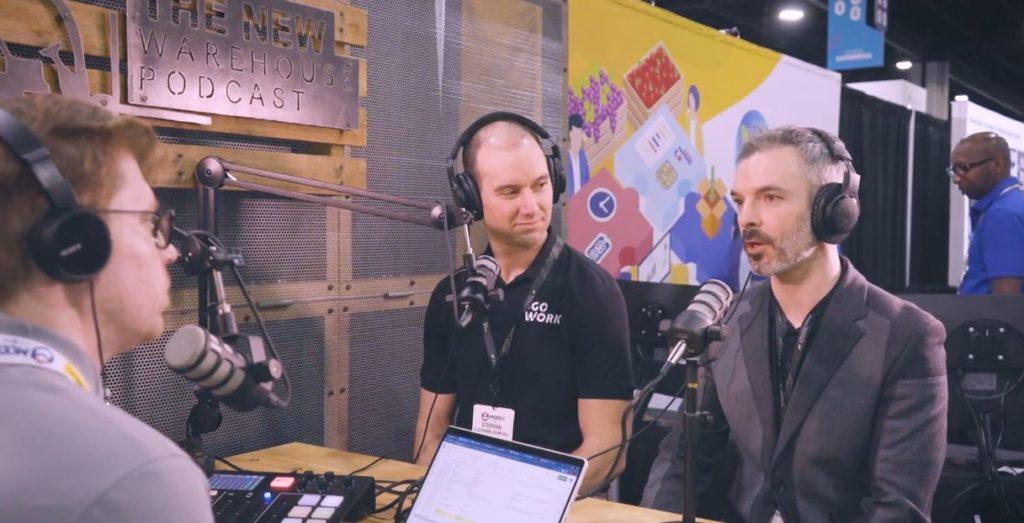
The New Warehouse Podcast welcomes Stephan Dumont and Jean-Francois Marchand from UgoWork. Based out of Canada, UgoWork manufactures lithium-ion batteries for the material handling industry. They provide a full range of UL-listed lithium-ion batteries designed for multiple classes of forklifts. On today’s show, Kevin and his guests discuss energy as a service and the advantages of switching from lead-acid to lithium-ion batteries. If you are wondering if lithium-ion is the right fit for your operation, give this episode a listen. Key Takeaways For material handling, switching to lithium-ion batteries involves questions about power and performance. Stephan explains how UgoWork starts learning the customer’s pain points to identify the proper solution. He adds many companies are looking to reduce maintenance time and energy consumption and achieve carbon-neutral objectives. Making the switch to lithium-ion power can help achieve these goals. Regarding return on investment(ROI), Stephan shares how the ROI for lithium-ion accelerates the more shifts you have. He adds that while the upfront cost of lead-acid batteries is cheaper than lithium-ion, the benefits quickly outweigh the price in the proper setting. Reducing maintenance, downtime, labor, and carbon footprint make lithium-ion batteries a better long-term option, especially when running at least two shifts. At this year’s MODEX show, UgoWork displayed its entire lineup of twenty-four, thirty-six, and forty-eight-volt lithium-ion batteries. Stephan shares how UgoWork differentiates itself through its unique charging infrastructure that is the same for all its batteries. The simple-to-use charging feature is very popular with their customers. Another differentiator is the intelligence of the UgoWork batteries. With each battery having a battery management system (BMS), customers can use data to improve performance and equipment usage. UgoWork also monitors the batteries 24/7 to ensure they operate in perfect condition. Stephan adds that if something happens to the battery, UgoWork knows before the customer, reducing downtime. They use data to provide their customers with insights to help them optimize power and equipment usage. The New Warehouse Podcast EP 338: UgoWork at MODEX 2022
AWRF names Caldwell’s Ferchen to Board
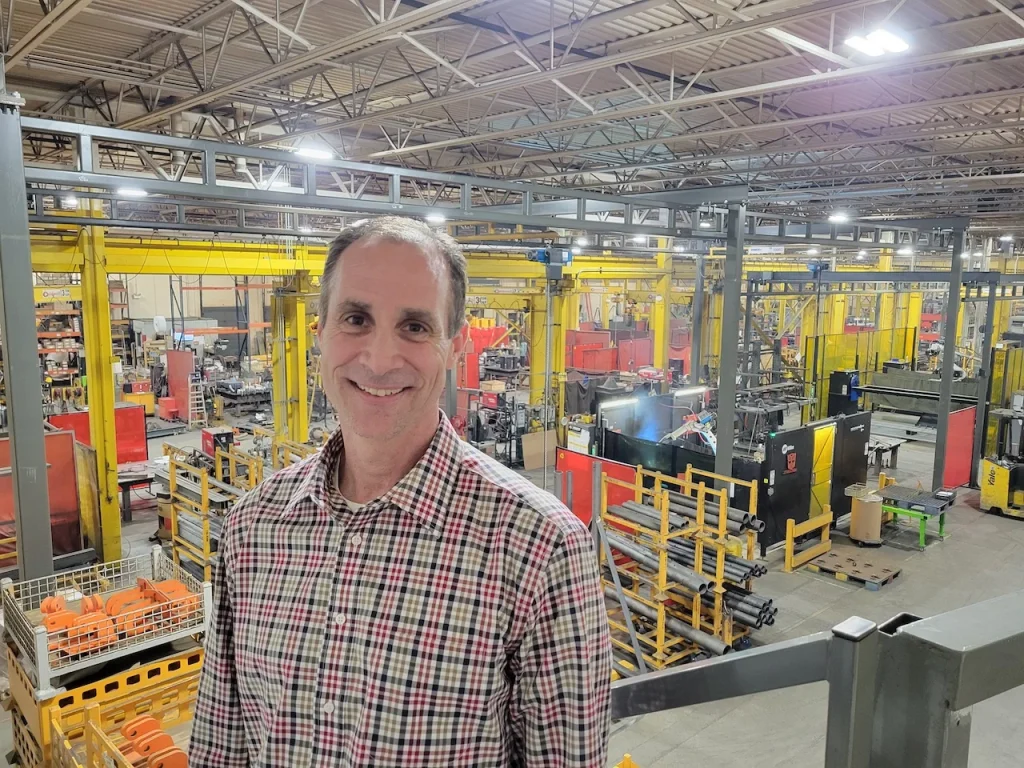
Associated Wire Rope Fabricators (AWRF) has named The Caldwell Group Inc.’s Director of Business Development Jeff Ferchen to the board of directors. It represents a return to the AWRF board for Ferchen, who previously served from 2015 to 2017. AWRF serves the lifting, rigging, and load securement industry by advancing interests common among its member companies. The association helps create and share technical information, promotes safety standards, and helps develop product identification procedures. Ferchen will serve on the New Member Committee. Ferchen, who joined Rockford, Illinois-based Caldwell, last year, said: “I am proud to represent both Caldwell and the wire rope, rigging, and lifting industries in this new, yet familiar, role. The good work performed of our board and the active participation of our membership make the industry stronger.” He continued: “AWRF is where all the industry experts work to get technical information and help drive overhead lifting standards.” Ferchen delivers a wealth of experience to the board, having spent more than two decades in the rigging industry at several large manufacturing companies and channel partners positioned closer to the point of use. Ferchen is a regular at AWRF’s 18-monthly Product Information Exhibition (PIE) and has worked with various committees during his career. Ferchen and other new board members attended AWRF’s Fall Meeting in Philadelphia, Pennsylvania, in October, and will next meet in Scottsdale, Arizona, in January 2023 for their first official board meeting.
Combilift launches The Elf Before Christmas

Ireland-based Combilift just released its annual Christmas video. This year the video release is named The Elf Before Christmas. The story is based around a magical elf who is determined to cause chaos in the Combilift factory, but the question is; how will the employees get Christmas back on track? What makes this Christmas video stand out from many others is that it has been created entirely in-house at Combilift’s headquarters, a forklift manufacturing facility in Ireland. At a total cost of under €800, it’s a tiny fraction of the budget that major retailers allot to this type of seasonal advertising. The cast was chosen from the 750 employees, with of course special thanks to our budding child star Saoirse for her guest appearance and magical charm! Combilift started to produce their own holiday videos during lockdown to help boost staff and customer morale, and they have been so popular that they are now a much-awaited feature of the Combilift calendar – you could say they have snowballed! Happy Christmas and New Year from Combilift.
Lincoln Electric completes acquisition of Fori Automation LLC

Lincoln Electric Holdings, Inc has announced that it has completed the previously announced acquisition of Fori Automation, LLC (“Fori”) and closed on a $400 million senior secured term loan to partially fund the acquisition. “We are excited to welcome Fori into Lincoln Electric and expand our leading portfolio of automation solutions and engineering expertise to advance customers’ productivity needs,” stated Christopher L. Mapes, Lincoln’s Chairman, President and Chief Executive Officer. “The transaction brings together two innovative organizations who are guided by similar values and follow a ‘customer-first’ approach.” Mapes continued, “The acquisition increases our annualized automation portfolio revenue to over $850 million as we advance towards our Higher Standard 2025 Strategy $1 billion target and our added scale allows us to better serve customers’ growing automation demands across different end markets.” The acquisition’s operating results will be reported in Lincoln Electric’s first quarter 2023 financials, with approximately 75% of Fori’s revenue reported within the Americas Welding Segment and the balance in International Welding. The acquisition is expected to be accretive to Company earnings, excluding transaction costs, at approximately $0.12 to $0.15 per diluted common share on an annual basis in 2023.
Senate votes to avert rail strike, conclude bargaining round
The Senate voted on an overwhelmingly bipartisan basis to avert a rail strike and implement tentative agreements reached between railroads and workers. Over the course of the contract, average railroaders will receive a $16,000 immediate payout and increase wages and benefits to $160,000 per year. “The Senate acted with leadership and urgency with today’s vote to avert an economically devastating rail work stoppage,” said AAR President and CEO Ian Jefferies. “As we close out this long, challenging process, none of the parties achieved everything they advocated for. The product of these agreements is a compromise by nature, but the result is one of the substantial gains for rail employees. More broadly, all rail stakeholders and the economy writ large now have certainty about the path forward. “Let’s be clear railroading is tough, essential work that keeps our nation moving, and our employees deserve our gratitude for moving America’s freight and doing so safely every day. The gains in this agreement are significant, including historic wage increases, best-in-class healthcare, and meaningful progress in creating more predictable, scheduled work shifts. Without a doubt, there is more to be done to further address our employees’ work-life balance concerns, but it is clear this agreement maintains rail’s place among the best jobs in our nation.” Among other things, the contracts now in place will: Provide a 24 percent wage increase during the five-year period from 2020 through 2024, including an immediate payout on average of $16,000 upon ratification. Include $5,000 in performance bonuses, with total average annual pay and benefits reaching $160,000 by the end of the contract period. Maintain some of the best healthcare plans in the nation. Provide an additional paid personal leave day per year. Continue to provide multiple options for time off and, for those employees who operate trains, the agreements include enhanced abilities to schedule time off and local agreements to be finalized after the ratification of the national agreement will further enhance the quality of life and the predictability of schedules. The industry would like to thank all unions involved in negotiations for their efforts and commitment to advancing the best interests of their members. In addition, railroads appreciate the Biden Administration, especially Secretary of Labor Marty Walsh, Secretary of Transportation Pete Buttigieg, Secretary of Agriculture Tom Vilsack, National Economic Council Director Brian Deese, and the members and staff at the National Mediation Board, for their leadership and assistance throughout negotiations.
Why you’re waiting longer for a forklift – and what to do about it

While the COVID-induced supply chain backlog is loosening up, not all warehouses have been able to return to normal – especially if they’re in the market for new materials handling equipment. Businesses looking to purchase new forklifts in particular are being quoted some eyebrow-raising lead times. Electric forklift lead times are running close to normal, about 35 weeks, but internal combustion forklifts, which would usually take 25-30 weeks, are taking 40-45 weeks. Perhaps the most astonishing wait: narrow aisle equipment, which often takes about 35 weeks, might take two years to arrive according to Kenco Group data. This logjam has led to soaring prices and headaches in the warehouse, as managers try to maintain their current fleet as long as possible. Here’s a look into the factors that are causing the shortage, what to expect in the coming months, and how to navigate the shortage while continuing to meet customer demand. What’s lifting wait times? Supply chains might assume that COVID is the culprit – and they’d be partially right. But that’s only scratching the surface. There are actually four factors that are contributing to the longer lead times: The COVID Shift. Consumers were already relying heavily on e-commerce prior to the pandemic, but purchases via digital storefronts skyrocketed in 2020. As warehouses rapidly replaced physical stores as the last touchpoint before the customer, warehouses began ordering additional forklifts to meet demand. The Chip Shortage. As forklift manufacturers tried to keep up with demand, they ran into a different backlog – microchips – slowing down the process even more. And with demand rising for electric vehicles, there is greater competition for the precious few microchips, making this backlog far from fixed. The EPA Violation. In early 2021, the EPA announced Toyota – the parent company of Toyota Material Handling, Inc., a forklift manufacturer – had been non-compliant with EPA reporting guidelines around emissions-related defects. The fallout rippled across Toyota’s businesses, and because Toyota Material Handling struggled to obtain engine emissions certifications later that year, production was temporarily halted. It has since restarted, but the manufacturer is still catching up on orders. The Big Buy. Here’s why narrow aisle equipment is taking so long to arrive: a major e-commerce company recently placed a sizeable order, in the tens of thousands, for new trucks – something that wouldn’t typically complicate the supply chain, but has been magnified because of COVID and Toyota’s manufacturing challenges. What will this cost me? The scarcity of materials to manufacture forklifts, compounded by inflation, means the forklift backup will likely give your wallet headaches as well. The cost of a new forklift is up about 27% from two years ago, and used forklifts have almost doubled in price. And as the Fed continues to fight the 8.3% inflation rate by raising interest rates, a forklift lease will currently involve a 7-7.5% interest rate, up 3-3.25% from normal. Inflation has had a significant impact on all areas of the forklift manufacturing process, from wages to raw materials. Steel, copper, and lead are particularly expensive at the moment; lead, which is especially important in the development of microchips for electric forklifts, has gone up in price because of U.S. tariffs on raw materials imported from China. How Do I Respond? Unfortunately, it’s likely warehouses – especially those looking for more specialized equipment – aren’t going to see resolutions for these challenges in the near term. It’s important for warehouse managers to closely maintain their current fleet while they wait for their new vehicles. That means preemptively buying various replacement parts well in advance, as these parts will also be in high demand. The best option for fulfillment centers is to closely monitor the utilization of their equipment. Different forklifts can run for varied cycle lengths before they need significant maintenance; keeping track of these timeframes can ensure warehouse managers perform maintenance in the correct cadence and optimize the forklift’s life expectancy. Alternatively, warehouses can invest in telematics software that will keep track of forklift utilization automatically, taking any guesswork out of when forklifts should be serviced. What’s Next? While new developments such as the Chips and Science Act, which increases U.S. investment in microchip manufacturing, could help ease some of the forklift backlogs, its likely warehouses will continue to endure long lead times and higher prices throughout 2023. That’s why due diligence with existing forklifts will be critical for warehouses and distribution centers looking to weather the shortages. With a combination of proactive maintenance and advanced software, supply chain managers can ensure the most efficient use of their equipment on hand. About the Author: Allen Polk is the Vice President of Sales for Kenco Group, with 20+ years of experience in sales and business development in the material handling industry. His responsibilities at Kenco are managing day-to-day sales operations and client relationships, technology development and integration and white label product management. From the beginning, Polk has always had a passion for creating meaningful client relationships, supporting team members and earning success for his clients. Prior to Kenco, Polk worked at Caterpillar in sales and business development. He attended Mercier University, receiving his Bachelors in Business Administration.
AAFA applauds Congressional action to thwart potential U.S. economic recession

The American Apparel & Footwear Association commends the cooperation of the White House and Congress this week to avoid a freight rail strike, which would have cost the U.S. economy $2 billion per day. A rail strike would have led to a loss of 700,000 American jobs and a four percent increase in inflation, which would have likely tipped the U.S. economy into a recession. “At a time of U.S. economic fragility, it is critical for the U.S. government to help America’s supply chains re-stabilize. We thank President Biden and House and Senate leaders for their leadership and we applaud every Representative and Senator who voted this week to stop a rail strike and save the U.S. economy. We urge President Biden to sign H.J. Res 100 into law as soon as possible,” says AAFA President and CEO Steve Lamar. “In June, Congress also successfully passed the Ocean Shipping Reform Act of 2022 (OSRA) as a huge leap forward towards supply chain resiliency. This is the type of bipartisan efficiency and progress that Americans expect to see every day. “Improving the resiliency of our supply chains remains of the utmost importance. We must protect American companies from price gouging in the global shipping industry and we must fix fundamental issues that continue to cause delays and bottlenecks. Further, it is imperative that all logistics stakeholders continue to work together to support modern and efficient systems, and ensure there are safe and responsible workplaces that power them.” Today’s Senate vote follows two Key Vote letters that AAFA delivered to the House on November 30 and Senate on December 1, as well as a letter from more than 400 organizations sent on November 28.
Wreaths Across America announces major donation from Jersey Mike’s Subs and issues challenge to the public
Now through December 14, every $15 Veteran Wreath Sponsorship made for placement at Arlington National Cemetery will be matched by the company up to $300,000 Today, national nonprofit Wreaths Across America (WAA) is proud to announce that Jersey Mike’s Subs, a fast-casual sub sandwich franchise with more than 2,300 locations nationwide, has made a $300,000 donation and issued a challenge to help raise funds to sponsor veterans’ wreaths for placement at Arlington National Cemetery. Through this generous donation, Jersey Mike’s has once again stepped up to help WAA reach its goal of placing a live balsam remembrance wreath at the headstone of every one of the nation’s veterans buried at Arlington National Cemetery. Starting today, Dec. 1, through Wed., Dec. 14, 2022, every $15 wreath sponsorship made at www.wreathsacrossamerica.org/JerseyMikes will be matched by the company, up to $300,000. Since 2010, Jersey Mike’s has supported WAA’s mission with contributions totaling more than $3 million dollars. Last year, across the country more than 2.4 million sponsored veterans’ wreaths were placed in honor of veterans, including on all the markers of those buried at Arlington National Cemetery. Jersey Mike’s franchisees across the country support the year-long mission to Remember, Honor, and Teach, through a variety of programs. “Experiencing the placement of a wreath, and knowing the impact that one simple action has for so many, is truly meaningful,” said Peter Cancro, founder and CEO, Jersey Mike’s Franchise Systems, Inc. “The thought of a headstone being left bare is unimaginable and we want to help make sure that doesn’t happen.” For more information about participating at Arlington on National Wreaths Across America Day – this year, Saturday, Dec. 17, 2022 – please visit www.wreathsacrossamerica.org/ARLING. To find a participating location near you to support or to learn how you can volunteer locally in your community click here. “The veterans we honor committed themselves unselfishly at the most critical moments in our nation’s history,” said Karen Worcester, WAA’s executive director. “The generous support of the wonderful people at Jersey Mike’s ensures that we will be able to fulfill our mission in remembrance of these brave men and women.”
Brass Knuckle® application-specific protective gloves are easy to source
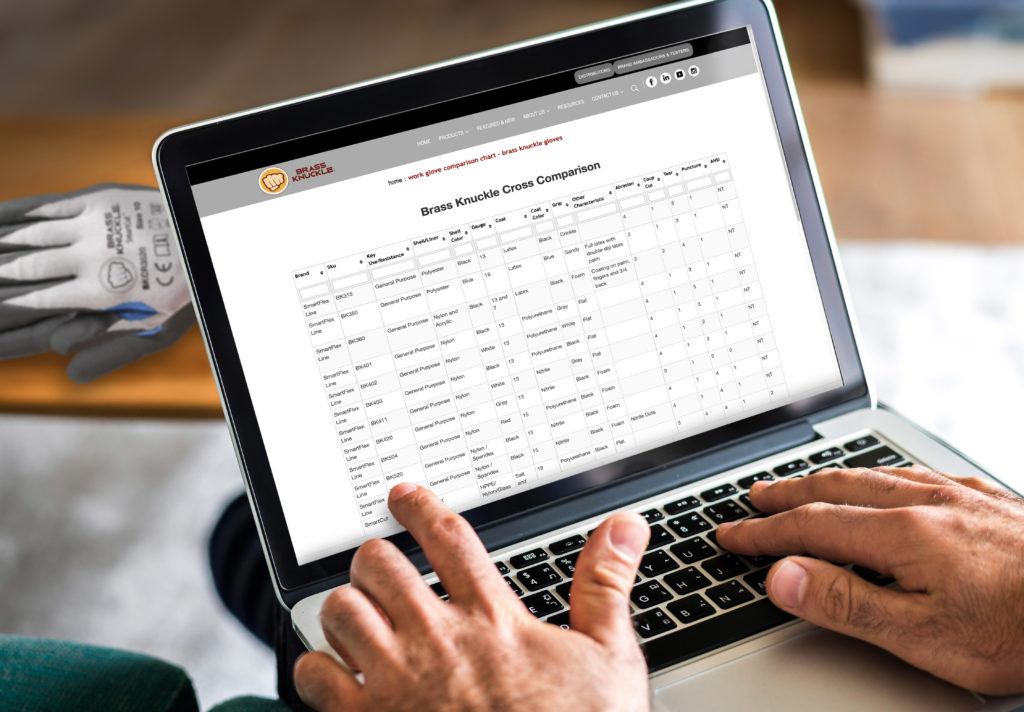
The hand is the leading body part injured at work and treated in hospital emergency departments, with acute hand and finger injuries sending over one million workers to the emergency room annually in the United States. Brass Knuckle® offers a complete line of gloves for maximum protection along with comfort and dexterity — and the company strives to make specifying gloves easier, with robust selection tools that make narrowing down glove choices a breeze. In its effort to help make gloves fit better, Brass Knuckle shines in the “construction of the glove.” Gloves are tested and measured against the following criteria: longer wear life, maximum dexterity, defined flex points, plus a wide range of protective features. Application-specific glove construction is critical. Brass Knuckle leads in understanding fibers, coatings, special features, and other material construction attributes that blend protection and value. Brass Knuckle offers three signature, application-specific glove lines, with multiple gradient options within each line. SmartCut™ gloves are cut-resistant from ANSI cut 2 through 5 and from 12 through 18 gauge. The cut lineup includes the company’s SmartShell™ glove, a favorite for impact protection. SmartSkin™ gloves keep hands dry from nasty and sometimes dangerous liquid hazards without compromising comfort. SmartFlex™are superior general-purpose gloves with a construction that delivers unparalleled comfort. CleanHand® disposable gloves are also available. Brass Knuckle provides two ways to find the perfect glove. An exclusive interactive tool allows you to choose gloves by type, gauge, shell, and coating. Or, use the Hand Protection Product Selector Guide and see the full line of Brass Knuckle gloves at a glance, with 15 individual characteristics that define each glove.
S.A.F.E. Structure awarded $1.1 million dollar contract to supply patented Chinook CH-47 ERFS Tank roller and shoring CELS system

S.A.F.E. Structure Designs was awarded a $1.1 Million dollar contract to supply its patented CH-47 ERFS Tank rollers and shoring system to over 27 United States Army National Guard locations. With full in-house design, engineering, and manufacturing capabilities, SAFE is a leader in supplying the Depart of Defense with creative and customizable solutions for just about any project. SAFE’s Internal Fuel Tank (A.K.A. ERFS) Roller System and Shoring product line is the only patented proprietary roller and shoring system of its kind. SAFE offers two options which are the cylinder directional style and the 360-degree multi-directional style. The cylinder-style roller system allows the Internal Fuel Tank (EFRS) to be moved directionally in and out of the aircraft. The 360-degree roller system allows the Internal Fuel Tank (ERFS) to be moved in any direction 360 degrees which allows the user to easily position the tank into exact locations. Additionally, SAFE roller and shoring system is so ergonomically efficient that it reduces the ERFS tank loading manpower from 4 crew members down to 2 crew members. SAFE’s Internal Fuel Tank (A.K.A. ERFS) Shoring System with CELS Technology (Cable Enabled Loading System) offers protection between the CH-47 cargo deck and the ERFS tank roller system, while still maintaining access to the aircraft winch. The aft ramp of the shoring allows for easy loading of the fuel tank when used in combination with S.A.F.E Structure’s Roller System. This revolutionary design allows the passage of the winch cable through the body of the shoring, thus maintaining the maximum potential of the winch without the use of tackle blocks. As an incorporated safety measure, the shoring contains the winch cable protecting crew members in the event of cable rupture. Additionally, items in this product line are fully compatible with the 463-L Cable Enabled Loading System to further promote crew member safety and efficiency.