
AMT’s Michael Horth honored with prestigious PMMI ‘On the Rise’ Award

Michael Horth, Senior Controls Engineer at AMT, honored with an On the Rise Award from the Association for Packaging and Processing Technologies (PMMI) during PMMI’s Annual Meeting on October 16, 2023 Applied Manufacturing Technologies (AMT), has announced Senior Controls Engineer Michael Horth has been selected as one of the honorees of the On the Rise Award from the Association for Packaging and Processing Technologies (PMMI). Horth was previously named a “2021 Engineering Leader Under 40” by Plant Engineering.nb The On the Rise Awards are hosted by PMMI’s Young Professionals Network (YPN), a group welcoming entry- to mid-level engaged young professionals in packaging and processing. The annual On the Rise Awards recognize ten distinguished professionals under age 35 who have demonstrated exceptional leadership potential in the industry. These awards offer honorees opportunities to further their careers, meet others in the industry, and learn more about PMMI. Horth’s award, announced at the PMMI’s Annual Meeting on October 16 in Stone Mountain, Georgia, was followed by recognition at the Chairperson’s Dinner, and an interview to be published in OEM Magazine. Horth, who started his journey with AMT as an entry-level automation engineer in 2013, has exemplified a commitment to innovation and industry advancement. Over the past decade, he has ascended the ranks to become a senior controls engineer, earning a strong reputation both within AMT and throughout the broader industry. “Mike truly embodies our AMT Core Values. He is always willing to embrace new challenges and drive our company forward, but Mike’s biggest contribution lies in his mentorship,” said Engineering Group Leader Jason Markesino, Horth’s manager. “Employees cherish their time with Mike; he is patient and understanding. His knack for simplifying complex topics into learnable chunks greatly enhances retention, ultimately making our team stronger.” “Michael Horth is a shining example of a bright and dedicated professional,” said Mike Jacobs, founder of AMT. “He is not only a willing mentor but also has a pleasant and easy smile that often lights up the room. Michael’s exceptional ability to describe complicated operations in terms others can grasp makes him very deserving of this award. His contributions continue to shape our industry positively.” Horth’s contributions to AMT encompass software development, technology integration and mentorship. In his current role, he has significantly contributed to controls engineering, particularly in the integration of Allen Bradley PLC programming and FANUC robotics programming. His expertise in controls and robotics automation has led to improved automation solutions for the company’s clients. He has notably advanced the course of AMT in his experimentation with new technologies including AI powered 3D vision solutions for depalletizing, enabling the company to expand into new markets. “In my day-to-day engineering career, I use Horth’s mentality of how to explain a new topic, program, and guide others to become a stronger, more efficient engineer,” noted AMT Controls Engineer Darin Shillair. “It has been an honor working under and alongside Michael Horth.”
Boosting efficiencies in the warehouse in a tough labor market

Ken Ramoutar sees productivity as a multi-dimensional concept. Ramoutar, chief marketing officer at Lucas Systems, said when he started in the industry over two decades ago, few would have anticipated the coming labor force challenges. “I’m not sure warehouse workers were viewed as a huge value and asset, and now they are,” said Ramoutar, who said the pandemic has accelerated this view. Now, the focus is on how to compete for the workforce, he said. “It’s more than productivity,” said Ramoutar, who said the traditional concept of more work for lower expenses has expanded. “There’s a whole notion of what can I do, not to make everybody work faster, but how do I make the jobs easier. If I make the job easier, I am more likely to have a workforce that wants to be here and stay here,” he said, adding that this calculation includes labor competition from other warehouses. Lucas Systems offers warehouse optimization solutions using AI, smart software and voice, according to the business website. The company’s tools are in over 400 warehouses worldwide, Ramoutar said. “We talk to customers all day long. The number one issue is the workforce,” he said. Working smarter Lucas Systems’ Jennifer™ software is the heart of the company’s software system, according to Ramoutar. “It’s the Alexus or Siri of the Lucas Systems,” he said, adding that the AI-based system incorporates a real voice and is somewhat like a hand-free system for a personal phone. “A distribution center is a busy place. Instead of looking down at screens or paper, workers can do their work and feel liberated,” Ramoutar said. He said the system helps avoid errors and bolsters efficiency. “There are a couple of things Jennifer does really well. One is around travel pass optimization,” said Ramoutar, who said the system is constantly computing the most efficient travel path inside the warehouse to get the work done, sometimes coordinating pathways for 100 to 200 workers at a time. Ramoutar said running smarter instead of faster using a system like Jennifer can help boost productivity in the range of 20 to 40 percent. Lucas Systems tends to work with mid-size to larger companies, and the sizes of warehouses are increasing, Ramoutar said. “The warehouses are getting bigger. And everybody loves e-commerce. Where’s that all going? That’s accelerating,” he said. Meanwhile, the labor needs are not going away. “All of the data around the labor issue suggest it’s not going to get better,” said Ramoutar, noting that the retiring Boomer generation is 4 million greater than Generation Z. Added to those numbers is the need to appear to younger workers. “Tech plays a pretty big role,” said Ramoutar, who said handing a new employee a clipboard and sending them into the warehouse is not going to appeal to many younger workers. “Companies are going to have to get better at attracting and keeping the labor,” he said. Software and tools like those provided by Lucas help check multiple boxes of need, Ramoutar said. “Software is the fastest thing you can do to get returns,” he said. “As soon as you start running, you’ll get returns right away.” Jennifer was designed to be user-friendly, and Ramoutar said workers typically find that after a few hours that they are comfortable with the technology. The system includes automatic speech recognition and includes over 30 language options. “This is a big deal for some operators. They may have a fairly multicultural workforce. With Jennifer, they can speak their native language and still work in the warehouse,” said Ramoutar, adding that this is appealing for workers. “It’s also attractive for the workforce. We’re going to give you stuff easy for you to use,” he said. The next wave of worker engagement will be using more video game mechanics in the tools, Ramoutar said. “There’s a lot of things that have come out of the gaming industry that can be applied in a service environment,” he said, naming features like competing against oneself or other workers, getting feedback and earning incentives. “It’s kind of making work fun. We think there’s a big opportunity for that,” he said. It all adds up to making the warehouse more dynamic, especially as warehouses handle ever-larger volumes of orders, according to Ramoutar, who said Lucas Systems’ will continually recalculate while operating. “We are constantly making sure everything is optimized,” he said. Productivity at the end of the line At SupplyOne, productivity is also a key area of focus. The company, a distributor of end-of-line packaging equipment, operates in both manufacturing and distribution centers. Chip Reavley, senior vice president of packaging automation, handles oversight and responsibility for the packing equipment and automation team, which includes equipment engineers and factory certified technicians. End-of-line packaging can also be referred to as secondary packaging, according to Reavley. “They’re really synonymous,” he said, noting the wide array of automation points covered by secondary packaging. The company bills itself as the largest independent supplier of custom corrugated and other value-added packaging products, equipment, and services in the U.S. SupplyOne offers a full gamut of automatic and semi-automatic case erecting and case sealing systems, strappers, banders, palletizing and wrapping equipment, as well as associated consumable including custom or stock corrugated films, tapes, strapping, and other materials, according to a SupplyOne press release. The company provides mid-sized manufacturers, food processors, and medical and e-commerce companies “leading packaging programs and complete packaging solutions,” the statement said. SupplyOne’s approach is to offer best-in-class solutions to customers, according to Reavley. “It allows SupplyOne to offer state-of-the-art proven solutions,” he said. The pressure of the labor market continues to influence industry developments, Reavley said. “The labor market has, and continues to be, challenging,” he said, referencing both finding and retaining skilled workers. While labor eliminations were originally a concern with automation, Reavley said the current trend for many is to implement automation to allow for labor reallocation. “It’s so hard to find good labor. They’re redeploying into other areas and automating,” he said. The interest in automation, overall, has been on the rise, according to Reavley. For those unsure about pricing on solutions, he will sometimes ask
H&E relocates branch in Pompano Beach Florida
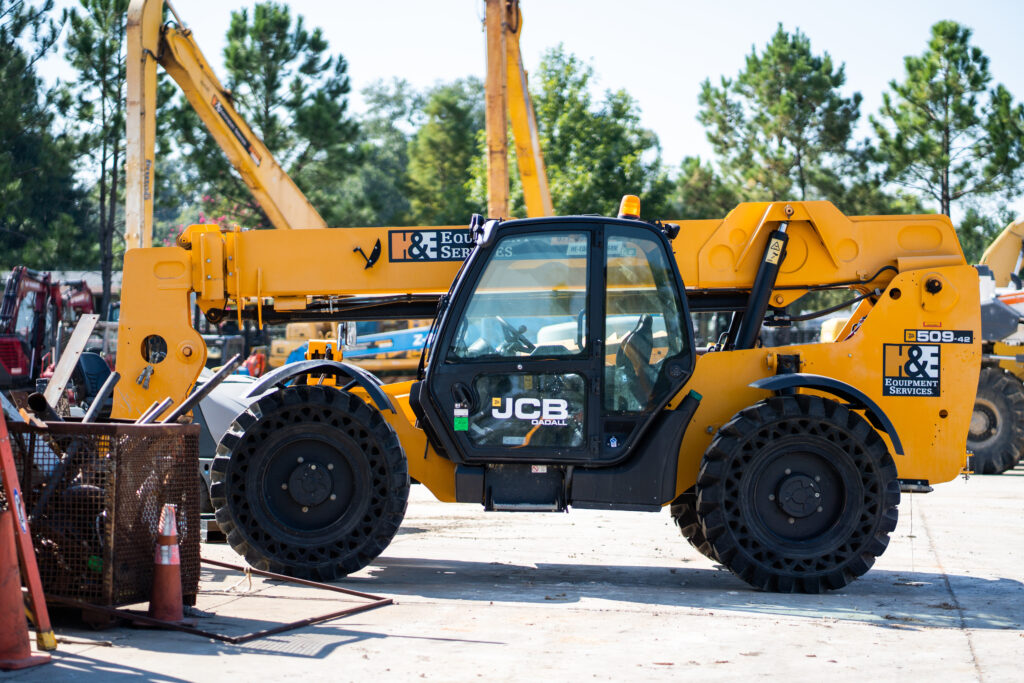
Effective October 18, 2023, H&E Equipment Services Inc. (H&E) has announced the relocation of its Pompano Beach, FL, branch. The facility is now located at 1660 N. Powerline Road, Pompano Beach, FL 33069-1623, phone 954-781-3099. The newly renovated property includes a fully fenced yard area, offices, and a separate repair shop and carries a variety of construction and general industrial equipment. “Our Pompano Beach location is just 2.6 miles northwest of our previous address. The newly renovated facility provides a comfortable environment, has a larger, more efficient yard to hold a variety of fleet, and maintains direct access to I-95 to move equipment quickly,” says Branch Manager Anthony Wallace. “And with our Hollywood branch just 17 miles south, we can work together to quickly locate available equipment and provide faster response time to job sites throughout South Florida.” The Pompano Beach branch specializes in the rental of aerial lifts, earthmoving equipment, telescopic forklifts, compaction equipment, generators, light towers, compressors, and more and represents the following manufacturers: Allmand, Atlas Copco, Bomag, Case, Club Car, Cushman, Doosan, Gehl, Generac Mobile, Genie, Hamm, Hilti, Husqvarna, JCB, JLG, John Deere, Kobelco, Kubota, LayMor, Ledwell, Lincoln Electric, Link-Belt Excavators, MEC, Miller, Multiquip, Polaris, Sany, Skyjack, SkyTrak, Sullair, Sullivan-Palatek, Tag, Towmaster, Unicarriers, Wacker Neuson, Yanmar, and others.
US Rail Traffic for the week ending October 14, 2023

The Association of American Railroads (AAR) has reported U.S. rail traffic for the week ending October 14, 2023. For this week, total U.S. weekly rail traffic was 492,781 carloads and intermodal units, up 0.5 percent compared with the same week last year. Total carloads for the week ending October 14 were 225,405 carloads, down 2.0 percent compared with the same week in 2022, while U.S. weekly intermodal volume was 267,376 containers and trailers, up 2.8 percent compared to 2022. Six of the 10 carload commodity groups posted an increase compared with the same week in 2022. They included petroleum and petroleum products, up 1,774 carloads, to 10,583; motor vehicles and parts, up 955 carloads, to 15,712; and miscellaneous carloads, up 809 carloads, to 8,786. Commodity groups that posted decreases compared with the same week in 2022 included coal, down 4,787 carloads, to 62,138; grain, down 2,049 carloads, to 22,176; and metallic ores and metals, down 1,705 carloads, to 18,137. For the first 41 weeks of 2023, U.S. railroads reported cumulative volume of 9,234,003 carloads, up 0.3 percent from the same point last year; and 9,862,159 intermodal units, down 7.7 percent from last year. Total combined U.S. traffic for the first 41 weeks of 2023 was 19,096,162 carloads and intermodal units, a decrease of 4.0 percent compared to last year. North American rail volume for the week ending October 14, 2023, on 12 reporting U.S., Canadian and Mexican railroads totaled 335,745 carloads, down 2.9 percent compared with the same week last year, and 347,146 intermodal units, down 1.4 percent compared with last year. Total combined weekly rail traffic in North America was 682,891 carloads and intermodal units, down 2.1 percent. North American rail volume for the first 41 weeks of 2023 was 26,749,075 carloads and intermodal units, down 3.6 percent compared with 2022. Canadian railroads reported 94,482 carloads for the week, down 2.4 percent, and 69,104 intermodal units, down 12.1 percent compared with the same week in 2022. For the first 41 weeks of 2023, Canadian railroads reported cumulative rail traffic volume of 6,507,594 carloads, containers and trailers, down 3.5 percent. Mexican railroads reported 15,858 carloads for the week, down 15.7 percent compared with the same week last year, and 10,666 intermodal units, down 20.0 percent. Cumulative volume on Mexican railroads for the first 41 weeks of 2023 was 1,145,319 carloads and intermodal containers and trailers, up 2.8 percent from the same point last year. To view the rail charts, click here.
Episode 429: Following the path to Warehouse Automation with Zion Solutions Group
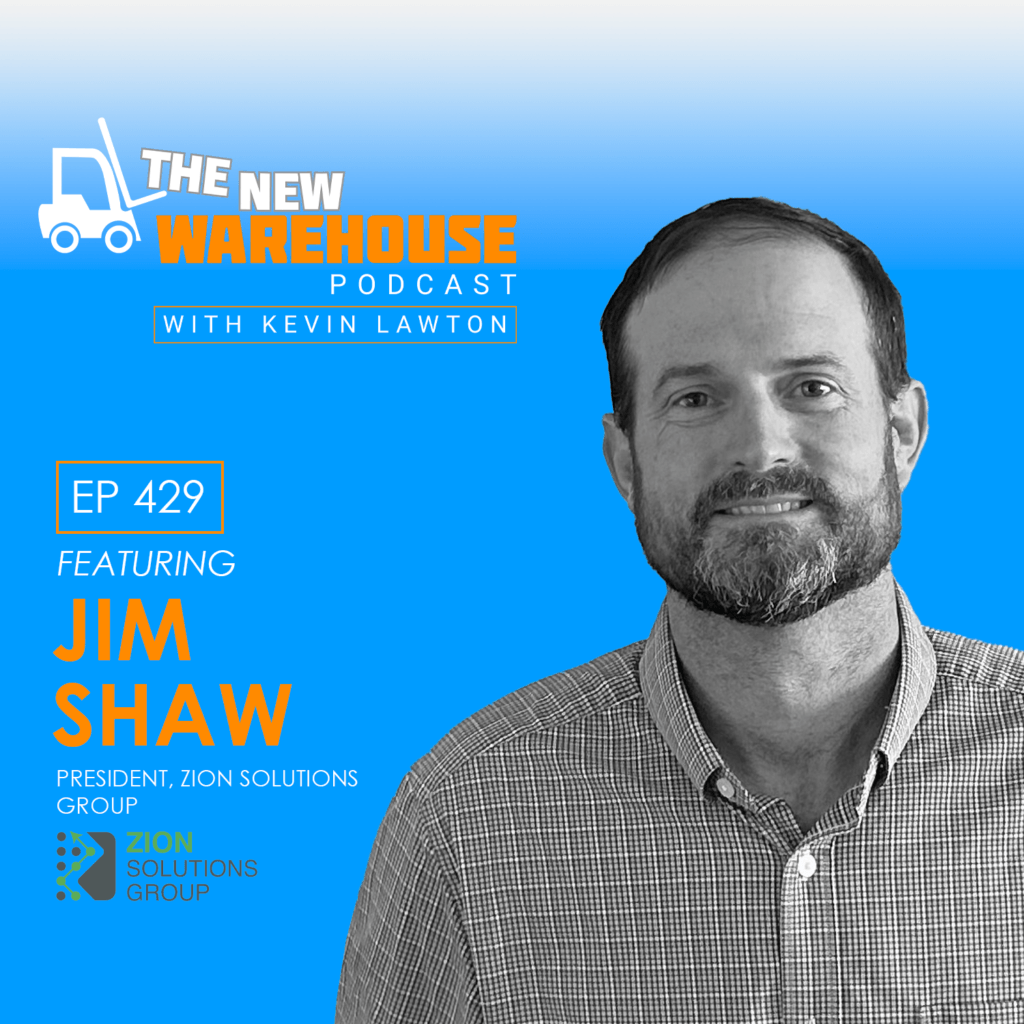
In the latest episode of The New Warehouse Podcast, Jim Shaw, President and Co-Founder of Zion Solutions Group, joins the show. With over 25 years of experience in the warehousing and logistics industry, Jim discusses his journey from his early days at UPS to eventually co-founding Zion Solutions Group, a company specializing in optimizing supply chain logistics. Rooted in deep industry experience and guided by his values of faith, family, and meaningful work, Jim offers a unique perspective on today’s warehousing challenges. Tune in to the episode for an in-depth look at Jim’s background and insights that could reshape how you think about supply chain optimization. Tackling Warehouse Efficiency and the Labor Equation Jim candidly addresses the multi-faceted challenges warehouses are currently facing. “How do I store more in less space? How do I use fewer people to get more out the door while maintaining my quality? And the biggest problem we’re seeing is labor,” he says. These concerns span various sectors, from retail to healthcare, and Jim suggests that the solution lies in “intelligent change.” He says it’s about “meeting the customer where they’re at, what problems they need solving,” whether that involves simple gravity conveyors or advanced robotics. Justifying Warehouse Automation Jim discusses the dilemma many warehouses face when considering high-end automation and robotics. “they may need some sortation, but their rates don’t qualify for the higher level sortation today,” he explains. Jim advocates for a more deliberate approach, cautioning against rushing into flashy, expensive solutions that may not serve immediate needs. “We’re looking for long-term meaningful partnerships… It’s not turning away work. It’s just more of an education process,” he notes, emphasizing the importance of starting with traditional material handling that can grow into more advanced systems. Jim adds, “Ultimately, you have to put your head on your pillow at night and feel good about how you solve a problem for a customer and did you do the right thing.” Navigating the Investment Horizon in Warehouse Automation Jim delves into the complexities of deciding how far ahead to plan when considering investments in automation and robotics. “I don’t know that there’s a right answer because every company has a different perspective,” he notes. According to Jim, businesses with their own distribution and fulfillment can potentially look at an extended investment period based on a clear understanding of their product’s future. For companies that don’t have a long-term commitment, like 3PLs, “the more flexible the automation, the more flexible the technology that you’re putting in,” advises Jim. Jim underscores the importance of partnering with trusted integrators or OEMs to navigate these decisions. “Find a partner that you can trust. Put your trust in that has your best interest in mind,” he says. In an environment where technology is rapidly evolving, Jim suggests a cautious approach, especially for more risk-averse companies. “You can be a fast follower… we spend it like it would be our money. If I was putting my money in my check and writing it, we take that pretty seriously because you can cripple somebody’s supply chain and ruin their business if you make wrong decisions.” Key Takeaways on Warehouse Automation Jim emphasizes the importance of “intelligent change” to address current challenges in warehouse efficiency, including labor and space constraints. A deliberate approach to automation is crucial; rushing into high-end, expensive solutions may not always serve a warehouse’s immediate needs. Flexibility is critical for long-term investments in automation, especially for companies without a long-term commitment to distribution and fulfillment, like 3PLs. EP 429: Following the Path to Warehouse Automation with Zion Solutions Group
Green Cubes celebrates ten years of Motive Power Technology leadership with continued investment in Innovation & Operations

Milestone marks a decade of manufacturing safe and reliable Li-ion technology for motive equipment with its Lithium SAFEFlex Battery solutions Green Cubes Technology (Green Cubes), the provider in producing Lithium-ion (Li-ion) power systems that facilitate the transition from lead-acid batteries and Internal Combustion Engine (ICE) power to green Lithium-ion (Li-ion) battery power, has announced it is celebrating ten years of motive power technology leadership for material handling and ground support equipment. For over 35 years, Green Cubes has been on the forefront of electrification innovations and this marks ten years of success with its flagship suite of Lithium SAFEFlex Battery solutions designed to meet the cost, performance, efficiency, and durability requirements of the rugged warehouse, distribution, and airport environments. Lithium SAFEFlex industrial lithium battery systems are designed as drop-in replacements for traditional Lead acid batteries. They eliminate the need for watering and battery swaps and increase equipment up-time with fast opportunity charging. With a lower total cost of ownership for electric equipment, industrial companies can capture cost-saving and greenhouse gas emission-reduction opportunities by planning the electrification of their operations, while increasing overall productivity. According to Allied Market Research, the forklift battery market is projected to reach $7.4 billion by 2026, growing at a CAGR of 7.04%. Green Cubes is poised to be an integral part of these projections. “As a pioneer in the Motive space for over a decade, Green Cubes has provided the industry with the solutions to modernize and optimize material handling power with Lithium SAFEFlex, our Lithium-ion battery power system that has dual benefits of improved ROI (Return On Investment) and decreased environmental impact,” said Michael Walsh, Chief Executive Officer for Green Cubes. “We will continue to invest in technology innovation and manufacturing excellence while expanding our service and customer application infrastructure. For 35 years we’ve made a positive impact on the Indiana economy and will continue to do so as we expand our footprint in Kokomo, creating more jobs in clean energy.” Green Cubes recently added a 36,000-square-foot facility to produce Lithium SAFEFlex batteries and house engineering and service talent to support customer applications. Additionally, Green Cubes established a new Technology Center in Switzerland, to focus on product innovation. Together these teams are working to improve technology and service offerings based on a decade of field learning and experience.
Industrial Forklifts ushers in “New Chapter” with new headquarters & full rebrand

The Southwest has a new forklift brand to help it grow. Industrial Forklifts, Inc., the sole distributor of the Heli forklift brand in the Western United States, has completed its move from Denver, CO, to Phoenix, AZ. In the process they’ve acquired a totally new facility in the Papago Industrial District, off 48th Ave and Van Buren. The facility boasts parts storage, a state-of-the-art training room, and of course, a full showroom of material handling equipment. The Phoenix facility sites on 1.12 acres, with 36,000 sq. ft. dedicated to parts, service, and a showroom floor. Who’s it for? To strengthen their Dealer and Rental Network coverage across the U.S. “Everything’s new about our Phoenix location,” says Dan Summers, Director of Aftermarket Sales at Industrial Forklifts. “Due to the rapid expansion of Industrial Forklifts’ customer base, and the success of the Heli forklift line in America, we came to Phoenix for a new chapter.” To cap off the expansion, the new Industrial Forklifts building sports a brand-new logo. Industrial Forklifts began as a part of FMH Material Handling Solutions in 2006, based in Denver. Through a series of acquisitions and business choices, the Industrial Forklifts brand and team split from FMH in 2022. With the new Phoenix location, Industrial Forklifts has a new showcase to continue its mission of introducing Heli forklifts to all businesses. “We’re open and here to help,” says Nick Gushue, Vice President. “Everyone’s welcome to come by!”
JLG® announces Executive Leadership changes

Frank Nerenhausen to retire effective November 13, 2023. Mahesh Narang named successor. Tim Morris appointed Chief Commercial Officer JLG Industries, Inc., an Oshkosh Corporation business and global manufacturer of mobile elevating work platforms and telehandlers, has announced the retirement of Frank Nerenhausen, executive vice president of Oshkosh Corporation and president of its Access segment. Mahesh Narang will succeed Nerenhausen effective November 13, 2023. Nerenhausen will serve as an advisor to the company through August 2024. Nerenhausen is retiring after more than 37 years with Oshkosh Corporation. Since joining the company as an intern in 1986, his career has included a range of management and leadership assignments of increasing responsibility across business segments. He was named the company’s Access segment president in 2012. “Frank has built a world-class team, successfully leading JLG to great heights for more than a decade. During his tenure, the Access segment has achieved significant growth and profitability, while introducing progressive innovations that leave our business in an outstanding position with a bright future,” said John Pfeifer, president and chief executive officer of Oshkosh Corporation. Narang is an accomplished global executive. Most recently he served as vice president and president of Components at Cummins Inc., where he developed the strategic direction and led all operational aspects of the Components business. Further, he executed a forward-looking strategy to grow in core diesel markets while expanding into new and fuel agnostic adjacent markets. Narang also led the acquisition and integration of several companies, helping grow the Components business by over 50% and prepare for future technologies. He holds a Bachelor’s degree in Engineering from the University of Mumbai, India, as well as Master of Business Administration and Master of Engineering Management degrees from Northwestern University. Pfeifer continued, “In addition, we are taking this opportunity to align the commercial activities of JLG Americas to prepare for future growth.” Tim Morris, who has been with JLG since 1992, has been appointed chief commercial officer for JLG Americas. He will be responsible for overseeing all JLG whole goods and aftermarket commercial business initiatives in the Americas region. Pfeifer concluded “We have an exceptionally strong bench of talent at our Access segment. Mahesh’s diversified experience combined with the longevity of Tim’s experience and deep customer relationships will allow us to continue our growth trajectory and maintain our market leadership.”
CKF recently started the install of the third central palletizing project for iconic snack manufacturer
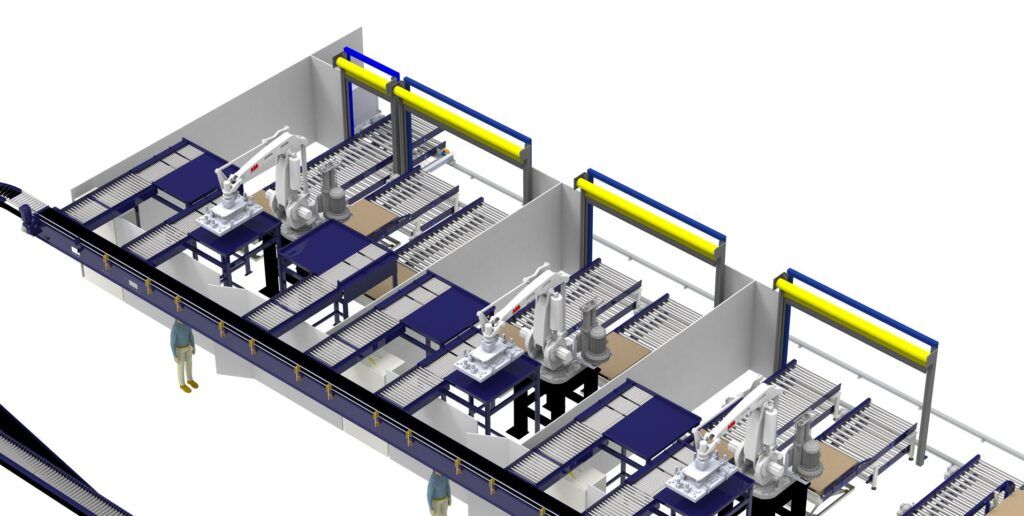
CKF Systems are delighted to have started the installation of another Robotic Central Palletising system for a world leading snack manufacturer at one of their large state-of-the-art, modern facilities, building further on the company’s 25-year strong working relationship. This latest install will provide fully automated palletisation, taking cased product from seven existing production lines. Elements of the systems design were carried over from the two large Robotic Central Palletising systems already supplied and commissioned by CKF for them at another of their plants. CKF are providers in automated robotic solutions with more than 30 years’ experience supporting different industries including Food & Beverage, Logistics, Pharmaceutical and Automotive. This new multi-million-pound system is the latest robotic system to have been delivered and commissioned by the experienced engineering team at CKF, aiding our client’s drive for the improvement and automation of the operations within their manufacturing facility. This system is a full turnkey solution from CKF Systems incorporating CKF’s own range of pallet and case conveyors along with ABB robots, Apollo Spirals and Intralox ARB equipment. CKF are ABB Value Providers and are the only company in the UK to hold a full Preferred Partnership agreement with Intralox giving CKF a license to manufacture Intralox’s ARB equipment in house. Jamie Quinton CKF Managing Director said “CKF Systems have built an established and successful relationship with our customer spanning more than 25 years. We’re delighted that they have again chosen CKF Systems to help automate their operations and further drive their ambitions to increase productivity, streamline their operations and reduce manual handling through effective use of automation and robotics. The length of the relationship shows how much trust has has been established between our two companies and the confidence they have in the reliability of our solutions”
Women In Trucking Association announces continued Gold Partnership with Walmart
The Women In Trucking Association (WIT) announced that Walmart has renewed its Gold Level Partnership for the fourteenth year, supporting the nonprofit organization as it attracts more women to the transportation industry and empowers them to be successful. Since 2009, Walmart has supported WIT at the Gold Level, making them the longest-standing top-level sponsor. In addition to financial support and regularly sponsoring the Driver of the Year program, the company actively participates in the association. Walmart’s Ryan McDaniel, vice president of transportation, serves on the WIT board of directors. “Walmart is proud to renew our partnership with Women in Trucking, a 14-year commitment that reflects our dedication to creating an environment of belonging,” said Ryan McDaniel, vice president, transportation at Walmart. “Together, we aim to drive positive change and ensure a more prosperous future for all that empowers women within the transportation industry at large.” “Walmart has shown a long-standing commitment to WIT’s mission, gender diversity and creating opportunities for women across the transporation sector,” said Jennifer Hedrick, WIT president and CEO. “We’re pleased to continue our strong partnership.”
Raymond West hosts 10th annual Pink Pallet Jack project to benefit Breast Cancer awareness
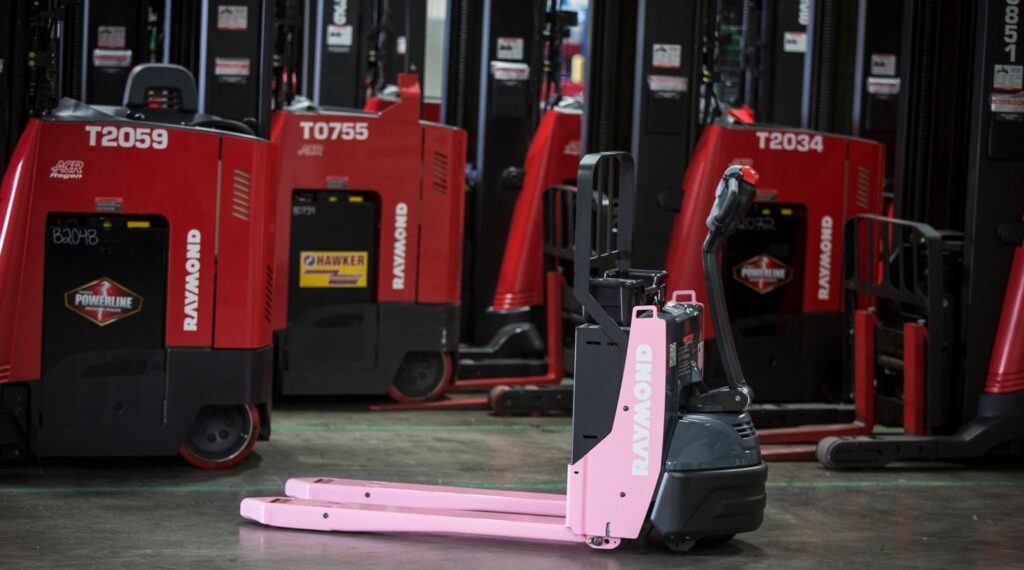
Raymond West will hold the 10th annual Pink Pallet Jack Project auction in support of Breast Cancer Awareness Month from Oct. 18 through 29 Raymond West, an authorized Raymond Solutions and Support Center, will hold the tenth annual Pink Pallet Jack Project online auction in support of Breast Cancer Awareness Month from Oct. 18 through 29. The 11-day auction will begin Oct. 18 at 12 a.m. PDT on Auctria.com (auctria.events/pinkpalletjack), where participants can bid on three pink Raymond® 8210 powered pallet jacks from suppliers. The auction will end Oct. 29 at 12 a.m. PDT. Winning bids will be announced the first week of November, with all proceeds from the auction being donated to The Tina Fund, Breast Cancer Angels and Northwest Hope & Healing. The Raymond 8210 powered pallet jack, part of The Raymond Corporation’s intralogistics solutions portfolio, is ideal for retail store, wholesale delivery and food processing applications that require navigation in tight and/or congested areas. The lift truck also will include Raymond’s exclusive Click2Creep™ design, which automatically reduces maximum travel speed, providing a tighter turn radius for pinwheeling or right-angle turning. Raymond’s Pink Pallet Jack Project has raised more than $175,000 for breast cancer over the past nine years.
ASSP welcomes new chief financial officer

The American Society of Safety Professionals (ASSP) has welcomed a new chief financial officer. Steven M. Lothary, MBA, will lead the Society’s finance team as of Nov. 1. He will replace Bruce Sufranski, who is retiring at the end of October after more than 14 years of service. Lothary joins ASSP’s leadership team, working with the CEO and Board of Directors to align resources with the organization’s strategic direction. He will oversee all financial functions of ASSP and the ASSP Foundation. His responsibilities include accounts payable and receivable, cash management, annual budgets and audits, financial and tax reporting, risk management, insurance, and headquarters office building operations and maintenance. Lothary brings more than 20 years of experience in the not-for-profit and association industry. “We’re excited to bring Steve on board to continue the competent work and valuable contributions that Bruce has provided for many years,” said ASSP President Jim Thornton, CSP, CIH, FASSP, FAIHA. “Steve will play a significant role as we continue to grow post-pandemic and strengthen our position as a global leader in occupational safety and health.” Lothary will create and manage a long-term financial sustainability plan and work to increase reserves. He also will oversee human resources, which includes compensation and benefits, organizational planning and talent management. “This is a terrific opportunity that is meaningful to me because it helps protect worker safety and health,” Lothary said. “My background and career experiences align well with ASSP’s objective of increasing its financial health and stability. I look forward to helping the Society build on its history of success.” Lothary most recently served for six years as senior director of finance at the Emergency Nurses Association in Schaumburg, IL. The professional medical association provides education for more than 50,000 emergency department nurses. He led the redesign of their budget process and implemented an automated budget system. Prior to that, Lothary was director of finance and facilities for the American Society of Anesthesiologists – also in Schaumburg – from 2008 to 2012 and again from 2014 to 2017. The professional medical association provides education and lobbying support for more than 50,000 members. He implemented monthly dashboard reporting that focused on major revenue sources to better enable the organization’s leaders to pursue strategic initiatives.
Episode 428: Speeding up grocery fulfillment with Adam Gurga of Cimcorp
Welcome to The New Warehouse Podcast, where our guest is Adam Gurga, the National Manager for Grocery and Retail Partnerships at Cimcorp. Cimcorp specializes in providing automation solutions within the fulfillment space, including tire manufacturing, grocery, and retail industries. What sets Cimcorp apart is its unique approach to automation, specifically through its overhead gantry robots. Be sure to tune in to learn how automation is shaping grocery fulfillment. Challenges in Grocery Fulfillment and Distribution Centers Adam’s insights paint a vivid picture of grocery fulfillment and distribution centers’ complex challenges. These hurdles shape the industry’s present and future, from labor shortages to network capacity. As technology evolves, new opportunities emerge, but these come with their own set of challenges. Labor Pool Constraints – Adam identifies labor issues as one of the most significant challenges in the industry. The labor pool is dwindling due to factors like the aging population and younger generations seeking different types of work. He notes, “You’ve got fewer younger people who want to do that work. They tend to have higher levels of education than previous generations, leading them to seek out those white-collar jobs.” Network Capacity – Another challenge Adam highlights is the strain on network capacity. He says, “Feedback right now is a lot of the network capacity from a distribution standpoint from our customers is nearly maxed out, but there’s still desires, especially for publicly traded companies, for growth.” Automation Challenges – Adam also discusses the difficulties in retrofitting older buildings with modern automation solutions. While building a new warehouse might seem like a logical solution, “Retrofitting is typically less expensive. With new buildings, you’ve got rising costs of land acquisition to deal with, not to mention infrastructure, lead times, logistical remapping, and zoning challenges.” Temperature-Controlled Environments – Adam addresses the complex issue of maintaining automation solutions in temperature-controlled environments, especially for perishable goods. He notes, “There’s some limitations, not just with our automation, but in automation in general, once you start to push below that freezing level.” Navigating these challenges requires a multi-faceted approach encompassing technological innovation, strategic planning, and an in-depth understanding of market trends. Accelerating the Grocery Fulfillment Pick Process to Address Last-Mile Challenges The conversation shifts focus to the speed of delivery, a critical factor in customer satisfaction in grocery fulfillment. Adam emphasizes the importance of accelerating the picking process as much as possible to meet the demands of quick delivery. Cimcorp utilizes systems like ASRS (Automated Storage and Retrieval Systems) and gantry robots to swiftly bring products into storage, reprocess them, and build orders for delivery. He adds, “We have produce systems with six pick modules, and they’re pushing 120,000 cases in 24 hours.” Such speed is essential in a market where consumers have come to expect same-day delivery for groceries. The last mile—delivery from the distribution center to the customer’s doorstep—is another hurdle even advanced in-house automation can’t solve independently. Adam points out that grocery retailers often lose money on this crucial part of the supply chain, with losses ranging from seven to twenty-five dollars per order. This economic pressure further emphasizes the need for speed and efficiency in every preceding step, making automation even more indispensable. Overall, the challenges of grocery fulfillment are many, and the solutions are complex. However, companies like Cimcorp are taking steps to address these hurdles as technology evolves. Key Takeaways Labor Pool Challenges – Adam highlights a significant challenge concerning the labor pool, particularly in sectors requiring manual labor, such as warehouses. A declining or aging population and changing career aspirations of younger generations are making labor-intensive jobs less attractive. Need for Flexible Solutions – There is a trend of developing modular and scalable solutions to tackle immediate challenges like labor shortages and maxed-out network capacities rather than building entirely new distribution centers. Automation and Cold Storage – Automation in cold storage environments has specific challenges tied to temperature and condensation. The New Warehouse Podcast EP 428: Speeding Up Grocery Fulfillment with Adam Gurga of Cimcorp
Kito Crosby unveils new corporate brand

Kito Crosby, a global manufacturer of the lifting and securement industry, has announced the launch of its new, unified corporate brand. The strategic business combination of KITO Corporation and The Crosby Group, announced in January this year, has combined the expertise and heritage of two industry leaders, creating a stronger organization equipped to further drive innovation and elevate industry standards. The Kito Crosby brand unites the best of both companies, amplifying their shared commitment to safety, quality, and technology advancements. “We are thrilled to unveil our new brand, a symbol of our two legacy businesses combining as one team with a single mission and vision,” said Robert Desel, CEO of Kito Crosby. “This corporate identity serves as the focal point for all of us as we come together to best serve our valued channel partners and end users.” The brand embodies a dedication to reliability, innovation, safety, and quality, serving as a hallmark for the industry. Kito Crosby supports customers with a wide range of products and services used to make lifting, rigging, transporting, and securing operations safer and more efficient. The new brand fortifies the company’s position as a one-stop solution provider for all lifting needs. While unveiling the new brand, Kito Crosby has also launched a new mission, vision, and corporate values for the company’s 4,000 employees. The corporate brand serves as an umbrella for Kito Crosby’s leading product brands such as Kito, Crosby, Harrington, Gunnebo Industries, Peerless, and others. The product brands remain unchanged and Kito Crosby will continue to invest in these for a safer and more productive lifting and securement industry. “The unveiling of our new brand, mission, vision, and values marks a pivotal moment in our journey,” continued Desel. “With this strong corporate identity, our portfolio of powerful product brands can flourish – continuing to build on our long-standing legacy of pioneering technologies and solutions. We are proud to join together with our employees, channel partners and the entire industry to ‘raise your world.’”
Cheap industrial batteries: Where’s the catch?
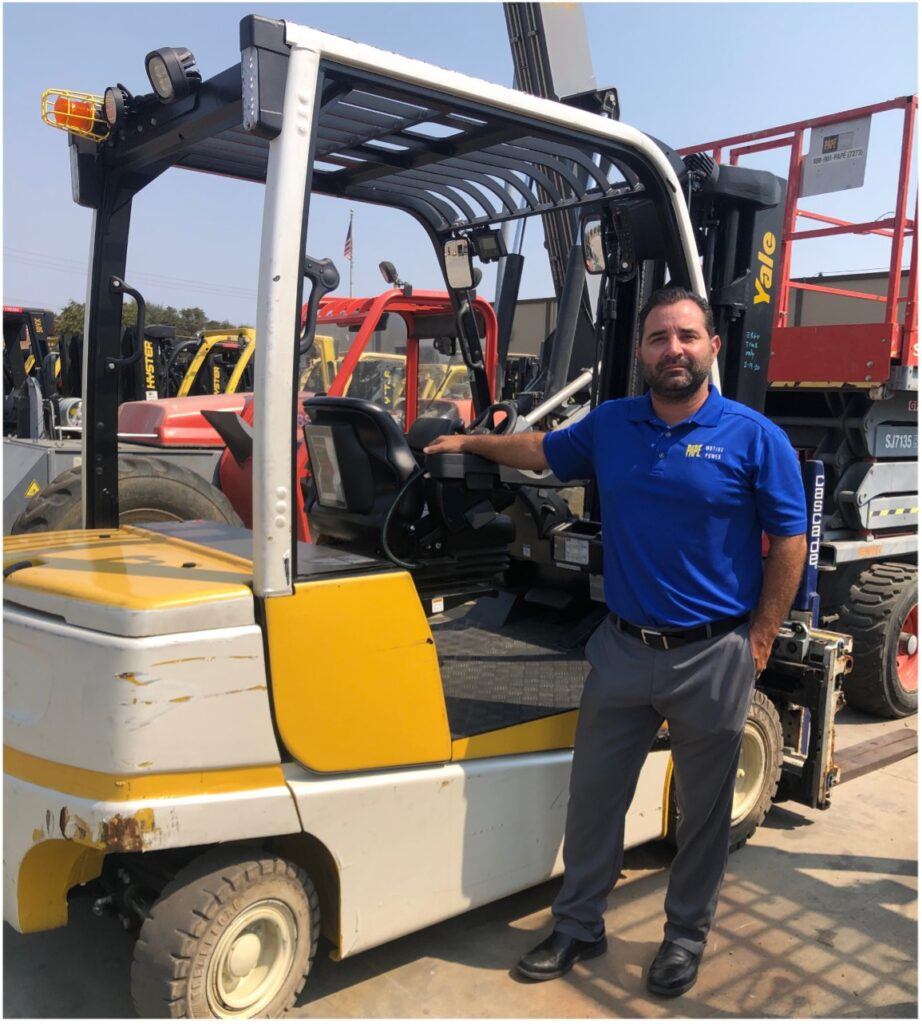
Motive power batteries for forklifts and other material handling equipment typically look very similar, with no differentiation of design or exterior features. Their technical specifications, like voltage and Ah capacity, are required to comply with the standard requirements of the host vehicles. However, there is often a significant price difference between different brands, which stems from the functionality of the battery management system (BMS), but also from other parts of the “total product”: delivery and installation; options for integration with the forklift and charger; and the availability of support, service, and parts. What helps cheaper batteries stay cheap? Cheap overseas labor can be a major factor in the US retail price when the production volume is large, but this is not the case for the relatively niche forklift lithium battery market. Transportation costs and longer lead times are leveling out this advantage. What is it, then? First and foremost, it is the limited functionality provided by a basic-level BMS. In our latest article focusing on the key factors extending the cycle life of a lithium battery, we argued that an advanced BMS plays a major role in preventing battery degradation by providing real-time diagnostics, equalizing the charge of individual cells, and safeguarding and optimizing the charge and discharge processes. A standard, off-the-shelf BMS with no adjustment for use in material handling and no advanced functions may give a price advantage, but also cause a lot of headaches to battery users. An inexpensive battery bought online from overseas, as you’ll see in the real-life example provided by PAPÉ’s Motive Power Regional Manager and top expert John Perazzo below, arrives at your door as if a forklift battery is as easy to install as a AAA battery in a TV remote. It is not. Not only does it require a second forklift or crane to remove the old battery, but a trained technician is required to properly connect and run tests on the battery, including connectivity, safety, and operation checks. On the other hand, installation and setup costs are typically included in the price of a US battery brand. Taking into account the potential service needs, the labor costs of initial installation will add up going forward. What is not included in the lower price, is the cost of downtime: in the best-case scenario, it equals the rental costs while you wait for spare parts to arrive. In the worst case, when the replacement is not quickly available, it equals the cost of business operation downtime. An online purchase of a lead-acid battery that went wrong Here is the story as it was told by John Perazzo, the motive power expert. PAPÉ had a customer in San Francisco for whom they quoted a replacement battery for a 5000-pound electric forklift. The customer called in to say PAPÉ’s offer was $2,000 higher than “the internet guy” and so PAPÉ lost the bid. A month later, the customer received a battery via a common carrier and was unable to install it because the old battery in his forklift was dead. Had he placed the order through PAPÉ, the new battery would have been delivered and installed, and the old battery would have been removed and properly disposed of, all included in the price. Instead, the customer needed to pay PAPÉ $450 for the installation. About 90 days later, this customer had a cell failure, contacted the manufacturer, and a replacement cell was shipped to him. This was another $500 service call for PAPÉ to come and have the cell installed. Meanwhile, the customer’s only forklift was down again while he waited for the cell. He ended up paying $900 for a rental. Not to mention the headache and downtime he experienced and the time spent overcoming these hurdles. “So we were $2000 more expensive up front, so he bought (a battery) from the internet,” says John Perazzo. “Once it was all said and done, the customer expressed the understanding of having local support for a product and that he wouldn’t make that mistake again.” Conclusion The technical specifications, size, weight, connectors, controls, and exterior design may be almost identical for industrial batteries from different brands. However, it is risky to treat industrial batteries as a commodity. The key differences are in the mechanical and electrical design, electronics and software, as well as in the level of local support and parts availability. To choose an industrial battery, operators need to understand the benefits and trade-offs of the total product to avoid painful losses with potential downtime and extra labor costs. About the Author: Maxim Khabur is a Director of Marketing at OneCharge, one of the US leading manufacturers of lithium industrial batteries, and a Chairman of the Advanced Energy Council, representing a group of companies – members of the MHI.org (Materials Handling Industry) Association.
Crossover at Kinnick Iowa Hawkeyes Women’s Basketball Bobblehead unveiled

This morning, the National Bobblehead Hall of Fame and Museum unveiled an officially licensed, limited-edition bobblehead commemorating the “Crossover at Kinnick” women’s basketball game that is set to take place this Sunday, October 15th at Kinnick Stadium in Iowa City, Iowa. The bobblehead features University of Iowa mascot Herky the Hawk holding a “Crossover at Kinnick” basketball while standing on a basketball court inside a replica of Kinnick Stadium. The special edition bobblehead is being produced by the National Bobblehead Hall of Fame and Museum, an official licensee of the University of Iowa. Iowa will look to set the all-time women’s basketball attendance record when it hosts DePaul at Kinnick Stadium on Sunday. The women’s basketball attendance record of 29,619 was set in the 2002 National Championship game between Connecticut and Oklahoma in San Antonio’s Alamodome, and over 47,000 tickets have already been presold for Sunday’s game. Holding a basketball with the “Crossover at Kinnick” logo and standing on a basketball court inside a replica of Kinnick Stadium, the Herky the Hawk bobblehead is wearing his white Iowa Hawkeyes basketball jersey. The stadium base reads IOWA HAWKEYES across the front along with the “Crossover at Kinnick” logo on the sides. Each bobblehead will be individually numbered to only 2,023 and they are currently available exclusively through the National Bobblehead Hall of Fame and Museum’s Online Store. The bobbleheads, which are expected to ship in January, are $40 each plus a flat-rate shipping charge of $8 per order. With more than 47,000 tickets sold 10 days prior to the big event, the “Crossover at Kinnick” featuring the Iowa Hawkeyes, last year’s national runner-up, and DePaul is certain to shatter the all-time women’s basketball attendance record. “This is a once in a lifetime opportunity for our women’s basketball program and the sport,” 24th-year Iowa coach Lisa Bluder said in a statement. “I look forward to seeing all of our closest friends inside Kinnick Stadium for a historic day.” All proceeds from “Crossover at Kinnick” game will go to the University of Iowa Stead Family Children’s Hospital. Excitement is high for the 2023-24 women’s basketball season in Iowa City after the Hawkeyes went on a memorable and historic run last season. Three starters, including All-American point guard and reigning National Player of the Year, Caitlin Clark, return from a team that went 31-7 and finished as the national runner-up. In August, the program announced that season tickets were already sold out. The state of Iowa has a long history of supporting girls and women’s basketball. The Hawkeyes were second nationally in attendance last season with an average of 11,143 at Carver-Hawkeye Arena. In addition to appearing in the title game of the NCAA Tournament for the first time in program history where they lost to LSU, 102-85, the Hawkeyes finished as the runner-up in the Big Ten Conference behind Indiana with a 15-3 record and won the Big Ten Conference Tournament title for the second consecutive season. Earning a No. 2 seed in the NCAA Tournament, the Hawkeyes recorded victories over Southeastern Louisiana, Georgia, Colorado, and Louisville to advance to their first Final Four since 1993. In the national semifinals, Iowa knocked off defending champion, previously undefeated and top-seeded South Carolina, 77-73, before a sellout crowd of 19,288 at American Airlines Center in Dallas in one of the most anticipated matchups in women’s Final Four history. “We are excited to release this very special bobblehead in celebration of the Iowa women’s basketball team’s ‘Crossover at Kinnick’ event,” National Bobblehead Hall of Fame and Museum co-founder and CEO Phil Sklar said. “After the excitement created by the Hawkeyes last season and the anticipation for another memory-making season, this bobblehead will be a must-have for fans of the Iowa Hawkeyes and especially for those that will attend this historic event!”
Combilift’s CB15-5E wins the Italian Terminal and Logistics Award
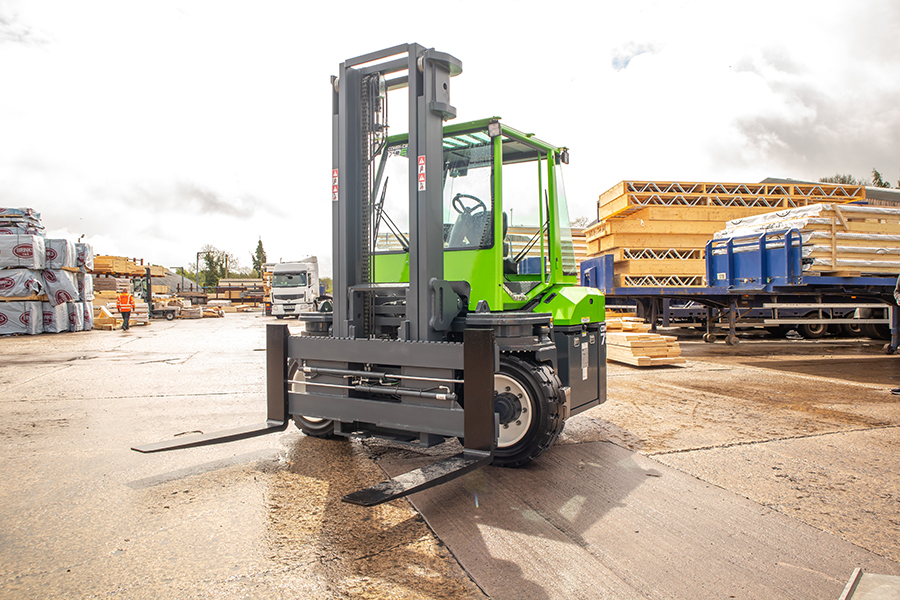
Combilift pick up award while attending GIS Expo in Italy Combilift, the largest global manufacturer of multidirectional trucks, articulated forklifts, and straddle carriers has announced that the Combi-CB15-5E has been honored with the coveted Italian Terminal and Logistics Award. This prestigious accolade recognizes the innovation in the operational field and its commitment to operator training and safety. The Italian Terminal and Logistics Award is a significant industry recognition, presented annually to highlight the skills of operators in port, intermodal, and logistics terminals both in Italy and abroad. The new Combi-CB15-5E is a further addition to Combilift’s ever-growing range of electric models which offers powerful performance, extensive battery life, and unrivaled ergonomics. This model, in the vibrant Combi-green livery, boasts the distinction of being the shortest 15,500lbs capacity counterbalance truck on the market whilst also benefitting from multidirectional ability, enabling the versatile space-saving handling of both long and bulky loads. Martin McVicar – CEO and Co-Founder of Combilift accepted the award alongside their EA Group partners and said: “We are honored to receive the Italian Terminal and Logistics Award for the CB155E. This recognition validates our unwavering commitment to innovation, safety, and training in the material handling industry. The CB15-5E is a perfect example of our dedication to providing our customers with efficient, eco-friendly, and safe solutions.”
Global Mobile Robotics Market Survey indicates widespread acceptance and significant growth
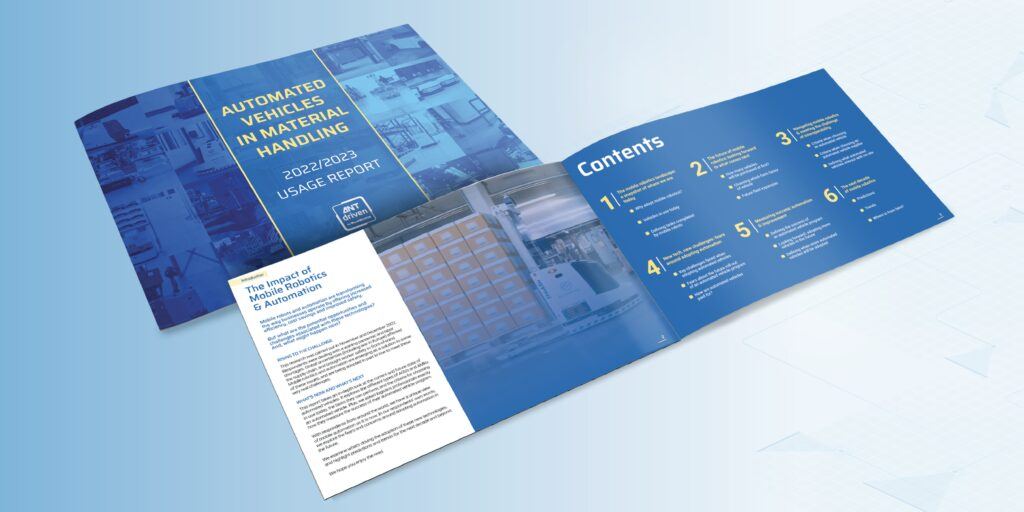
BlueBotics, the global reference in natural navigation for automated guided vehicles (AGVs) and autonomous mobile robots (AMRs), has released results of a new survey indicating significant growth in automated guided vehicle (AGVs) on its educational website, ANTdriven.com. Conducted in collaboration with Logistics Business magazine, the report “AUTOMATED VEHICLES IN MATERIAL HANDLING 2022/2023 USAGE REPORT indicates a bright outlook for the future of AGVs. Between November 28th and December 14th, 2022, the independent research firm Logistics Business interviewed 180 respondents from 29 different countries, 87 percent of whom were involved in purchasing automated vehicles. Virtually all respondents used some automated vehicle to improve their operations, and most planned to expand use soon. The results also indicated increasing acceptance and trust in automated vehicle technologies, high adoption of natural navigation methods, and significant interest in interoperability. Key findings: Widespread use of automated vehicles. More than 70 percent of the respondents have adopted or plan to adopt AMRs or AGVs and 21 percent were using self-driving forklifts. The average fleet size was 7.7, consisting mostly of AMRs or AGVs; only 17 percent used more than one type of vehicle. Diverse uses. Respondents used AGVs to compensate for staff shortages but generally not to reduce headcount. Applications included moving payloads to or from conveyors, palletizers, and wrappers; packaging or other end-of-line applications; pallet toting and retrieval; and picking. About a third cited on-site safety as a reason for adopting automated vehicles. Natural navigation is the most popular guidance method. About 3 out of 4 respondents were using vehicles guided by natural navigation methods, with others using laser triangulation, inductive wire, magnetic tape, and QR code or tag-based systems. Market growth. 91 percent of respondents plan to extend their AGV or AMR fleets, with 81 percent planning to do so within the next two years. Most will purchase between 3 and 10 vehicles. Interoperability trending. The need for new purchases to interoperate with each other and other plant technology showed as important as brand reputation and payload capacity, as respondents seek to avoid single vendor reliance. The need to measure ROI remains. But how they will measure that return remains of concern. The two most cited approaches include comparing cost savings to manual or automated vehicle technologies and productivity increases, with break-even time, accident reduction, and staff acceptance. “This survey confirms our belief that the adoption of automated vehicles will continue strongly for many years, driven by the challenge of hiring and retaining material handling workers, the continued need for increased efficiency and cost savings in challenging global conditions. We are especially gratified to see such strong current use of natural navigation as users see the value of automating material handling operations,” said BlueBotics CEO, Dr. Nicola Tomatis. For more details on survey results, read the complete survey report here.
AutoScheduler now available on SAP® Store

AutoScheduler.AI, an innovative Warehouse Management System (WMS) accelerator, announces that its warehouse resource planning and optimization platform, AutoScheduler, is now available on SAP® Store, the online marketplace for SAP and partner offerings. AutoScheduler takes data from SAP ERP solutions and uses capacity-constrained schedules to create plans and schedules that optimize the warehouse. “Adding AutoScheduler to the SAP Store will be an invaluable resource for companies needing to speed fulfillment operations, optimize warehouse resources, and better manage inventory. Many of our customers and prospects use SAP ERP solutions and are searching for ways to improve supply chain operations. AutoScheduler will help them orchestrate warehouse operations to drive value and efficiencies through the supply chain.” said Keith Moore, Chief Executive Officer, AutoScheduler AutoScheduler.AI enables organizations to: Combines disparate data from multiple systems, converges supply chain activities, and prescriptively creates fulfillment plans that orchestrate campus operations for optimized efficiency. Properly orchestrated facilities work harmoniously to get inventory shipped on time and in full. Prescribe the optimal workflow for operations using constraint-based mathematics and digital twins to minimize touches and ensure on-time, in-full fulfillment. Crossdock more frequently to keep inventory and activities steady so everything is on time and available for fulfillment. Minimize the number of transfer shipments by automatically shifting dock locations to reduce the number of moves among warehouses, which helps to speed fulfillment. SAP Store, found at store.sap.com, delivers a simplified and connected digital customer experience for finding, trying, buying, and renewing more than 2,300 solutions from SAP and its partners. There, customers can find the SAP solutions and SAP-validated solutions they need to grow their business. For each purchase made through SAP Store, SAP will plant a tree. AutoScheduler.AI is a partner in the SAP PartnerEdge® program. The SAP PartnerEdge program provides the enablement tools, benefits, and support to facilitate building high-quality, disruptive applications focused on specific business needs – quickly and cost-effectively.
Four Hargrove Controls & Automation Trailblazing Engineers named among CFE Media and Technology’s Engineering Leaders Under 40

Hargrove Controls & Automation, an industrial automation system integrator and a subsidiary of global EPC firm Hargrove Engineers & Constructors, announced that four of their engineers have been listed along with 30 other engineering professionals as rising stars of innovation in the CFE Media and Technology class of 2023 Engineering Leaders Under 40. This achievement recognizes individuals in automation, industrial manufacturing, and system integration who have made substantial contributions to the control engineering and plant engineering professions. “We are so proud of each teammate representing Hargrove Controls & Automation in the class of 2023 Engineering Leaders Under 40,” said Karen Griffin, Vice President of Hargrove Controls & Automation. “These outstanding individuals are following a legacy of excellence that previous Hargrove Teammates have achieved while forging their own that will be tough to match.” The four engineers representing Hargrove Controls & Automation include Matthew Bailey and Megan McIntosh from Mobile, Alabama and Chase Beard and Elliot Miller from Atlanta, Georgia. “Matthew’s, Chase’s, Megan’s, and Elliot’s commitment to Hargrove’s core values and their dedication to excellence and growth is the reason they are top performers within our company,” said Uwe Kurfurst, Hargrove Controls & Automation Industry Engineering Leader. “It is an impressive feat for Hargrove Controls & Automation to have continued representation in the program each year and demonstrates our commitment to engineering excellence.” Last year, the Engineering Leaders Under 40 class of 2022 featured five Hargrove Controls & Automation engineers – from technical consultants to controls and automation engineers – including the Control System Integrators Association (CSIA) 2023 Rising Star Award recipient Sean Phillips. Learn more about the Engineering Leaders Under 40 program.