
KION Group delivers strong earnings and free cash flow in the first nine months of 2023 and raises outlook

Revenue at €8.347 billion (Q1–Q3 2022: €8.243 billion) Adjusted EBIT more than doubles to €571.9 million (Q1–Q3 2022: €210.6 million) Adjusted EBIT margin at 6.9 percent (Q1–Q3 2022: 2.6 percent) Strong free cash flow at €329.3 million (Q1–Q3 2022: minus €971.9 million) Sustainability: MSCI increases KION Group’s ESG rating to AAA Outlook raised for the Group’s adjusted EBIT and free cash flow KION Group strengthens leadership team The KION Group achieved a strong increase in its profitability and free cash flow in the first nine months of this year. These results were mainly driven by a continued momentum in the Industrial Trucks & Services (ITS) segment. The primary reasons for this impressive performance were the stabilization of the supply chain enabling higher production volumes, and the positive effects of the measures initiated in 2022 to boost commercial and operational agility. “The significant upward trajectory of KION Group is once again underscored by these strong results for the first nine months of this year”, says Rob Smith, Chief Executive Officer of KION GROUP AG. “This strong momentum reinforces our leading position in intralogistics solutions for customers worldwide.” Consolidatedrevenue amounted to €8.347 billion in the first three quarters of 2023, a year-on-year rise of 1.3 percent (Q1–Q3 2022: €8.243 billion). The proportion of consolidated revenue attributable to the service business increased to 44.6 percent (Q1–Q3 2022: 41.7 percent). Total revenue in the Industrial Trucks & Services segment increased by 16.5 percent to €6.160 billion (Q1–Q3 2022: €5.288 billion). The systematic processing of the sizeable order book built in 2022 had a positive impact on revenue in the segment. In addition, price increases implemented in the previous year made a substantial contribution to revenue growth. At 48.1 percent, the proportion of the segment’s external revenue attributable to the service business was lower than in the prior-year period (Q1–Q3 2022: 51.7 percent). In the Supply Chain Solutions segment, total revenue contracted by 25.4 percent to €2.216 billion (Q1–Q3 2022: €2.970 billion). Whilst the stable and higher-margin service business (customer services) registered a proportionate increase to 34.9 percent (Q1–Q3 2022: 23.9 percent) of total revenue muted customer demand in the project business (business solutions) in the preceding quarters led to a drop in revenue. Moreover, the projects secured in the reporting period were predominantly of a long-term nature, from which the revenue will be recognized over an extended period. Adjusted EBIT for the nine-month period increased to €571.9 million (Q1–Q3 2022: €210.6 million). Price adjustments introduced in 2022 and, on the supply side, the general improvement in the availability of materials and stable costs contributed to these strong earnings. Reflecting this, the KION Group’s adjusted EBIT margin significantly increased to 6.9 percent (Q1–Q3 2022: 2.6 percent). The adjusted EBIT of the Industrial Trucks & Services segment more than doubled to €613.6 million (Q1–Q3 2022: €300.4 million). This was partly due to the earnings effect from increases in volumes and prices and the efficiency gains in production. The ITS segment’s adjusted EBIT margin returned to double digits to 10.0 percent for the first nine months of the year (Q1–Q3 2022: 5.7 percent). Adjusted EBIT for the Supply Chain Solutions segment was €30.7 million in the first three quarters of 2023 (Q1–Q3 2022: € minus 32.2 million). The segment’s earnings improved in the third quarter with the successive completion of lower-margin orders. The adjusted EBIT margin for the first nine months of 2023 turned positive to 1.4 percent (Q1–Q3 2022: minus 1.1 percent). The Group’s net incomefor the period amounted to €228.3 million, which was up by €161.4 million year on year (Q1–Q3 2022: €66.9 million). Basic earnings per share attributable to the shareholders of KION GROUP AG came to €1.70 (Q1–Q3 2022: €0.48) based on a weighted average of 131.1 million no-par-value shares (Q1–Q3 2022: 131.1 million). The Group generated free cash flowof €329.3 million (Q1–Q3 2022: € minus 971.9 million) during the reporting period. MSCI, one of the leading index providers, raised the KION Group’s sustainability rating to AAA at the end of September, putting the KION Group in the top 10 percent of its sector. Outlook In the third quarter of 2023, the KION Group once again significantly increased its earnings and margins compared with the corresponding quarter of 2022. The ongoing positive effects of the measures taken to enhance operational and commercial agility led to a particularly noticeable improvement in the financial performance of the Industrial Trucks & Services segment and thus of the Group compared with the first half of 2023. Having already updated it in July 2023, the KION Group has once again raised its 2023 full-year outlook for the key performance indicators adjusted EBIT, free cash flow and return on capital employed (ROCE) because the earnings of the Industrial Trucks & Services segment in the third quarter of 2023 were better than expected. This was primarily due to the continued improvement in the availability of materials and the easing of material prices on the supply side. The 2023 full-year outlook for revenue and adjusted EBIT in the Supply Chain Solutions segment has been lowered. This is because the customer orders received in the reporting period were predominantly for long-term projects, which means that only a small volume of revenue from these projects will be recognized in 2023. Furthermore, customers are continuing to postpone the placement of orders. In light of this situation, the Executive Board of KION GROUP AG decided on October 13, 2023 to update the outlook for 2023, both for the Group and for the Industrial Trucks & Services and Supply Chain Solutions segments. The outlook had originally been published on March 2, 2023 and was most recently updated in July 2023. The new outlook is shown below: Outlook for 2023 KION Group Industrial Trucks & Services Supply Chain Solutions Outlook July 2023 Outlook October 2023 Outlook July 2023 Outlook October 2023 Outlook July 2023 Outlook October 2023 Revenue1 minimum €11.4 billion minimum €11.2 billion minimum €8.2 billion minimum €8.2 billion minimum €3.2 billion minimum €3.0 billion Adjusted EBIT1 minimum €680 million minimum €780 million minimum €730 million minimum €830 million minimum €65 million minimum €55 million Free cash flow minimum €615 million minimum €660 million – – – – ROCE minimum 6.0% minimum 7.0% – – – – 1 Disclosures for the Industrial Trucks & Services and Supply Chain Solutions
Seagull Scientific appoints Kendall Hyatt as new Director of Business Development and Strategic Alliances

Seagull Scientific, maker of BarTender® software, the global leader in software to print, mark and code labels, RFID tags, products, and packaging, has announced the appointment of Kendall Hyatt as the company’s new Director of Business Development and Strategic Alliances. “Kendall Hyatt has made significant contributions to the growth of Seagull Scientific’s business over the past 18 months as our Americas’ Business Development Manager of Channel Sales”, said Matthew Brine, Chief Revenue Officer of Seagull Scientific. “We are thrilled to welcome Kendall Hyatt to the role of Director of Business Development and Strategic Alliances. His skills and competencies across multiple technology sectors make him an excellent fit for this role. We look forward to his continued contributions and leadership.” Kendall’s appointment as Director of Business Development and Strategic Alliances is timely, coinciding with the creation of Seagull Scientific’s new Business Development and Strategic Alliances Sales Team. “I’m excited to work closely with my colleagues and our partners, to deliver value that meets the dynamic needs and business goals of our mutual customers,” said Kendall Hyatt, Director of Business Development and Strategic Alliances at Seagull Scientific. “As we continue to expand our digital transformation offerings, we are dedicating time and resources to positively impact customers along their modernization journey.” BarTender is the first labeling, marking and coding solution to offer full integration with the entire Microsoft Dynamics 365 ERP product suite. Click here to learn more about how BarTender customers can harness BarTender’s trusted, proven, label printing and management solutions for the Microsoft Dynamics 365 Supply Chain Management or Business Central.
Robroy Industries® Enclosures Division announces promotion of Roger Schroder to Operations Manager

Robroy Industries has announced that Roger Schroder has been promoted to Operations Manager for the company’s enclosure manufacturing facility in Belding, Michigan. Mr. Schroder will be responsible for all engineering and operations functions of the organization. He provides extensive experience from nearly 14 years with Robroy Industries where he has served as Engineering Manager, Product Manager, and Business Development Manager. His professional history includes expertise in electrical, electronic, and automotive manufacturing. “Roger knows enclosures inside-and-out, top-to-bottom,” says Craig Mitchell, President of Robroy Industries Enclosures Division. “For many years we have relied on his strong engineering management and cross-functional team leadership. Among his many strengths, Roger is skilled in product development and quality assurance, as well as the intricacies of thermoplastic materials and compression molding of thermoset polymers. He will help us continue to lead the way in the production and availability of the highest quality non-metallic enclosures.”
MARTINS announces the launch of three new sub-brands
MARTINS has announced the launch of its three new sub-brands: tiretools, tirestow, and tiresupp. This expansion marks a significant milestone in the company’s ongoing commitment to providing top-notch solutions and services to its clientele. tiretools is dedicated to providing smart and innovative tire equipment solutions. Focused on quality, safety, and user-friendly design. tirestow represents MARTINS’ commitment to addressing the need for effective tire storage solutions. Designed to optimize space and streamline tire storage for businesses of all sizes, tirestow aims to offer a seamless and efficient experience for its users. Complementing these offerings, tiresupp presents itself as an expert in tire supplies. With a dedication to quality and reliability, tiresupp aims to serve as a trusted partner for businesses seeking premium solutions for their tire-related needs. Martin Depelteau, President of MARTINS, expressed his enthusiasm about the launch, stating, “These new sub-brands testify to our relentless pursuit of innovation and customer-focused solutions. We are determined to provide the tire industry with the tools and supplies necessary to thrive in an ever-evolving market.” As MARTINS continues to expand its global presence, the introduction of tiretools, tirestow, and tiresupp reflects the company’s unwavering commitment to providing businesses with cutting-edge solutions, quality products, and unparalleled customer service.
KEEN Utility introduces the Lansing Chelsea with pull-on convenience

With the release of the Lansing Chelsea, KEEN Utility brings its go-to work hiker with pull-on convenience while still providing essential protection and support. Made with a durable, water-resistant leather upper that’s as good-looking as it is hard-working, the Lansing Chelsea steel-toe boot offers elastic panels in the ankle area that make it easy to pull on, while a reflective safety feature runs from heel to toe for added visibility on the job. Other product highlights include an EH-rated outsole to provide a secondary source of protection when accidental contact is made with live electrical circuits and an oil- and slip-resistant, non-marking, multidirectional lugged rubber outsole. New for Fall 2023, the Lansing Chelsea is available for men.
Episode 431: Breaking down fulfillment software, warehouse management systems & AI with Logiwa
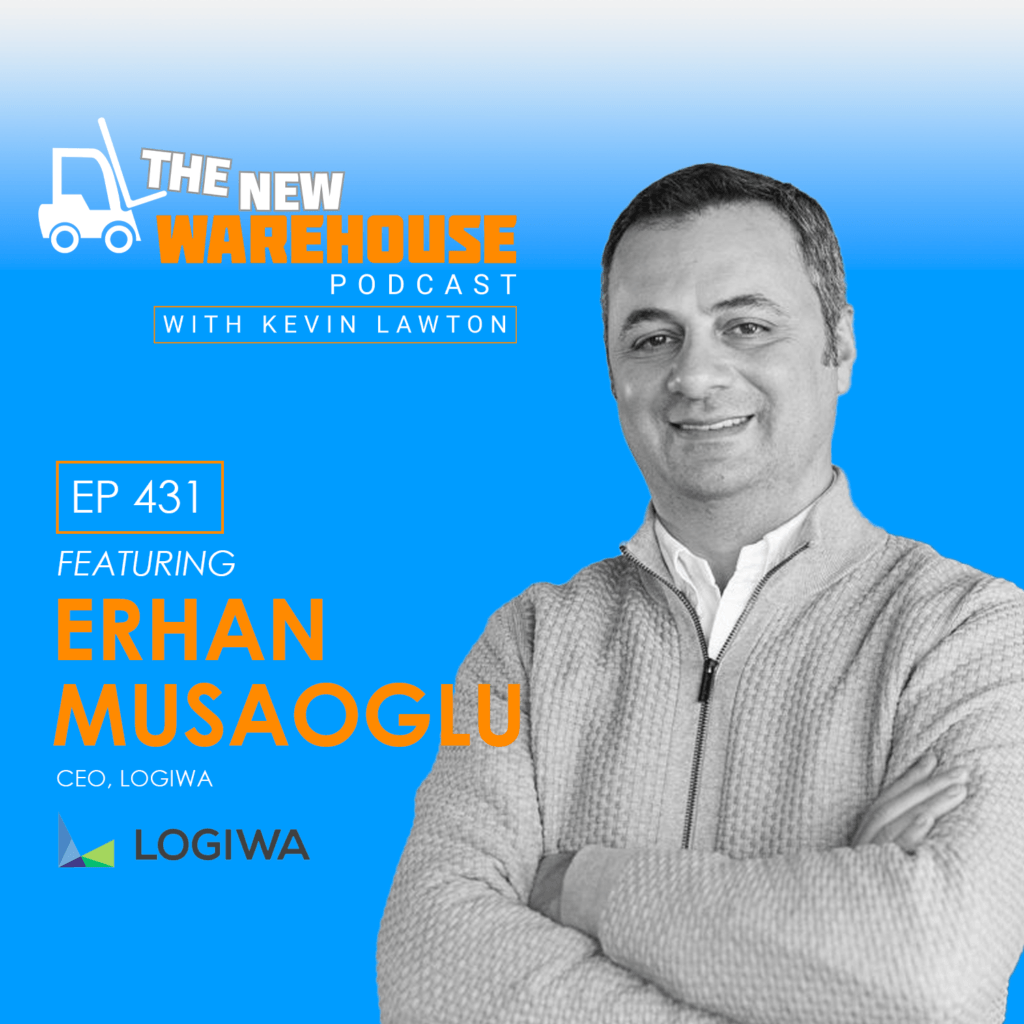
Logiwa positions itself not as a traditional WMS but as a modern fulfillment software specifically designed for high-volume, direct-to-consumer operations On today’s episode of The New Warehouse podcast, Kevin welcomes Erhan Musaoglu, the CEO and Founder of Logiwa. Erhan launched Logiwa two decades ago, initially implementing tier-one legacy WMS systems for large B2B companies. However, he noticed a gap in the market when it came to e-commerce companies. Traditional WMS solutions designed decades ago were inefficient for today’s direct-to-consumer models, which require processing thousands of small, individual orders. The inefficiencies of using old systems led him to create Logiwa, a solution that addresses the distinct needs of e-commerce and direct-to-consumer businesses. Be sure to tune into this episode to discover more about how Logiwa is revolutionizing the world of warehousing and what the future holds for AI in this sector. More than Just a WMS, Logiwa Provides Fulfillment Software Logiwa distinguishes itself from traditional WMS solutions by being highly adaptable to the requirements of modern e-commerce. As Erhan explains, shipping 10,000 pens in a B2B environment might involve a single forklift and two pallets, but in a direct-to-consumer scenario, it involves thousands of different orders, shipping labels, and a much larger workforce for picking, packing, and shipping. This real-world example illuminates the company’s focus on creating a product tailored to the labor-intensive nature of e-commerce fulfillment. Erhan stresses the importance of distinguishing between traditional WMS and fulfillment systems. The difference lies in their core objectives: while WMS focuses on storage, fulfillment systems are all about speed. “You don’t want to store anything in the fulfillment center. You just want to ship faster and faster,” Erhan states. Exploring the Diverse Landscape of Fulfillment Software and Warehouse Management Systems Erhan describes various types of technology powering WMS solutions, from on-premise legacy systems to cloud-based offerings. This diverse range of options reflects the changing needs and challenges businesses face today. One Size Fits All: According to Erhan, some providers are transitioning from a one-size-fits-all model to more targeted solutions. This change aligns with a broader industry trend toward specialized solutions that offer quicker time to value. User Experience: Erhan points out that modern WMS solutions are increasingly user-friendly and intuitive, reflecting a broader shift in how technology is designed and interacted with. Connectivity: easily integrating with other platforms is becoming more critical than ever, as Erhan notes. This development is part of a more significant trend of increasing interoperability in the industry. Emerging Focus on Fulfillment: Erhan suggests a growing focus on fulfillment over storage in some corners of the industry, illustrating the array of strategic choices that businesses now have. Erhan adds, “Eighty-two percent of Logiwa’s customers are shipping in less than 20 hours. And if your old legacy system is causing you to ship slower, you are losing your money.” The Transformative Impact of AI on Fulfillment Software and Warehouse Operations Erhan highlights the transformative potential of Artificial Intelligence (AI) in actively optimizing warehouse operations, particularly in outbound flow. AI uses algorithms for complex tasks that the human brain or even mathematical models find challenging—such as order batching, walking path optimization, and employee assignment. These algorithms capture every user activity and motion in the warehouse to establish labor standards, thereby efficiently matching employees to tasks. The real-world application of AI in Logiwa’s systems reflects the future-forward focus of the company, where predictive analytics and real-time adjustments can enhance labor productivity and operational efficiency. Furthermore, Erhan believes AI will play an increasingly central role in planning and coordinating warehouse operations. The future vision includes a “big AI machine” that runs continuously and can forecast demand, inventory management, and even immediate employee assignments based on their skill set and patterns. He points out that the advancements in AI technology could eventually lead to humanoid robots efficiently picking from bins and packing orders, something not yet fully realized. Key Takeaways Modern fulfillment software is moving towards high-volume, direct-to-consumer operations, differing significantly from traditional Warehouse Management Systems (WMS) that focus on storage. The landscape of WMS and fulfillment software is diverse and evolving, featuring everything from on-premise legacy systems to user-friendly, cloud-based platforms. Artificial Intelligence (AI) is poised to revolutionize warehouse operations, specifically optimizing outbound flow. Through sophisticated algorithms and predictive analytics, AI can optimize labor assignments, enhance operational efficiency, and even forecast demand. The New Warehouse Podcast EP 431: Breaking Down Fulfillment Software, Warehouse Management Systems & AI with Logiwa
Smart Vision Lights launches JWL150-DO Lightgistics Machine Vision Light with hidden strobe technology

Smart Vision Lights (SVL) has introduced the JWL150-DO Lightgistics Series light, now with Hidden Strobe technology, which delivers the benefits of strobing without the distraction and disorientation associated with LED strobe lights. Hidden Strobe technology allows LEDs to internally self-trigger thousands of times per second, pulsing faster than the human eye can perceive and creating the illusion of continuous light. The technology maximizes machine vision systems while protecting employees from the disorientation caused by flashing lights. “In high-speed machine vision systems today, LEDs are pulsed to freeze images of fast-moving objects, but the strobing effect can create an uncomfortable and potentially unsafe working environment,” says Steve Kinney, director of training, compliance, and technical solutions at Smart Vision Lights. “Designed specifically to address these issues, the JWL-150-DO with Hidden Strobe technology helps high-speed machine vision systems capture the right images without causing unintended environmental hazards and without shielding.” Improve Track-and-Trace through lighting Designed specifically for performing challenging high-speed, accurate barcode reading and optical character recognition (OCR) with packages in highly reflective plastic wraps or shipping bags, Lightgistics lights feature Dual OverDriveTM technology — which combines SVL’s Deca OverDriveTM and standard OverDriveTM engines and allows end users to attach polarizers that retain exceptional light output while handling any speed. “Automation applications in logistics today require high speeds and high accuracy, and when difficult applications such as reading through polybags and plastic wraps slow down the process, throughput slows down,” says Kinney. “Lightgistics LED lights address these issues head on by offering greater than 10 times brighter light pulses compared to standard continuous mode. This capability improves overall logistics and track-and-trace. The JWL-150-DO delivers an intense, compact light source with an integrated camera mount that can be directly connected and controlled through a camera’s trigger output. The JWL150-DO features an onboard charging capacitor designed to ensure powerful bursts of energy with a low consistent electrical draw. The IP65-rated bright field operates using a working distance of 500 mm up to 2000 mm; 10-, 14-, and 30-degree lens options; and built-in Multi-Drive technology that provides both continuous operation and OverDriveTM mode.
Episode 430: The Evolution of WMS Implementation with Tryon Solutions
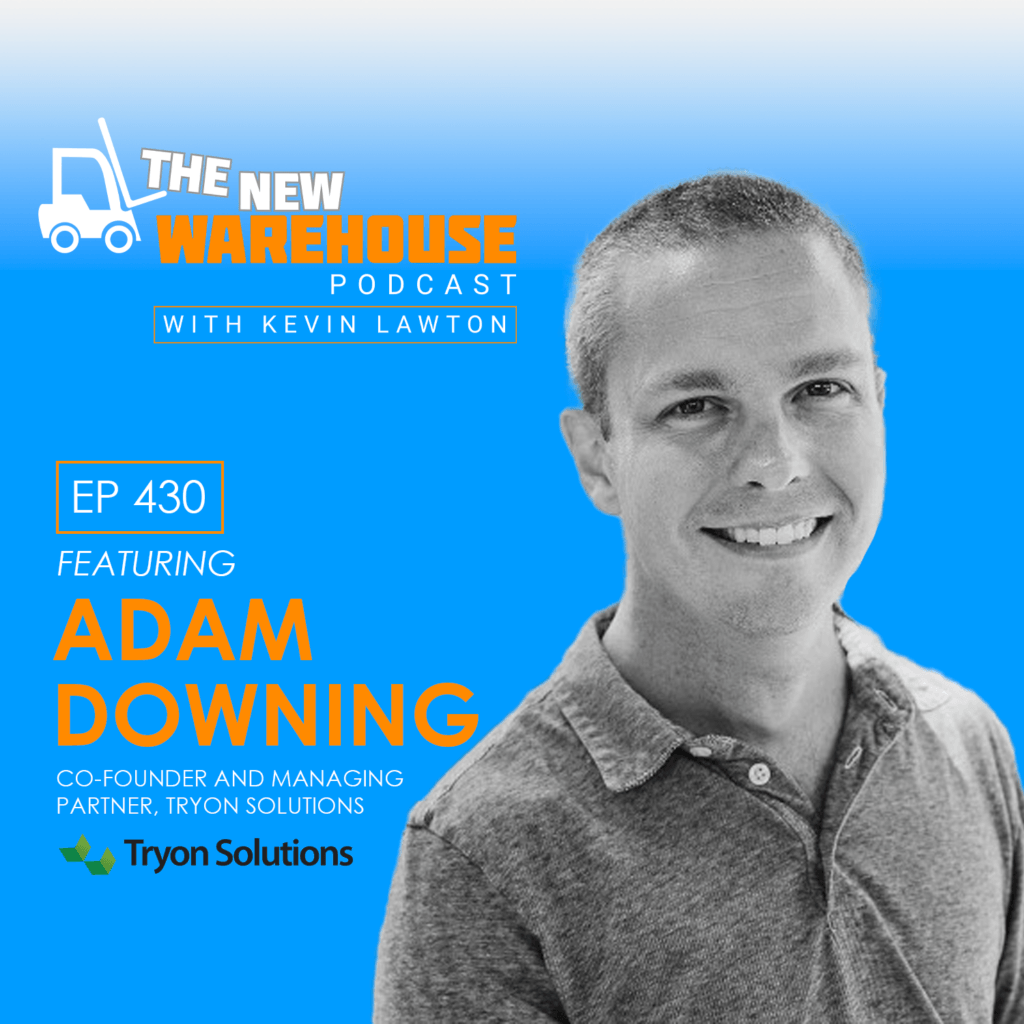
In the latest episode of The New Warehouse Podcast, special guest Adam Downing, President of Tryon Solutions, dives into the intricate world of Warehouse Management Systems (WMS). With 14 years of specialization in Blue Yonder WMS implementations, Tryon Solutions provides a comprehensive suite of services spanning consulting and operational improvements to upgrades and support. Based in Raleigh, North Carolina, and boasting a global presence, the company completed an impressive thirty-nine go-lives just last year. Adam offers invaluable insights into how WMS providers are evolving to keep pace with rapidly advancing technologies, including automation and robotics. Don’t miss the chance to gain these insights; tune in to the episode for the full discussion. Robotics, Labor Issues, and the Rise of SaaS in Warehouse Management Systems In an industry as dynamic as warehousing keeping up with technological advancements and labor market shifts is crucial. Adam sheds light on some of the most pressing issues and changes currently affecting the warehouse management landscape. “A lot of our products right now are centered around either robotics or automation,” Adam mentions, highlighting the increased focus on these technologies to drive efficiencies, with labor remaining a significant concern. One of the most noteworthy shifts is moving from on-premise solutions to Software as a Service (SaaS). “There’s this big push to move to SaaS,” Adam notes. This change, though sometimes met with resistance from large enterprise IT departments, is becoming increasingly accepted. It allows operational folks to take more ownership of the systems, bypassing the need to rely solely on internal IT teams. “SaaS WMS solutions are not a new thing, but certainly from the enterprise level, they are becoming more and more adopted,” Adam adds. WMS Implementation and Integration in an Age of Robotics and Automation Adam emphasizes the integration challenges of the proliferation of robotics: “You’re just automating things that are in your work queue, and rather than assign it to a person, you’re assigning it to a robot. Much of that still boils down to how you implement it and do the industrial engineering to build that into your operation.” This becomes particularly pertinent as warehouses strive for seamless coordination between human labor and automation technologies. As warehouses increasingly adopt robotics and other automation technologies, one critical hurdle is how these new tools integrate with existing WMS platforms. “The biggest challenge our customers see is how you integrate these various technology solutions with your existing WMS system?” Adam points out. He notes that while older WMS systems might still be able to handle new technologies via middleware, there’s a growing push toward SaaS solutions. The transition to SaaS offers better reliability and eases the integration of additional microservices that can optimize operations further. The Value of Test Automation in Streamlined Warehouse Operations Test automation is pivotal, especially as the warehouse ecosystem becomes more complex. “Test automation, for example, doesn’t necessarily make your go-live easier, but it makes your ongoing maintenance more robust and reliable. It’s always about mitigating risk,” Adam shares. He notes that while test automation is most effective in a large ecosystem where WMS is just one part of a broader IT infrastructure, its value is undeniable in maintaining long-term operational integrity. “We look at automating those tasks of the high priority things…the picking, the put-away, those sorts of tasks,” says Adam. By focusing on automation for these tasks, warehouses can better mitigate risk and reduce the need for manual interference, which can be especially critical during system upgrades or other changes. Key Takeaways on WMS Implementation Robotics and automation are increasingly essential in warehouse management, necessitating seamless integration with existing WMS platforms. The transition from on-premise to Software as a Service (SaaS) solutions accelerates, allowing operational teams to take greater ownership and improve system reliability. Test automation is pivotal for mitigating risks and streamlining operations, particularly in larger ecosystems where WMS interacts with a broader IT infrastructure. EP 430: The Evolution of WMS Implementation with Tryon Solutions
Women In Trucking Association announces finalists for 2023 Influential Woman in Trucking Award
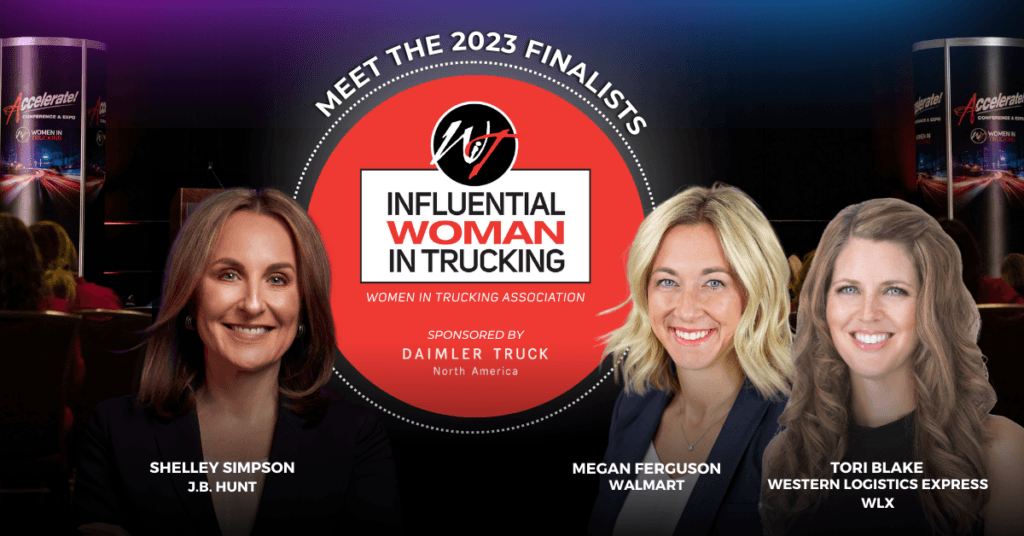
The Women In Trucking Association (WIT) just announced the three finalists for the 2023 Influential Woman in Trucking award sponsored by Daimler Truck North America (DTNA), the leading manufacturer of Class 6-8 commercial vehicles in North America. This award was developed in 2010 to recognize female leaders and to attract and advance women in the trucking industry. The award highlights the achievements of female role moles and trailblazers in the trucking industry. The 2023 Influential Woman in Trucking finalists are: Tori Blake, Chief Financial Officer and Co-owner, Western Logistics Express and WLX Megan Ferguson, Vice President and of End-to-End Delivery Acceleration, Walmart Shelley Simpson, President, J.B. Hunt Transport Services, Inc. Tori Blake, Chief Financial Officer and Co-Owner of WLX and Western Logistics Express “WLE”, has made it her mission to mentor women in all facets of her business. In her role, she is responsible for financial management, talent acquisition, employee development and strategic visioning. WLX|WLE have been recognized as one of Kansas City’s fastest growing companies each year Tori has been on the team, as well as one of Kansas City’s best places to work. She was also named Kansas City Business Journal’s 2023 CFO of the year. At the start of her career, Tori was an auditor at Ernst & Young, one of the four largest accounting firms in the world. Over her 16-year career as an executive leader, she has led startup companies and has a true passion for entrepreneurial endeavors. Tori has a heart for serving others. She was instrumental in supporting Children’s Mercy Hospital in Kansas City through “Sunshine Taggie” blankets for patients, handmade by WLX|WLE employees. She has also served as chairwoman of her church board, has been a children’s church teacher for over a decade, and is serving as the church mission trip leader. Tori is also a coach of two youth sports teams where she has the honor of coaching and guiding 25 young female athletes and leaders each year. Megan Ferguson, Vice President of End-to-End Delivery Acceleration at Walmart, holds over 15 years of experience at Walmart and Sam’s Club, with a deep background in transportation operations and strategy and merchandise operations. Megan joined Walmart in 2007 as a Private Fleet Strategy Intern and moved into the role of Project Manager of Walmart’s Private Fleet Strategy upon obtaining a degree in Supply Chain Management at Michigan State University. During her career at Walmart, she has filled transportation leadership roles in sourcing and procurement, inventory management and optimization as well as merchandise operations. In her current role, Megan brings Walmart’s delivery strategy to life, across first, middle, and last mile, and always prioritizing the customer’s needs. Megan is a passionate mentor and leader to her teams. She co-leads Walmart’s Women of Supply Chain Council as well as hosts educational sessions and mentorship circles while continuing to grow herself as an active member in the Walmart’s Women’s Officer Caucus. While her passions lie in advocating for women in the transportation and supply chain industries, her mentorship extends to all associates seeking guidance in managing relationships, peer collaborations, and various business topics. Megan prioritizes volunteering her time to train and participate in fireside chats and panel discussions to inspire other women to take on leadership roles. Shelley Simpson is President of J.B. Hunt Transport Services, Inc. Her 29-year career at J.B. Hunt reflects the company’s continued progression as an innovative leader in the transportation and logistics industry. Since joining J.B. Hunt as an hourly customer service representative, she has held multiple positions in business segments across the company, including leading Integrated Capacity Solutions, Truckload, Customer Experience, Highway Services and most recently serving as Chief Commercial Officer and Executive Vice President of People and Human Resources. While leading the strategic direction of marketing, sales, customer experience, and external product development, Shelley also led the development of the company’s freight matching technology platform J.B. Hunt 360°®. As the company evolved the platform and its technology-driven services, Shelley was also responsible for commercializing them on a global scale as the leader of International Services. In 2021, she was named one of the Top 100 Women in Supply Chain by Supply Chain Digital and has been named one of the top 100 HR Professionals by the National Diversity Council in 2022. She recently received the 2022 Woman of the Year in Innovation award by the Women’s Foundation of Arkansas and the Excellence in Free Enterprise Award from Economics Arkansas. There will be a panel discussion at the WIT Accelerate! Conference & Expo held in Dallas, TX, Nov. 5-8, 2023. The winner will be announced after the panel discussion on Tues, Nov. 7 at 10:15 a.m. CST.
Toyota Material Handling receives Manufacturing Excellence Award for community impact
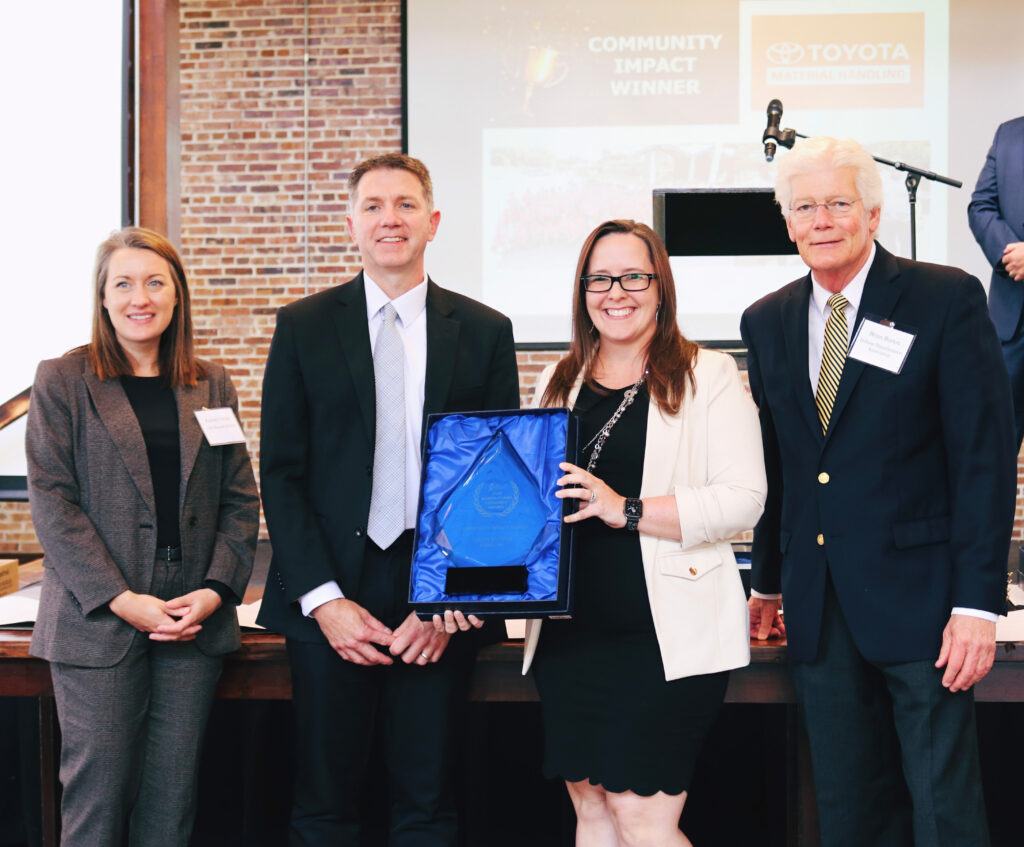
Toyota Material Handling (TMH), the North American leader in material handling innovation, received the 2023 Manufacturing Excellence Award for Community Impact during the Indiana Manufacturers Association’s (IMA) Hall of Fame Luncheon last week at Indianapolis’ Bitwell Event Center. The awards, given annually by the IMA, recognize manufacturers that make important contributions to the customers and communities they serve and set an example for other companies to follow. Toyota Material Handling was selected from a large group of applicants for showing exemplary leadership and a strong commitment to community service as reflected in its company policy, resources and employee participation. “At Toyota, we believe it is our responsibility to contribute to society in meaningful ways and make a real difference in the communities in which we live and work,” said Tony Miller, Toyota Material Handling Senior Vice President of Operations, Engineering & Strategic Planning. “We take that responsibility seriously, and it’s an honor to be recognized with this award by the IMA. I’d like to thank every one of our associates for their unwavering commitment to making our community a better place. This award is not about the contributions of a few; it’s only possible because of the efforts of everyone at Toyota. We will always seek opportunities to invest in the communities we serve and dedicate our time and resources to continuously improve the lives of those around us.” Corporate social responsibility is integral to Toyota’s culture. Toyota has cultivated numerous community-focused relationships, including corporate partnerships with the American Red Cross, United Way and Anchor House, a local nonprofit focusing on investing in neighbors through housing, employment resources and nutritional assistance. Throughout the year, Toyota sponsors and organizes volunteer activities on and off Toyota’s campus. In 2022, Toyota associates donated 12,000 hours of their time to support local organizations, contributing to a total economic impact of $750,000. “We instituted the Indiana Manufacturers Hall of Fame Awards in 2015 to help bring awareness and recognition to the many positive contributions of Hoosier manufacturers, and added the Manufacturing Excellence Awards in 2019 to focus and honor companies in specific areas of achievement,” said IMA President and CEO Brian Burton. “We congratulate Toyota Material Handling for their outstanding work and continued dedication to making Indiana manufacturing a positive and driving force for the state.”
Terex announces leadership succession plan

John L. Garrison, Jr. to retire as Chairman and CEO effective January 1, 2024 Simon Meester, current President Terex Aerial Work Platforms, named next CEO Joshua Gross named next President Genie Raises Full Year 2023 Outlook Terex Corporation has announced that John L. Garrison, Jr. is retiring as Chairman and Chief Executive Officer and a member of the Board of Directors, effective January 1, 2024. Garrison will be succeeded by Simon Meester, current President Terex Aerial Work Platforms, as the Company’s President and Chief Executive Officer. Meester will also join the Company’s Board. Garrison will work closely throughout the remainder of 2023 with Meester to ensure a seamless and orderly transition of responsibilities. Joshua Gross, current Genie Vice President of Global Strategy and Product Management, will be promoted to President Genie. Garrison will continue as a consultant for Terex after January 1, 2024 through June 30, 2024. David Sachs, currently lead independent director of the Terex Board will become Non-Executive Chairman of the Board effective January 1, 2024. Garrison said, “Leading Terex has been the highlight of my career. Without a doubt, our success and achievements have been driven by our dedicated, engaged team members who live our Terex Way Values and Zero Harm Safety culture each and every day. Terex is in as strong a position as it has ever been in and now is the right time to begin the transition to Terex’s next leader. I have had the privilege of working closely with Simon for a number of years and he has proven to be a global, strategic thinker with a natural ability to lead teams and drive results. I have great confidence that he is the right leader for Terex as the Company focuses on delivering long-term value for its stakeholders.” Sachs said, “On behalf of the entire Board, I want to thank John for his significant contributions, leadership and dedicated years of service to Terex. Since his appointment as CEO, he has been instrumental in transforming our Company into the Terex of today which comprises a very strong portfolio of market leading businesses. Under his leadership, Terex has experienced remarkable success and remains well positioned for continued growth. The naming of Simon as the next CEO is the culmination of a thorough and orderly succession planning process undertaken by the Terex Board, that included the evaluation of internal and external candidates, to ensure continuity of leadership. The Board is confident that Simon is the right choice to lead Terex in its next phase of growth and value creation for our shareholders.” “I am excited and humbled to be named the next CEO of Terex,” said Meester. “It is an honor and privilege to represent our dedicated and hardworking team members. We are in a great position for the future given our strong foundation, and I look forward to continuing to work closely with John to ensure a seamless transition. In the months ahead, I also will continue to work closely with Josh Gross to ensure a smooth transition at Genie. Josh has been a critical member of the Genie leadership team and is the right person to successfully drive Genie’s strategic initiatives going forward.” Gross said, “I look forward to working alongside Simon and our leadership team as we continue to provide our customers with industry leading products and services. This is an exciting time for our business and an incredible opportunity to build the future together with our customers.” Raises Full Year 2023 Outlook Terex expects its full year 2023 earnings per share results to be approximately $7.05. The Company will provide a detailed full year 2023 outlook when it releases its third quarter 2023 financial results on October 26, 2023. About Simon Meester Simon Meester has been President Aerial Work Platforms since May 2023. He was appointed President, Genie, on August 1, 2021. Previously, Mr. Meester had been serving as Chief Operating Officer of Genie since June 2020. He joined Terex in 2018 as Vice President, Global Sales and Marketing Administration for Genie. Prior to joining Terex, he was VP and General Manager of the Industrial Control Division at Eaton Corporation. Earlier, he spent 14 years in progressively senior roles at Caterpillar, Inc., before becoming President, Sandvik Mining and Construction in India. He has managed global teams and operations for more than 20 years, based in seven countries, including 11 years in the United States. He holds an MBA from the University of Surrey, England and a Bachelor of Science in automotive engineering, Apeldoom, Netherlands. About Josh Gross Josh has been Genie’s Vice President Global Strategy and Product Management since July 2022, and prior to that was Vice President Global Commercial Operations since August 2020. Josh joined Genie in 2019 and has led areas including strategy, product management, Genie Operating System, marketing, pricing and sales, inventory and operations planning (SIOP). He has worked closely with Simon in reimagining Genie’s brand positioning, resulting in the launch of Genie’s updated brand promise, “Quality by Design.” Before joining Genie, Josh spent almost 11 years with Eaton, where he served in a variety of roles in increasing levels of responsibility including Plant Operations Manager and Multi-Site Leader, Global Product Line Manager (P&L Leader), Product Manager, and Senior Sales Engineer. Josh holds BS degrees in Aerospace Engineering and Mechanical Engineering from West Virginia University, and an MBA from Marquette University.
Enabling frontline workers to drive efficiency and cost reductions with lean manufacturing

When it comes to supply chain and logistics, efficiency takes center stage. Central to this pursuit is the practice of lean manufacturing, which identifies processes and practices to streamline operations, reduce costs, and engage frontline workers. However, multiple misconceptions surround lean, from its purpose to its impact on the workforce. Contrary to popular belief, lean does not typically result in layoffs and is not merely about trimming the fat. It’s a strategic growth initiative that demands investment and engagement at every level – including your frontline employees. Unlocking efficiencies through lean manufacturing requires active participation and support from frontline workers familiar with daily tasks and operations. Warehouses and manufacturing facilities can tap into their expertise by involving frontline workers in all aspects of lean training and instilling a deeper understanding of lean’s purpose and methodology. Recent surveys reveal a disconnect between the potential benefits of involving more employees and actual lean training practices. Historically, frontline workers have been left out of lean training even though 72% of manufacturers say production would increase, and 91% believe their workers would be more engaged in efficiency efforts if they understood lean principles and objectives. Yet only 40% of manufacturers provide lean training to frontline workers.* Let’s break down some of the positive outcomes of extending lean training to a broader set of warehouse and manufacturing employees. Strategic investments for tomorrow The beauty of lean lies in its ability to generate substantial cost savings that can fund employee-related initiatives such as enhanced training, upgraded tools, and new technology or wellness programs. By introducing these benefits, frontline workers can see the advantages of lean manufacturing firsthand. Redirecting lean savings back into the workforce creates a culture of loyalty and empowerment among frontline workers. Companies can build trust and provide a sense of belonging by showing they value employees enough to dedicate resources that improve their work environment. Skill-building programs, health and wellness programs and facilities, and employee assistance programs demonstrate commitment to frontline employees who become a driving force for long-term prosperity. Maximizing employee potential and growth As the lean process takes hold, a transformative shift occurs within the workforce. Enhanced efficiency gives employees more time and opportunities to explore other value-added tasks. Companies have more time to cross-train employees, giving them additional skills and opportunities for professional growth. Embracing the spirit of experimentation One of the most important facets of lean manufacturing is the willingness to embrace experimentation. Failure is necessary for continuous improvement and is one of the most critical factors in the overall success of the lean process. Every employee, from the frontline workers to managers to top executives, plays a pivotal role. Implementing lean processes requires managers and workers to introduce new ideas, some of which will work and some that won’t. Ideas that don’t work provide employees with valuable lessons. A good rule of thumb for all lean improvements is to plan, do, check, and adjust. Lean manufacturing uncovers new efficiencies and cost savings that can be reinvested to create a more engaged and empowered workforce. When employees are incentivized to find more savings, a never-ending cycle of improvements and efficiencies is created. *Source: Industry Survey, “The Regulatory, Economic, and Workforce Trends that Will Shape 2023,” Intertek Alchemy About the Author: Holly Mockus has over 30 years of experience in safety and quality assurance roles at companies like ConAgra, Kellogg, and Sara Lee, Holly currently serves as Director, Content and Industry Strategy at Intertek Alchemy, where she helps to create world-class workforce development solutions for large, complex operations within the manufacturing industry.
Monetize your value Part 2

I am preparing an intro for this month’s topic, and then we will jump into material prepared by Nathan Hawkins asking him to update the readers about the status of ESOPs in today’s economic environment. I asked him five questions about the state of the ESOP (Employee Stock Option Plan) market, how ESOPs could help with recruiting and employee retention, what’s changed since the Pandemic, how interest rates and inflation have impacted ESOP transactions and what the future holds for ESOPs. I also asked for a recap of the tax benefits generated by an ESOP transaction (spelled additional cash flow). Hopefully, we can include all of this material in this month’s publication. I am afraid Dean is going to charge me for the additional space I am asking for. I am doing this because the annual readers’ survey indicated that readers wanted to know more about ESOPs. So, here you have it. I believe this is an important topic since I keep reading about markets consolidating through M&A transactions. In other words, you can sell it to an outsider or to your employees. With the ESOP you can sell 100% or 51% and get tax benefits. You can also use the ESOP and a platform to build a larger company. If there is any interest going forward, I am sure we could put together a ZOOM meeting to address questions readers may have. We, of course, would not disclose who is asking the questions. 1.What is the state of the ESOP market, and what are some of the key components impacting decisions today? Growing Popularity: ESOPs have been growing in popularity as a succession planning and employee retention tool for business owners. ESOPs can help owners sell their businesses to their employees, ensuring continuity and preserving the company culture. Regulatory Environment: The regulatory environment for ESOPs can influence their prevalence and structure. Changes in tax laws and regulations may impact the attractiveness of ESOPs as a business transition strategy. Financing: The ability of employees to finance the purchase of company shares can affect the feasibility of ESOP transactions. Companies may use a combination of debt, seller financing, and contributions from the business to fund the ESOP. Valuation: Determining the fair market value of a company’s shares for ESOP transactions is critical. Professional valuation firms are often involved to ensure fairness and compliance with regulations. Employee Benefits: ESOPs offer employees an opportunity to accumulate ownership in the company. Employees may become more engaged and motivated when they have a financial stake in the business’s success. Exit Strategy: For business owners looking to retire or exit their companies, ESOPs can provide an alternative to selling to external parties or competitors. Industry Variability: The prevalence of ESOPs can vary by industry. Some industries, such as manufacturing and construction, have a long history of using ESOPs, while others may be less common. Challenges: ESOP transactions can be complex and require careful planning and execution. Challenges may include financing, governance, and managing the transition from owner to employee ownership. 2. How do ESOPs help businesses attract and retain employees? Employee Stock Ownership Plans (ESOPs) can be effective tools for attracting and retaining employees for several reasons: Ownership Stake: ESOPs provide employees with a direct ownership stake in the company. When employees have a financial interest in the success of the organization, they are more likely to be motivated and committed to achieving the company’s goals. This sense of ownership can lead to increased loyalty and dedication to the company’s long-term success. Financial Incentive: ESOPs offer employees the opportunity to share in the company’s financial success. As the company performs well, the value of their ESOP shares increases. This can serve as a powerful financial incentive, aligning the interests of employees with those of the company and its shareholders. Long-Term Perspective: ESOPs encourage employees to think long-term rather than focusing solely on short-term gains. This can be especially valuable for companies that prioritize sustainable growth and stability over quick profits. Employees are more likely to stay with a company that emphasizes long-term success. Employee Engagement: When employees feel like owners, they are more likely to be engaged and committed to their work. They may be more willing to go above and beyond to contribute to the company’s success because they directly benefit from that success. Retention Incentive: ESOPs often have vesting schedules, which means that employees must stay with the company for a certain period of time to fully vest in their ESOP accounts. This serves as a retention incentive, as employees who leave the company before vesting forfeit some or all of their ESOP benefits. Retirement Benefits: ESOPs can serve as a valuable retirement savings vehicle for employees. Knowing that they are building a significant retirement nest egg through their ESOP participation can be a strong incentive for employees to stay with the company for the long term. Competitive Advantage: Offering an ESOP can be a competitive advantage when recruiting new talent. It can set a company apart from competitors and attract candidates who value the opportunity to become company owners. Positive Company Culture: ESOPs can contribute to a positive company culture. They promote transparency, open communication, and a sense of teamwork among employees, which can enhance the overall work environment. Tax Benefits: ESOPs can provide tax benefits to both the company and employees. Contributions to ESOPs are often tax-deductible for the company, and employees may receive favorable tax treatment on the distribution of their ESOP benefits. Succession Planning: For companies looking to transition ownership from one generation to the next, ESOPs offer a structured way to do so while retaining the company’s legacy and culture. Overall, ESOPs can be a powerful tool for attracting and retaining employees who value ownership, financial incentives, and a long-term commitment to the company’s success. However, it’s important for companies to communicate effectively about the benefits of ESOP participation and provide ongoing education to employees to ensure they fully understand and appreciate the value of their ESOP ownership.
Know your Key Performance Indicators in rental management

As the calendar turns to November, it’s hard to believe that it’s been over a year now since becoming a regular contributor in this Aftermarket column. In last month’s edition, I wrote about the topic of relational capital; the intangible asset that encompasses the network of relationships you build with your customers, partners, and employees. My personal relational capital has allowed me to regularly get inspiration for content to contribute to this monthly column. So, with that, this month’s inspiration came from my attendance at the recent MHEDA Rental and Used Equipment Management Conference in Chicago. The goal of the conference was not only to enhance rental and used equipment management skills, but also to increase the profitability of said departments. A common topic shared after speaker presentations and during round-table discussions was the topic of having dedicated technicians for your rental equipment. Let us further explore this topic. Many dealerships I visit tend to have a dedicated rental equipment department. The rental department managers are responsible for making the service and parts decisions for the equipment within. Many of the rental management professionals I spoke to at this conference shared the same sentiment: When it comes to managing a rental fleet, where efficiency and reliability are paramount, the role of dedicated technicians cannot be overstated. Whether your dealership rents forklifts, construction equipment, or any other type of machinery, having a team of specialists solely focused on maintaining and servicing your rental fleet can be a game-changer. Three important rental management KPIs that are related to aftermarket parts and service include: Maintenance Costs: Monitoring the expenses related to maintaining your rental fleet. Costs include technician labor, spare parts, as well as any other 3rd party maintenance costs. Regular maintenance can extend the lifespan of your equipment and reduce long-term costs. Employee Productivity: It is important to regularly measure the productivity of your staff involved in the rental process, including sales, customer service, maintenance and logistics. Downtime: Monitoring the amount of time your rental equipment is out of service due to maintenance, repairs, waiting on spare parts, and other reasons. Reducing downtime is crucial for maximizing profitability. These three KPIs (Key Performance Indicator) are why it’s recommended to have dedicated technicians servicing your rental equipment. Dedicated technicians are the heart and soul of your rental fleet maintenance. They are the ones who will know the intricacies of your equipment. By specializing in the specific make and model of forklifts or any machinery within your fleet. They can develop an intimate familiarity that extends far beyond the operator’s manual. Their expertise enables them to swiftly diagnose issues, execute efficient repairs, and minimize downtime. These specialists are the guardians of your machinery, ensuring it operates at peak performance. Consistency is a cornerstone of dedicated technician teams. With a singular focus on your rental fleet, they adhere to a standardized maintenance and inspection regimen. Every forklift, aerial work platform, or other machine receives the same meticulous care, enhancing reliability, safety, and unwavering quality assurance. Technician efficiency is a precious commodity. With dedicated technicians, you gain an edge in efficiency. These specialists are not distracted by the demands of everyday service calls with a wide array of customer owned equipment. Their undivided attention translates into quicker turnaround times for maintenance and repairs, ultimately benefiting your bottom line. Preventive maintenance is the key to cost savings and a well-run rental fleet. Dedicated technicians excel at identifying and rectifying issues before they escalate into costly problems. By proactively addressing maintenance needs, they keep downtime to a minimum and ensure that the machines in your fleet remain reliable money-making machines. Dedicated technicians create accountability and clear lines of responsibility. With a specialized team in place, it’s easier to pinpoint who is responsible for the condition of each machine. This accountability fosters a culture of excellence and ensures that your forklifts or other equipment are consistently kept in optimal working condition. These dedicated technicians also maintain meticulous records of all maintenance and repair activities for each piece of equipment in your rental fleet. This documentation is invaluable for tracking the history of each machine, adhering to maintenance schedules, and ensuring compliance with safety regulations. Dedicated technicians are the driving force behind your rental fleet’s success. Their expertise, consistency, and commitment to excellence ensure the continued reliability of your equipment and elevate your service quality. In the competitive landscape of equipment rentals, dedicated technicians are a strategic investment that propels your business towards operational excellence and customer satisfaction. By having a team of dedicated technicians responsible for servicing your rental fleet, you not only ensure the well-being of your equipment but also elevate the overall quality of service you provide to your valued customers. In the competitive world of equipment rentals, dedicated technicians are an investment that pays dividends in operational excellence. Downtime is lost time. So, look to employ dedicated technicians for your rental equipment to ensure operational efficiency, profitability, and customer satisfaction. The presence of dedicated technicians instills a sense of accountability and excellence in the management of your rental fleet, making them an indispensable asset for success. About the Author: Chris Aiello is the Business Development Manager at TVH Parts Co. He has been in the equipment business for 16-plus years as a service manager, quality assurance manager, and business development manager. Chris now manages a national outside sales team selling replacement parts and accessories in various equipment markets such as material handling, equipment rental, and construction/earthmoving dealerships.
The secret formula is React, Respond, Recover, +1

You do something wrong. The customer gets mad. You apologize and try to fix the problem, make nice, and hope they don’t go someplace else next time. Want to buy some “Customer Insurance?” Sure, you do. How do you get “Customer Insurance”, you ask? Easy, you already have it. The problem is that most people (companies) don’t use it. Reason? Insurance costs a little extra. It’s called Plus One Insurance and here’s how it works: When the customer is angry, or you can’t deliver the way they expect, the formula that will make them forgive you, continue to do business with you, and tell others about you is React, Respond, Recover, +1. Here’s what that means. Let’s say you’re late for a delivery, or you deliver the wrong thing, or you make an error in something personalized, or you miss a deadline, or you deliver bad food to the table. In short, you make a business mistake that irritates (or angers) the customer. Now, you must react, respond and recover from the mistake. When you’re done with your dance of apology and making amends, that’s when the customer STARTS talking. They will say something good, nothing, or something bad about you depending on what you said, how you said it, what you did, and how you did it. IMPORTANT NOTE: The customer’s story was crafted by your words and deeds. How much is a positive story worth? How much is a saved customer worth? How much does a negative story cost? How much does a lost customer cost? The answer is “Plus 1.” All you have to do to ensure that the story will be positive, and the customer will be saved is to add a “+” to the end of the transaction. Something extra that the customer was not expecting. Something that will add a smile. Something that will add some “good” to the situation and make a pleasant surprise the last memory the customer has. For example, if your customer: goes into your store for a sale item and you’re sold out. checks into your hotel and their room isn’t ready. orders something and you deliver it wrong. You figure if you just get the customer what they need, you’re out of the woods and they’re “satisfied.” And you figured it wrong. You may be out of the woods, but you may still be in the dog house. You need to add the extra. The “Plus.” You need to add a surprise. You need to add the memory. You need to add a reason to say something good about you. Because the risk of NOT doing it is too large. Let’s take the three examples above and elaborate. Let’s assume you can meet their fundamental needs and recover from the wrong. The real question is: what can you ADD to the situation that will make it a memorable one? Here’s how to add the “+” and create a WOW! You go into the store for a sale item, and they’re sold out. The clerk gives you a “raincheck” to ensure you get the item. AND (the plus) the clerk calls other stores, locates the item and has it delivered to your home at no extra charge. AND (another plus) the clerk gives you a “private sale” card that lets you purchase anything else in the store today only at a 15% discount. You check into a hotel and your room isn’t ready. The clerk says, “Mr. Gitomer, you’re in luck! Your room isn’t ready. That means you get to eat breakfast for free AND (the plus) use our business canter for free. Wow!” You order something and it’s delivered wrong. The correct response when confronted is NOT an excuse. The correct response is, “OH, THAT’S HORRIBLE.” Followed by a statement of what will be done and when. Followed by some bonus that has verbiage something like this: “Mr. Gitomer, you are in luck. You have qualified for our “Wrong delivery, customer bonus” program. Here’s how it works………” The “PLUS” is the difference between satisfactory and loyal. The “PLUS” is the difference between a positive and negative story retold. And the story will be retold. The only question is which way. I hope you’re willing to invest in the “plus” customer insurance premium. Some fools aren’t. About the Author: Jeffrey Gitomer is the author of twelve best-selling books including The Sales Bible, The Little Red Book of Selling, and The Little Gold Book of Yes! Attitude. His real-world ideas and content are also available as online courses at www.GitomerLearningAcademy.com. For information about training and seminars visit www.Gitomer.com or email Jeffrey at [email protected] or call him at 704 333-1112.
Port of Long Beach has strongest September on record

Cargo rises due to labor pact, heightened consumer confidence The Port of Long Beach achieved its busiest September on record, boosted by consumer demand for holiday-related goods, recent ratification of a labor pact between dockworkers and management and an ongoing effort to showcase the business attributes of the Port of Choice. Dockworkers and terminal operators moved 829,429 twenty-foot equivalent units (TEUs) in September, up 11.8% from the same month last year and surpassing the previous record set in September 2020 by 78,849 TEUs. September also marked the Port’s first monthly year-over-year cargo increase in 14 months. Imports rose 19.3% to 408,926 TEUs, while exports declined 10.3% to 101,248 TEUs. Empty containers moving through the Port grew 11.5% to 319,255 TEUs. “Consumer confidence is on the rise and shippers can rely on the Port of Choice now that we have a ratified contract in place with our waterfront workforce,” said Port of Long Beach CEO Mario Cordero. “We look forward to a moderate rebound in cargo volume through the end of the year.” “Offering the best service and facilities anywhere while supporting our labor and industry partners remains our top priority,” said Long Beach Harbor Commission President Bobby Olvera Jr. “Merchants and consumers can prepare for the holiday season with confidence in our ability to deliver goods reliably, quickly and sustainably.” The International Longshore and Warehouse Union and the Pacific Maritime Association announced a tentative agreement on June 14. Dockworkers of the ILWU ratified the six-year contract on Aug. 31. The Port has moved 5,822,666 TEUs during the first nine months of 2023, down 20.7% from the same period last year. Cargo volume this year has been on pace with pre-pandemic levels, when the Port of Long Beach moved more than 5.7 million TEUs through September 2019. Additionally, the Port processed 2,089,990 TEUs between July 1 and Sept. 30, down 10.5% from the third quarter of 2022. For complete cargo numbers, visit polb.com/statistics.
Take safety to new heights

The American Ladder Institute (ALI) is seeking sponsors for next year’s National Ladder Safety Month. New for 2024, the enhanced Top Cap Sponsor becomes a leading voice on ladder safety at work and at home. The sponsorship is a valuable brand extension for any company invested in the manufacturing of ladders or their safe use. Companies with employees working at heights fully understand the value of emphasizing safety and its impact on accident prevention and saving lives. Observed every March, National Ladder Safety Month is the only program dedicated exclusively to promoting ladder safety at home and work. Each year, tens of thousands are injured and hundreds die in accidents caused by improper ladder usage. The reach of National Ladder Safety Month only thrives with the support of its sponsors. They are the driving force behind helping to raise awareness on safe use and decreasing these tragic numbers. ALI, the only approved developer of safety standards for the U.S. ladder industry, is the presenting sponsor for National Ladder Safety Month. Other major sponsorship opportunities are also available and can be found here. The Top Cap Sponsor will be designated as the exclusive title sponsor of National Ladder Safety Month and will receive an array of promotional consideration, media impressions, and other perks. These include recognition on the National Ladder Safety Month virtual Save the Date (sent to over 3,000 safety managers and professionals), logo placement on all event promotional materials, a dedicated press release, including a quote, in March 2024 (average views of 2,000 per release), and recognition in the February 2024 press release (average views of 2,000 per release). This is in addition to a dedicated email blast to ALI’s database of more than 23,500+ contacts, dedicated social media posts (audience of 2,000+) with tagged recognition on ALI and National Ladder Safety Month channels (Facebook, Twitter, and LinkedIn) between January and March 2024, the company logo and link on National Ladder Safety Month website, a 300-word article on the ALI website, and a company video hosted on the National Ladder Safety Month website. To become Top Cap Sponsor or other level sponsor, contact [email protected]. For a list of other National Ladder Safety Month sponsorship levels, visit https://www.laddersafetymonth.com/.
Piab strengthens its grip on palletizing with the LBG-50
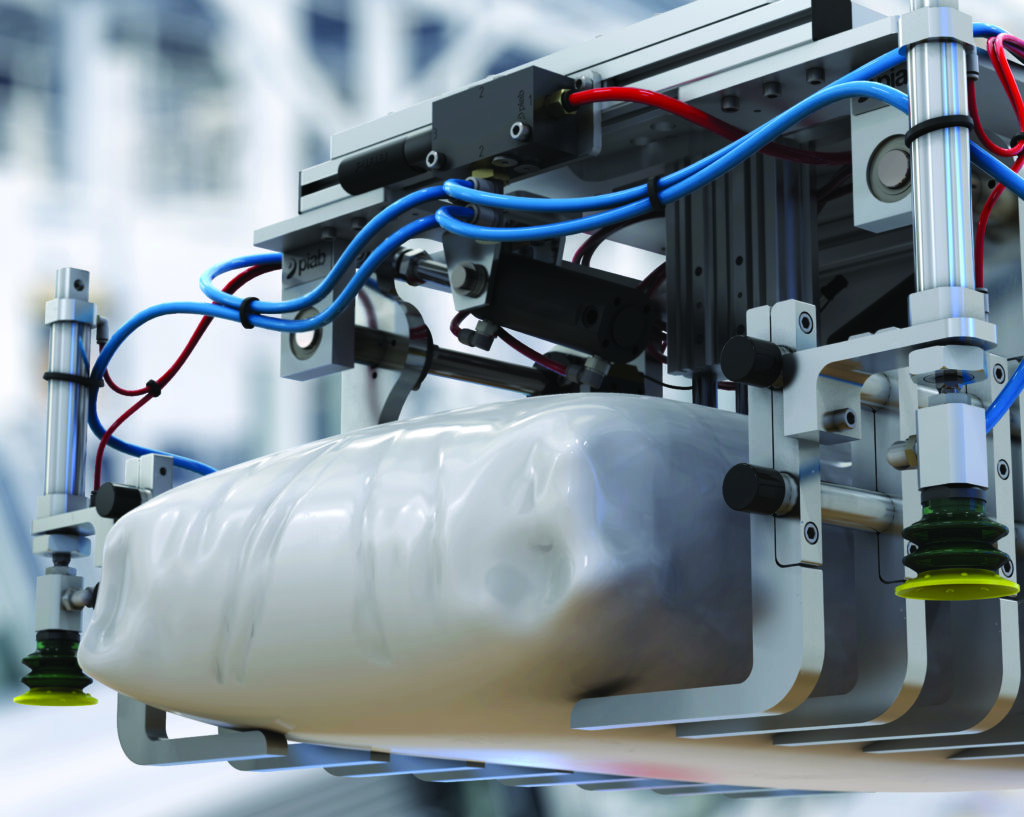
Piab strengthens its grip on the palletizing solutions market with a lightweight bag gripper, the LBG-50. The new gripper easily lifts sacks and bags with weights of up to 50 kg [110 lbs]. As it is a pre-engineered tool, valuable development time can be saved An unavoidable challenge when defining a new bag gripping system in a palletizing line is to get the exact measurements to align with the conveyor rollers for a smooth lifting and releasing process. This demands time-consuming analysis and design and, later, even more time for adaptation and adjustments. Furthermore, additional solutions may have to be considered, e.g., for slip sheet handling, which prolongs the implementation process and may interfere with the original set-up and purpose of the gripper. Piab‘s newborn in the palletizing tool family, lightweight bag gripper LBG-50, solves all that. “LBG-50 is the result of our long experience from developing custom palletizing End-of-Arm-Tooling (EOAT)”, says Madeleine Sheikh, Product Manager at Piab Vacuum Automation Division. “What we have here is a complete pre-engineered bag gripper that is easy to install, adjust and maintain. It offers flexibility to fit any roller conveyor on the market, and slip sheets are handled just as easy by our vacuum-based upgrade option with Duraflex® suction cups and COAX® technology.” Handling sacks normally poses a challenge as they are heavy and flexible, yet with a surface that is sensitive to pinching, puncture or rough treatment. LBG-50 avoids that by providing a gentle but firm lift while a built-in top clamp plate secures the bag from above during motion. This, in turn, allows higher cycle speed. Both the arm and the framework of LBG-50 are made of aluminum, which makes it robust yet lightweight. Other positive features are flexible width and finger positioning and generous mounting options. Flexibility also goes for the valve package, which can be configured with either Discrete I/O, Ethernet/IP or Profinet.
Eliminating waste over increasing efficiency

Efficiency is fundamentally about using less input and getting more output.When CEOs talk about increasing “worker efficiency”, it usually means getting fewer workers to do more work. You can have the most efficient workforce in the world, but if the company, the system, and the process they’re working in are wasteful, none of it really matters. Eliminating waste is actually way more important than driving efficiency. Efficiency will help you, but waste will crush you. To waste means to use or expend carelessly, extravagantly, or for no purpose. In business, this usually manifests as time spent on things that don’t matter. This could be anything from an executive’s pet project to utilizing hundreds of hours to tweak and modify documents that never end up seeing the light of day. There are also things that might look like waste but aren’t. Waste is not an idea explored that ultimately doesn’t make the cut. Waste is not an effort that fails. Waste is not a canceled project, no matter how much went into it. Waste is not a prototype abandoned along the journey to a solution – there’s always a portion of things that can get naturally lost in the process. (In making whiskey, this is called the “angel’s share” – a portion of the product that’s lost in the production process.) But when we allow actual waste to occur, we’re draining our organization culturally, competitively, and financially. Typically, there are four common causes of waste within an organization. First is bad communication – Say you come out of a leadership meeting energized with clear direction. You and your team charge ahead and make a ton of progress. Then, you hear from leadership the direction has already changed. Days ago, in fact. The problem here isn’t the fast pace of change, it’s bad communication or even the lack thereof. Is bad communication worse than no communication? Who cares. They both create excessive waste. Second is no framework — When a team gets handed strategic direction without any framework, they’re guessing what will meet expectations. They will bust their butts only to find out they’ve misunderstood the goalposts or worse, the goalposts have changed. When teams have to guess to understand strategy, objectives, or success measures, they’re mining rubies with a spoon and flicking them into the ocean. Third is bottlenecks — A bottleneck is a place in the work process where progress gets stuck. It might be because progress can’t happen without meeting with someone who’s double booked until 2050 or hasn’t looked at their inbox in months. Bottlenecks can force teams to sit on their hands until the bottleneck is resolved. What’s even worse is when ambitious teams decide to push on with the work anyway, only to find out only they were on the wrong track, and now you didn’t just generate waste but also destroyed souls at the same time. Fourth is fake urgency — Say you’re just wrapping up for the day when you get a message from the boss asking you to drop everything because something urgent is needed before the next morning. Your team pulls an all-nighter and gets it out the door. Then crickets. You never hear back and only later find out it wasn’t really needed at all. When we create false urgency, often it’s theater. It’s like when your boss’s boss slightly mentions that it’d be interesting to see some data, and your boss is already lighting up to get your team to produce it. Some people will see this as “an issue with leadership” and that it should be remedied by conducting a slew of leadership training exercises. I’d argue it’s not just leaders, but organizational culture. It’s likely most leaders aren’t thinking about waste on a day-to-day basis. But most organizations also haven’t created a culture to continually define, examine, and discuss waste, or define success metrics that actively measure the amount of waste in the organization versus how much has been eliminated. By ignoring organizational waste, you’re also wasting employee enthusiasm and morale. You’re also wasting opportunities for employee growth and learning. And ultimately you’re wasting employee loyalty. Most people are actually willing to work extremely hard. When it’s rewarding, they feel it. But when they see their good work wasted for no good reason, they’re left with animosity, angst, and frustration. And that’s what puts one foot out the door. About the Author Andrea Belk Olson is a keynote speaker, author, differentiation strategist, behavioral scientist, and customer-centricity expert. As the CEO of Pragmadik, she helps organizations of all sizes, from small businesses to Fortune 500, and has served as an outside consultant for EY and McKinsey. Andrea is the author of three books, including her most recent, What To Ask: How To Learn What Customers Need but Don’t Tell You, released in June 2022. She is a 4-time ADDY® award winner and host of the popular Customer Mission podcast. Her thoughts have been continually featured in news sources such as Chief Executive Magazine, Entrepreneur Magazine, Harvard Business Review, Rotman Magazine, World Economic Forum, and more. Andrea is a sought-after speaker at conferences and corporate events throughout the world. She is a visiting lecturer and startup coach at the University of Iowa, a TEDx presenter, and TEDx speaker coach. She is also an instructor at the University of Iowa Venture School. More information is also available on www.pragmadik.com and www.andreabelkolson.com.
Gorbel®wins rare Platinum Distinction at 2023 Greater Rochester Quality Council Awards

Victor, NY based manufacturing company receives seldom-presented Platinum Award in Team Excellence for their Destuff-itTM Portable Ergonomic Conveyor Implementation Project Gorbel®, a provider of cranes and ergonomic lifting solutions in the material handling industry, has announced that it has been honored with a Platinum Award in Team Excellence from the Greater Rochester Quality Council (GRQC) at their annual Performance Excellence Awards at the Locust Hill Country Club in Pittsford on October 11. The mission of the GRQC and purpose of this event is to celebrate local organizations that have demonstrated outstanding performance and continuous improvement. Awards are divided into three categories: gold, silver, and bronze. On rare occasions, a platinum award is granted to organizations that exceed the stringent criteria set forth by the GRQC. Gorbel® received this award in recognition of the Destuff-itTM Implementation Project, which involved acquiring the Canadian conveyor system and bringing it to production in the United States during the COVID-19 pandemic. This project was completed in just six months and was meant to sustain the company through a period of economic uncertainty. “This remarkable achievement is a testament to the dedication, hard work, and exceptional teamwork exhibited by members of our organization,” wrote Franklin Allen, Director of Quality and Continuous Improvement at Gorbel®. “We are committed to delivering the highest quality products and services to our customers and will continue to innovate and excel in the years to come.”