
Locus Robotics and GEODIS bring warehouse AMR automation to Mexico
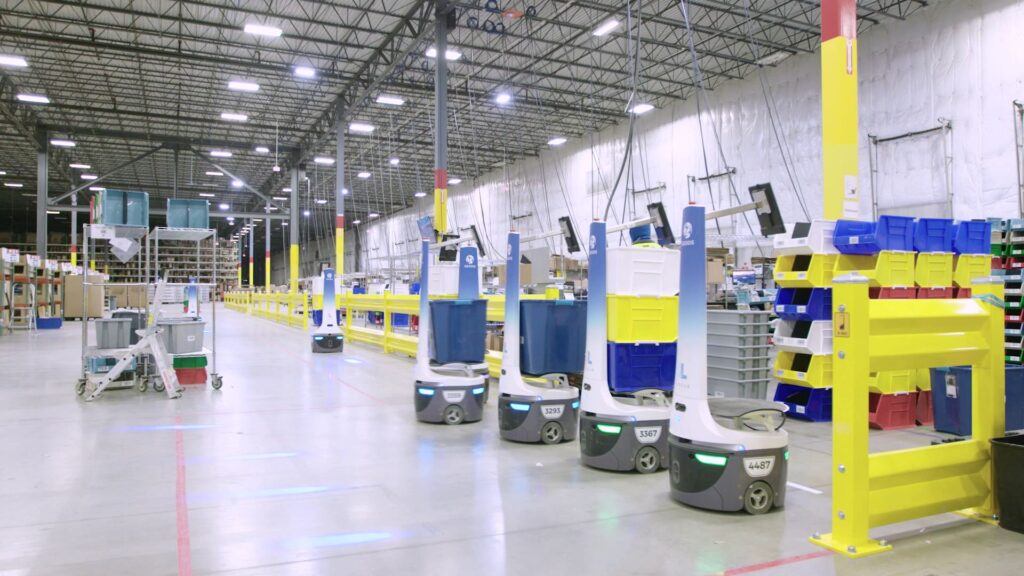
New site is first GEODIS location in Latin America with this technology and features the Locus solution operating across three-level mezzanine Locus Robotics has announced a new implementation with GEODIS to bring high-performance, next-generation robotics automation to Mexico to fulfill e-commerce and retail orders for a major global apparel brand. The new site, GEODIS’ first in Latin America to feature Locus Robotics technology, is located in Cuautitlan Izcalli, Mexico, and features a fleet of Locus’s award-winning Origin bots operating across all levels of a three-level mezzanine structure, efficiently controlled by the innovative LocusOne warehouse execution platform. LocusOne enables efficient pick-and-pass, multi-level functionality while delivering real-time operational visibility and management insights to ensure high productivity and a fast ROI. “We are thrilled to work with GEODIS to bring the power of Locus’s warehouse automation to Mexico,” said Rick Faulk, CEO of Locus Robotics. “This deployment represents a significant expansion of our footprint into Latin America and enables us to support GEODIS in setting the new benchmark for e-commerce fulfillment efficiency in the region.” “Locus allows us to unlock significant productivity improvements while also creating an engaging work environment for our teammates,” said Kevin Stock, Executive Vice President of Engineering at GEODIS in Americas. “We are excited to deploy the Locus solution at this flagship site in Mexico where we will provide transformative workflow automation and management insight for a globally admired brand.” In August 2022, GEODIS announced a new expansion agreement to deploy a total of 1,000 LocusBots at GEODIS’ worldwide warehouse locations over the next 24 months. The announcement represented one of the industry’s largest AMR deals to date.
Kenco grows its next-generation material handling equipment capabilities with new offering

Automation Guidance, a service proven to save customers on average more than $2.5m annually, joins the Kenco MHE Solutions™ portfolio Kenco has announced it will launch Automation Guidance, a consulting offering dedicated to helping operations managers upgrade their existing facilities with automated material handling equipment (MHE) assets, which have become increasingly critical to their success. With the addition of Automation Guidance, an offering within Kenco MHE Solutions, supply chain professionals now have access to a complete lifecycle of MHE benefits. Market demands have created a need for faster, more efficient technology across the facility floor, and Automation Guidance will help managers envision, execute, and maintain upgrades to their existing infrastructure – from forklifts and pallet jacks to conveyors and robotic picking tools, and everything in between. “The reality for most supply chain professionals is that the “warehouse of the future” isn’t new construction – it’s the step-by-step automation of existing facilities, which can be an arduous process when tackled alone,” said Denis Reilly, CEO of Kenco. “Kenco is already known for our robust MHE maintenance and planning solutions, so we’re well positioned to help facility managers not only design an achievable MHE automation strategy but also execute in the long term.” The Kenco team designed Automation Guidance on the company’s deep pool of operational analytics, gathered from supply chains across North America. By combining its decades of experience with operational data from more than 110 distribution centers, Kenco can guide customers through a proven roadmap to maximize automated MHE efficiency. “For years, customers have pointed to Kenco’s trove of real-world data as one of our key differentiators. It gives us the ability to not only help customers manage their MHE day-to-day but also counsel them on the best approach to MHE automation for their specific needs,” said Jeff Burns, President of Kenco MHE Solutions. “Executing automation can feel like a Herculean task, but when customers apply our data pool to their project, it’s easier to find the needle in the haystack – the automated MHE tools that will make the biggest difference in their operations.” Kenco MHE Solutions has already made a measurable impact on existing customers – with some seeing as much as a 26% average reduction on total MHE spending through benefits from asset optimization, asset tracking, damage reduction, and increased equipment life. Through Automation Guidance, customers will see benefits for years to come.
AutoScheduler CEO Keith Moore discusses warehouse trends, innovation, and entrepreneurship

Legacy Systems Still Exist; it’s Time to Augment Their Capabilities Making Them Faster & Smarter. Keith Moore, CEO of AutoScheduler.AI discusses with Joe Rule on a Bold Visions podcast, current warehouse trends, and Keith’s entrepreneurial journey. Joe interviews people who work with disruptive technology and how they use the power of storytelling to turn vision into reality. “Logistics technology has gotten extremely popular since COVID,” says Keith Moore, CEO of AutoScheduler.AI. “It has moved from a cost center to a boardroom conversation.” A summary of the podcast discussion follows: There is much automation out there, and executives must discern which is best for their business. Robotics are being deployed everywhere, but not to replace people. Instead, companies can’t hire the people they need to do a specific job, so robots are helping fill the gap. Many legacy systems exist in companies, especially for mission-critical operations like the supply chain. Nobody’s willing to put the legacy system on hold for six months to install a new solution. Most companies may try to do this, but it’s like trying to change your tire while driving down the freeway. It is more valuable to be complementary to the existing systems. Replacing systems lengthens the sales cycle. The best way to sell a supply chain solution is “in addition to.” People replace their systems once every 5 – 10 years; some don’t even upgrade their software. When starting a company, it is hard to get your share of voice, but if you work with an industry analyst group, people will listen to them. Ensure you understand where companies get their information from and ensure the information is messaged appropriately through these sources. When these sources start writing about you, you become a trusted voice, and you can start building trust with everybody. Hire an industry-specific, outside PR firm. These agencies understand your industry, know the analysts and editors, and work closely to get your company in the stories that target your audience and make you a thought leader. New sales are great, but supporting current customers is better. AutoScheduler’s business mentality is to lose a sale to ensure an existing customer is supported and successful. Invest in partnerships to help your business grow. Based on how the warehousing landscape runs, every unique site has its own WMS. So, if a company has 250 sites, each site will have its own WMS with five to ten people per shift, ensuring the system is running and doing what it should. AutoScheduler’s objective is to centralize the planning and optimization of all the different sites in one location, with a team of 5 to 10 people managing all 250 sites. Keith’s entrepreneurial journey started while he was in college when he would buy a $5 pizza and sell it for $1/slice. He always knew he wanted to work for a startup, so he got a degree in Engineering. While working at National Instruments, he created a company in fantasy soccer. The company was growing but was shut down by the Attorney General for gambling. He then worked for Spark Cognition as a product manager, focusing on data analytics and machine learning. Then his dad, Tom Moore, CEO and Founder of ProvisionAi, told him about a tool he built while consulting for P&G. Tom said, “We’ve built this tool called AutoScheduler. Does it have any value? Is it something that could be used elsewhere?” So, Keith obtained the technology and decided to launch AutoScheduler.AI. AutoScheduler, a warehouse resource optimization platform, manages all the work coming in and out of the warehouse to streamline operations and improve efficiencies. It answers questions like, “What work must I do? How many people do we have to do it? How much space do you have? What inventory do you already have? What are the time-critical components, meaning what do I need to ship outbound to a Walmart now? AutoScheduler acts as the brain of the operation, which says, “Here’s exactly how you need to distribute all of your people at every point in time and exactly what they need to work on.” Keith uses a “Keith Moore Bar Test” to measure awareness. When he first started the company, if he went into a bar and people asked him where he worked, no one would know of AutoScheduler. Today, he can walk into a bar, and people will have heard of AutoScheduler.
Changing landscape

And that is the problem. Inflation or no inflation. GDP growth or inadequate GDP growth. Job claims that help and worker shortfall that does not. Interest rates too high or not high enough. Consumer spending to slow because of increasing personal debt balances. Just what are economic factors telling us that provide comfort because you feel the “conclusions” our “guesses” are reasonable? As you know I read many economic reports and follow the markets closely to get a feel for the industries I follow. One of those is drafted by John Mauldin who I read religiously every Friday evening. It is a free publication, prepared for anybody who needs to get a feel for what is going on in the economy, which I hope then will assist with your ability to make both personal and business decisions. John’s February 17, 2024, letter is titled CHOOSE YOUR OWN ECONOMY, primarily to explain the complexities in today’s economic environment whereby economists are having a hard time deciding what data sets to select to be able to produce a meaningful forecast, which is almost impossible to do. In short, recent forecasts have not been close and thus leave us hanging from a planning perspective. I tell myself there must be a report that works better than most that explains where we are heading, and I find the CB Leading Economic Index dated February 24. The LEI is made up of several indicators that anticipate turning points in the business cycle, which then in turn can anticipate where the economy is headed. On average, there are usually 10.6 months between a peak and a recession. This report has been in place for many years with the last peak in 2021 and we are 12.8% off the 21 peak, which puts us 25 months off from the 21 peak without a recession. With 10.6 months being the average for a recession to follow a peak, 25 months from the last peak in 21 makes me think we are closer to a recession than we think. POINT #1 for this month is to plan thinking there is trouble on the way. The next issue I found interesting this month is the reshoring movement to bring more manufacturing back to the US and the rest of North America. GOOD NEWS for lift truck dealers because these shops will require lift trucks for both the manufacturing and warehousing of materials or finished products. POINT #2 for this month is to research the possibility of who may be coming into your territory to do this work. I would ask the sales team to question customers as well as OEMs about any activity coming your way. City officials would normally have leads related to permits or any approval process required to do the work in that City. Contractors may also have leads if properties need to be upgraded for a new tenant. Another important issue arising is the use of AI to better provide services and products for less cost than those not using AI. This topic was all over the February/March Forbes talk about AI and robots to do work for less cost compared to current methods being used. The important point is that larger firms are spending to accomplish this goal to better compete with firms that are not. Usually, a smaller firm has an advantage cost-wise. That may not be true any longer. AI is also being used to close the union versus non-union gap from a cost standpoint. POINT #3 for this month is to decide if your major customers are at risk because another major dealer can now compete on a product and service basis. After all, they are now more efficient and can reduce costs. I see this as a major threat for many dealers who do not have the time or funding available to produce AI to reduce costs and improve customer service. This is happening NOW and should be considered when you ponder what your company may be worth a year from now. There is, however, some good news that could help you mitigate these problems. I have a couple of sale deals working and in reviewing the M&A markets I see that Private Equity firms are moving into situations where they want to keep investments longer to set up platform companies and then acquire add-ons to grow the operation and increase the value to produce a healthy ROI. Sellers could sell 100% and be paid off. Or they could leave a piece of the deal and play the growth game for bigger returns when the deal is finally turned over. Or dealers with the financial ability could become a platform, take on add-ons, and sell to a PE firm. There are many options available. A shareholder could take a lifestyle approach and take as much out every year as possible. Or take an investment approach to grow the company and increase overall wealth. POINT #4 for this month is to spend some time to see how you fit into this CHANGING LANDSCAPE. Put in the time, effort, and funding to protect your investment or invest to grow wealth. There appears to be plenty of opportunity coming down the line stemming from the government programs and reshoring efforts being made by manufacturers to reduce costs. This potential business, however, will go to the most professional firms, with high levels of customer service and competitive cost, which may not be one of the smaller dealers in town. A lot to think about. About the Columnist: Garry Bartecki is a CPA MBA with GB Financial Services LLC and a Wholesaler columnist since August 1993. E-mail [email protected] to contact Garry.
Navigating the Shift: Adapting to the changing forklift market

In the ever-evolving landscape of the forklift industry, staying ahead of market trends is crucial for resellers to maintain a competitive edge. Recent data on our platform indicates a significant shift in the market dynamics compared to January 2023, with the number of machines available for sale experiencing a notable 40% increase. Since mid-2023, the market for forklifts has transitioned from being predominantly seller-driven to favoring buyers, marking a substantial shift in dynamics. This shift has not only expanded the options available to buyers but has also instilled a sense of caution due to prevailing economic uncertainties. Consequently, we are observing an initial decline in prices, further exacerbated by rising interest costs. We even observe consolidation trends with bigger dealers swallowing up smaller ones. Considering these developments, forklift dealers must strategize and adapt to this new reality to optimize their sales and capitalize on emerging opportunities. Thanks to modern technology today, operational excellence is not limited to big corporations only. Let’s look at six strategies that can help forklift dealers in today’s: 1. Excel in your local market: If your website only shows outdated equipment or no equipment at all, visitors will not give you a call but jump to the next website they find on Google. In light of more available choices for buyers, make sure your website is up to date with available equipment including good images and complete technical data. Big dealers have their own staff for that but that is not mandatory. Modern marketplace solutions have built-in features to effortlessly integrate your used stock into websites and make your website and local business perform stronger than ever. 2. Expand your markets: Staying in your area is comfortable, but keeps you limited. Of course, it’s your favorite choice as a dealer to sell locally as you can add services. In a buyer’s market, this comfort is illusionary. Selling outside your area and selling to other dealers makes your company sell equipment faster and gain new customers. 3. Competitive Pricing and Timely Selling: In response to the shifting market dynamics, resellers are encouraged to advertise their inventory at competitive prices. Selling now enables resellers to leverage the proceeds to invest in “new” used equipment later at potentially lower prices. Even if it’s hard to accept lower margins, waiting too long to adjust will only result in less profit. 4. Optimized Advertisements: Enhance the visibility of listings by optimizing advertisements with high-quality images and compelling pricing. This proactive approach attracts more clicks and inquiries, maximizing the chances of successful transactions. 5. Agile Trading Approach: In a market characterized by fluctuating prices, agility is paramount. Resellers should prioritize swift transactions over maximizing margins on individual devices. By promptly listing and selling equipment in its current condition, resellers can capitalize on market fluctuations and maximize profitability. 6. Market Awareness and Price Adjustment: Stay vigilant of market trends and adjust pricing strategies accordingly. Every day a listing that remains active incurs costs, particularly with rising interest rates. Regularly updating prices to align with market conditions is essential to optimize returns. Bonus: Get expert support Navigating the complexities of a shifting market landscape can be challenging, but you don’t have to do it alone. If you are a small to medium-sized dealer with the challenges above, let’s set up a free one-hour consultation – limited to the first 20 dealers who contact us at [email protected] Together, let’s navigate the changing tides and unlock new opportunities for growth and profitability. About the Author Chris Schmid is the CEO of Motus Group, the company behind Forklift-International.com, the largest international marketplace for used forklifts and material handling equipment. Before joining Motus, he led Sales & Marketing for a technology incubator, releasing and marketing software and e-commerce products. He was COO of a tech startup in Switzerland and San Francisco. Chris holds a master’s degree in international management from Reims Business School in France as well as the European School of Business in Reutlingen, Germany, and lives with his wife and three kids in Regensburg, Germany.
February 2024 jumps to a strong 150 new Industrial Manufacturing Planned Projects
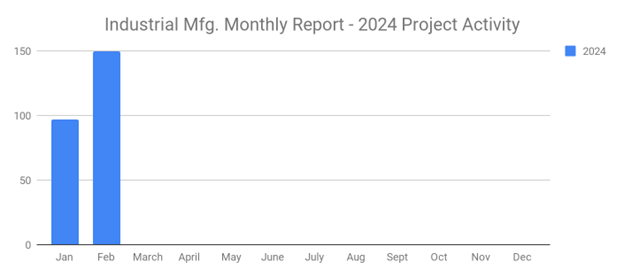
Industrial SalesLeads has announced the February 2024 results for the new planned capital project spending report for the Industrial Manufacturing industry. The Firm tracks North American planned industrial capital project activity, including facility expansions, new plant construction, and significant equipment modernization projects. Research confirms 150 new projects in the Industrial Manufacturing sector as compared to 150 in January 2024. The following are selected highlights on new Industrial Manufacturing industry construction news. Industrial Manufacturing – By Project Type Manufacturing/Production Facilities – 134 New Projects Distribution and Industrial Warehouse – 61 New Projects Industrial Manufacturing – By Project Scope/Activity New Construction – 46 New Projects Expansion – 38 New Projects Renovations/Equipment Upgrades – 68 New Projects Plant Closings – 15 New Projects Industrial Manufacturing – By Project Location (Top 10 States) Ohio – 16 Indiana – 12 Georgia – 10 New York – 9 Texas – 8 Illinois – 7 Massachusetts – 7 Michigan – 7 North Carolina – 7 Quebec – 7 Largest Planned Project During the month of February, our research team identified 19 new Industrial Manufacturing facility construction projects with an estimated value of $100 million or more. The largest project is owned by Micron Technology Inc., which is planning to invest $100 billion for the construction of a 7.2 million sf manufacturing complex in CLAY, NY. They are currently seeking approval for the project. Construction will occur in phases, with completion slated for 2030. Top 10 Tracked Industrial Manufacturing Projects NEW YORK: Semiconductor MFR. is planning to invest $12 billion for the construction of a 358,000 SF manufacturing facility on their manufacturing campus in MALTA, NY. The project includes the expansion of their existing plant. Construction is expected to start in 2025. NORTH DAKOTA: A mining company is planning to invest $2 billion in the construction of an iron manufacturing facility in UNDERWOOD, ND. They have recently received approval for the project. NEW YORK: EV MFR. is planning to invest $500 million for the expansion of its manufacturing facility in BUFFALO, NY. They are currently seeking approval for the project. SOUTH CAROLINA: Battery MFR. is planning to invest $500 million for the construction of a 500,000 SF manufacturing facility in GREENVILLE, SC. They are currently seeking approval for the project. Construction is expected to start in early 2025, with completion slated for late 2027. FLORIDA: Clean hydrogen and solar technology company is planning to invest $450 million for the construction of a hydrogen processing and solar panel manufacturing facility in KISSIMMEE, FL. Construction is expected to start in Summer 2024, with completion slated for 2027. GEORGIA: Solar panel glass mfr. and recycling company is planning to invest $344 million for the construction of a manufacturing facility in CEDARTOWN, GA. They are currently seeking approval for the project. Completion is slated for 2026. WISCONSIN: Plumbing equipment MFR. is planning to invest $340 million in the construction of a manufacturing facility in DICKEYVILLE, WI. They have recently received approval for the project. Completion is slated for 2026. MARYLAND: Biopharmaceutical company is planning to invest $300 million for the renovation and equipment upgrades on a recently leased 84,000 SF processing facility at 9950 Medical Center Dr. in ROCKVILLE, MD. Completion is slated for 2026. WASHINGTON: Wood pellet MFR. is planning to invest $250 million for the construction of a manufacturing facility in PORT OF LONGVIEW, WA. They are currently seeking approval for the project. Construction is expected to start in Summer 2024, with completion slated for early 2025. INDIANA: Recycled paper products mfr. is planning to invest $130 million for the construction of a 350,000 SF manufacturing and warehouse facility on Park Rd. in ANDERSON, IN. They are currently seeking approval for the project. About Industrial SalesLeads, Inc. Since 1959, Industrial SalesLeads, based in Jacksonville, FL is a provider in delivering industrial capital project intelligence and prospecting services for sales and marketing teams to ensure a predictable and scalable pipeline. Our Industrial Market Intelligence, IMI identifies timely insights on companies planning significant capital investments such as new construction, expansion, relocation, equipment modernization, and plant closings in industrial facilities. The Outsourced Prospecting Services, an extension to your sales team, is designed to drive growth with qualified meetings and appointments for your internal sales team. Visit us at salesleadsinc.com.
Data-driven decision making

One of the MHEDA’s 2024 Material Handling Business Trends states, ‘Technology is profoundly impacting the material handling industry including artificial intelligence, digital automation, data-driven decision-making, and the integration of advanced systems that optimize efficiency, productivity, and safety. Members must have a clear understanding of emerging technologies.’ Let’s dissect that statement, in particular explore the topic of ‘data-driven decision making.’ In our ever-evolving industry, the ability to make informed decisions swiftly and accurately can be the difference maker in running a successful dealership and remaining competitive in the market. Nowhere is this more apparent than in the operations of your service department. The service department is tasked with maintaining, repairing, and optimizing the end customer’s equipment to ensure the customer’s warehouses and logistics operations run smoothly. The service manager is responsible for managing the department’s productivity and profitability. Therefore, the importance of data-driven decision-making cannot be overstated. Gone are the days when service departments relied solely on intuition or past experience to address maintenance issues or plan repairs. Today, the availability of data and advanced analytics tools empowers service managers and technicians to leverage valuable insights in real-time, leading to increased efficiency, reduced downtime, and ultimately, improved customer satisfaction. However, most dealerships I visit live with silos of data that do not integrate. The cost and difficulty of properly connecting all these data sets becomes a struggle for even the largest dealerships. If you must deal with orderly silos of data, it is important to identify the purpose of each data set. Then inside of those data sets identify what things need to be managed the most. Often service managers are tasked with manually running their own data reports to analyze. In today’s fast-paced environment, waiting for managers to manually run reports can result in missed opportunities and delayed actions, meaning by the time the manager has time to run or review the report, oftentimes it is too late. Also, if the output is long lists of data or actionable items, this can be overwhelming to the service staff that already have a full day of work fielding inbound calls and everyday tasks and projects that get longer by the week. Let’s look at Work-in-Process (WIP) reports from your business system as an example. Instead of running a report that generates the entire list of current WIP, look to generate a ‘subscription’ type report model that can provide the 10 oldest work orders by open date and have it auto generated each Monday to start the week. Additionally, you could set up another subscription report to show the 10 oldest work orders by the last day of labor date posted to the work order. Essentially, your Service Manager should get this data ‘pushed’ to them automatically in subscription form and then the data-informed decision-making process makes it obvious the next 10 things to address and work on. As my industry colleague, John L. Gelsimino (President, All Lift Service, and MHEDA’s Immediate Past Chairman), says, “Call it actionable data – easy-to-digest information that allows the manager to quickly identify problems to jump in on.” He will tell you that this type of strategy can be used for any type of dealership management data. Furthermore, data-driven decision-making fosters continuous improvement and innovation within your service department. By regularly monitoring key performance indicators (KPIs) and benchmarking against industry standards, your service manager can identify areas for improvement and implement strategies to enhance efficiency and productivity. For example, if data analysis reveals that the average time taken to complete a repair is higher than industry norms, your managers can investigate the root causes of delays and implement process improvements to streamline workflows. By charting out revenue per technician in a rolling 12 format you can better determine the technician’s performances and how they are trending. Here are some other tips to optimize data-driven decision-making in your service department: Dashboard Visualization: Develop user-friendly dashboards that provide at-a-glance insights into critical performance indicators. These dashboards should be accessible to all relevant parties at your dealership, allowing them to quickly assess the status of operations and identify areas requiring attention. Predictive Analytics: Leverage advanced predictive analytics algorithms to forecast customer equipment failures and maintenance needs. By analyzing historical data and identifying patterns, these algorithms can anticipate potential issues before they arise, empowering your service department to proactively address them. Additionally, this will give you an advantage over your competition and help maintain customer loyalty. Mobile Applications: Provide service technicians with mobile applications that enable them to access relevant data and documentation on the go. This allows technicians to quickly retrieve information, input data, and communicate with your service department from the field, minimizing delays and improving responsiveness. In conclusion, data-driven decision-making is paramount in today’s landscape for forklift service departments seeking to remain competitive and efficient. By leveraging data and analytics tools, Service Managers and technicians can proactively address maintenance issues, optimize resource allocation, enhance safety, and drive continuous improvement. Ultimately, embracing a data-driven approach not only ensures the smooth operation of your customer’s equipment but also contributes to the overall success and profitability of your dealership. About the Author: Chris Aiello is the Business Development Manager at TVH Parts Co. He has been in the equipment business for 17-plus years as a service manager, quality assurance manager, and business development manager. Chris now manages a national outside sales team selling replacement parts and accessories in various equipment markets such as material handling, equipment rental, and construction/earthmoving dealerships.
Are you a sales leader or a sales chaser?

I grew up in Haddonfield, New Jersey. We lived at the corner of the busiest intersection in town. I was 15 years old when we got a puppy named “Thing-a-ma-jig.” The cutest, friendliest mutt-puppy you ever saw. One morning, about a week later, I opened the front door to get the paper — and the puppy got loose. She started running as fast as she could — right for the traffic. I started chasing her — hopelessly for five blocks, across busy streets — my little dog was gone — I was panicked (and out of breath). I decided to run back home and ask my dad to use the car and find the dog. I ran straight to my parent’s bedroom. “Dad — dad,” I panted, “The — dog’s — run — away — car — chase — it!” “OK son,” he said,” “Let’s jump in the car and find your puppy.” I turned to run out the door – took one step and tripped over the dog. You see, as soon as I started to run the other way, the dog chased me! Chasing your prospects too hard? Trying to push too hard for the sale? Follow up with a thinly disguised: “Is the money ready? Can I come over and get the money?” You figure that the best way is to be assertive and tell him why your company and product (or service) are the greatest. Right? — Wrong, sales breath! Try the opposite approach. Try running the other way by being attractive through your value. Create the law of attraction, and — let the prospect chase you. It’s the best sales and follow-up technique you’ve ever experienced. And the easiest way to sell is to buy. EARLY WARNING SIGNAL: No returned phone call. If prospects are not returning your call — whose fault is that? You’re chasing too hard. They’re running away. You couldn’t get their interest — you couldn’t get them (they aren’t interested enough) to chase you. Other tell-tale symptoms that the chase is going the wrong way: You are still cold calling (or direct emailing) to get prospects. You’re uncomfortable about calling. You are unprepared, or you have not established the needs of the prospect and are unsure of their status, or you don’t have much rapport with the prospect, or some of each. You are having trouble making appointments Prospects just won’t decide, and you keep hounding them. You’ve followed up a few times, and now you’re searching for a reason to call them — but you can’t think of one. The prospect is giving you a bunch of lame excuses. And worse, you are accepting them. If chasing people too hard makes them run away, why are you continuing to do it? The way I got my puppy-dog to come home was — I led the dog home. You can either lead the field or be in the field (some people are in left field). Your challenge is to lead your prospects so they will follow you — and turn into customers. Here’s the simple solution: (NOTE: I didn’t say easy, I said simple. There are no easy solutions.) Create a better market position for yourself. Are your prospects and customers reading about you – or getting information they can use written by you — in their social media accounts? Are they gaining helpful information on your web site? Have you recently spoken at their annual meeting? Or are you thinking “brochure,” “appointment,” and “product demo” or “corporate video.” Wrong thoughts. Those are competitive thoughts and lead to a dissertation by you and your competition as to who is better – and always lead to a battle over price. A battle that everyone who fights in it, loses. To create the position you seek: Getting qualified people to call you – you’d better get beyond the typical marketing materials. ASK YOURSELF: Where are people seeing you or talking about you? TELL YOURSELF: It takes time to create position. REWARD YOURSELF: But once you do, people call you to buy, instead of you calling them to sell. The secret formula? The magic potion? Real simple… whatever you do with your outreach, always have a prime objective at your core. Here is the one that has worked for me: PRIME OBJECTIVE: Put yourself in front of people that can say “yes” to you and deliver value first. About the Author: Jeffrey Gitomer is the author of twelve best-selling books including The Sales Bible, The Little Red Book of Selling, and The Little Gold Book of Yes! Attitude. His real-world ideas and content are also available as online courses at www.GitomerLearningAcademy.com. For information about training and seminars visit Are you a sales leader or a sales chaser? or email Jeffrey at [email protected] or call him at 704 333-1112.
The innovative Movu escala 3D bin shuttle system took 1st place and receives “Product of the Year 2024” award
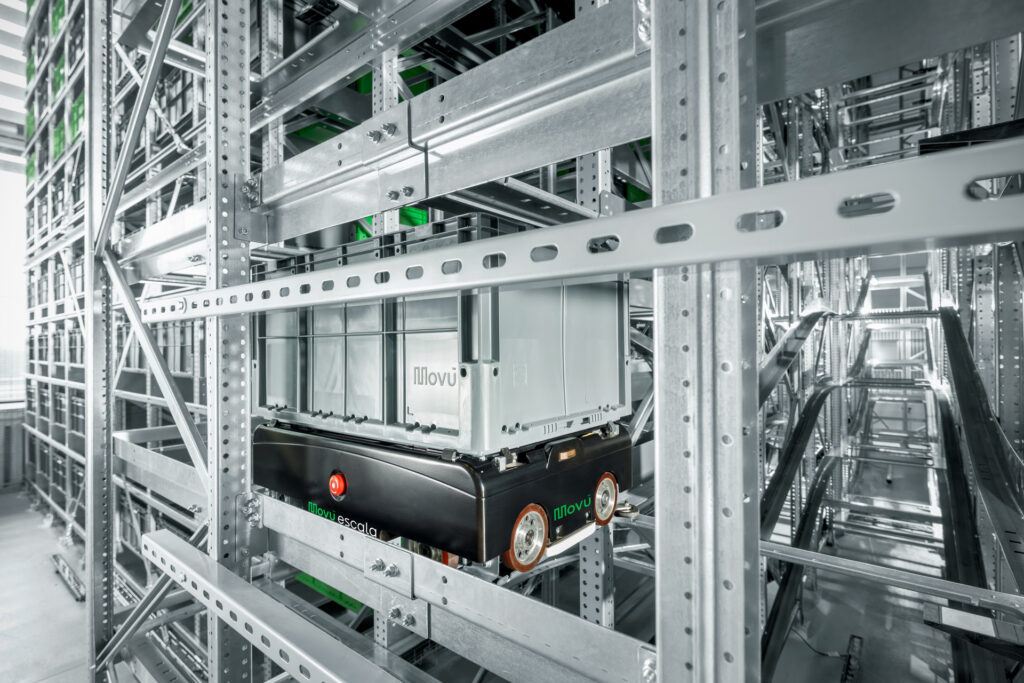
The Movu 3D shuttle system “escala” has been awarded “Product of the Year 2024” by the readers of the logistics trade magazine Materialfluss. After the Movu ifollow and the Movu atlas, the next family member from the Movu portfolio has now also received an important award. Votes were cast for products and solutions in five categories, with Movu escala took 1st place in the ‘Picking technology”, which was judged on three main criteria. First, the product is technically mature and available on the market. Secondly, it stands out significantly from its market competitors thanks to innovative features. Finally, the entry offers customers a clearly recognizable benefit. The award-winning Movu escala is the next-generation, flexible robotic automated bin storage and retrieval sub-system – for even the smallest applications of bin-compatible products. Robots move along a sophisticated rail track that connects every location point within the dense storage and retrieval rack – from fellow stow Group company, stow Racking – transferring between levels via ramps. This eliminates the need for maintenance-intensive conveyors, lifts, service aisle access, and sequencers. Intelligent management software, combined with the innovative rack design, allows the sequencing of bins at multiple points within the system and at the goods-to-person workstations. Jos De Vuyst, CEO of stow Group, said: “We are delighted to have received this award and would like to thank all readers who voted in our favor. The award confirms the innovative strength of the stow Group and of Movu Robotics and motivates us even more in our endeavors to develop advanced and accessible logistics automation solutions for all customers, regardless of whether they are starting in automation or expanding further.”
Loftware unveils enhanced cloud labeling platform at LogiMat 2024

Loftware Cloud enables companies to conquer supply chain complexities, ensure supplier compliance, and improve traceability Loftware has unveiled Loftware Cloud at LogiMAT 2024. The cloud-based labeling platform harnesses the power of the company’s state-of-the-art technologies and is designed to help businesses of all sizes conquer diverse supply chain complexities, ensure supplier compliance, and improve traceability. The powerful and intuitive solution empowers organizations to adapt to changing demands across the global supply chain by providing users with the ability to easily design, manage, and print millions of accurate labels per day. This level of standardization and automation transforms legacy manual error-prone processes, facilitating high-performance supply chain label printing and enabling scale. Loftware Cloud is a robust and secure platform designed to meet the needs of all businesses no matter their size or industry focus. With fast deployment times, lower upfront costs, easy access, high availability, unmatched scalability, and impressive flexibility, the innovative solution helps companies meet a full range of business challenges. This includes addressing increasing customer requirements and evolving regulatory compliance. “2024 marks a pivotal point for global supply chains as automation becomes increasingly prevalent. Many organizations have historically struggled to keep up with this pace of change, risking lost opportunities and revenue,” said Michelle Northey, Loftware EVP Product. “However, for companies looking to transform their digital supply chain, Loftware Cloud offers a powerful, versatile, and cutting-edge solution that adheres to critical regulatory and customer standards while saving companies time, money, and resources.” Evolving customer demands, industry standards, and regulations define how products are developed, shipped, and disposed of across the global supply chain. Maintaining supplier compliance is a vital part of ensuring this is done seamlessly and accurately. Using Loftware Cloud, suppliers and co-packers can seamlessly print labels using pre-approved templates and data. Businesses can regulate access to the platform, gaining a meticulous record of each label printed and guaranteeing that labels meet compliance and brand standards. By doing so, companies can eliminate relabeling, save time, and reduce costs. In a bid to foster a sustainable enterprise, Loftware Cloud also brings unprecedented visibility and transparency across the global supply chain network by supporting track and trace and serialization initiatives. The benefits are varied – from minimizing costs and enhancing operational efficiency to improving agility and eliminating redundancies. Organizations leveraging Loftware’s solution also experience reduced rework, lower scrap rates, and a decreased need for relabeling, resulting in significant inventory loss prevention, and removing the need for costly product recalls. Additionally, Loftware’s certified SAP labeling solutions – designed to integrate with any SAP landscape – allow companies to drive their labeling seamlessly no matter where they are on their journey to S/4HANA. Loftware Cloud offers market-leading integration with SAP, S/4HANA, SAP Business Suite on HANA, and SAP ECC, allowing businesses to reduce costs, improve agility, and minimize costly errors. Existing Loftware customers, regardless of their current Loftware platform, will enjoy a seamless transition to a more powerful and integrated solution that delivers on our promise of innovation and excellence.
AIT Worldwide Logistics promotes three leaders to new executive roles

Ben Naro, Bill Fallon and Mike Tegtmeyer will guide growing sales, strategic accounts and infrastructure teams AIT Worldwide Logistics has announced promotions for three executive team members. Ben Naro and Bill Fallon have been named chief sales officer and chief commercial officer, respectively. They are the seventh and eighth members of the company’s C-level team. Meanwhile, Mike Tegtmeyer has been promoted to the role of executive vice president, of global infrastructure and security. Naro and Fallon report to President and Chief Operating Officer, Keith Tholan. Tegtmeyer reports to Chief Information Officer, Ray Fennelly. “Ben, Bill, and Mike have made outstanding, unique contributions to the company’s growth,” said AIT Chairman and Chief Executive Officer, Vaughn Moore. “I feel incredibly grateful and confident knowing that our sales, strategic accounts, and infrastructure teams are guided by the leadership of these three professionals whose accomplishments have raised the bar for high performance.” Chief Sales Officer, Ben Naro As AIT’s Chief Sales Officer, Naro is responsible for managing the global territory and field sales team. He is also tasked with aligning the sales organization to AIT’s overall global strategy while collaborating with all stakeholders to ensure strategic goals and initiatives are fulfilled. Finally, Ben will work diligently to drive growth through team building that connects and coordinates sales strategies amongst the AIT network’s primary geographic regions. “More than two decades ago, Ben came to AIT with just three years of freight forwarding sales experience,” Tholan said. “Since then, he has continually earned career advancement opportunities by performing in just about every sales role imaginable. He is a champion for AIT’s sales strategy, working diligently to upgrade processes and build high-performing teams of sales professionals across the network.” Chief Commercial Officer, Bill Fallon In his new role, Fallon sets the strategy and manages the set-up for a diverse array of vertical markets in AIT’s strategic account program. He also supports the entire organization by establishing solutions for broader strategic opportunities requiring a highly specialized, customized approach and he will focus on extending these niche, high-touch solutions to new markets in the AIT network. “Bill has more than 41 years of transportation experience, including 10 years with AIT, spanning from his early days in operations to becoming one of the best solutions design professionals in the forwarding industry,” Tholan said. “He reinvented himself early on at AIT and soon became the company’s number one sales professional and he has worked hard to assemble a team of highly diversified experts in the strategic account program.” Executive Vice President, Global Infrastructure and Security, Mike Tegtmeyer In his new role, Tegtmeyer continues leading the organization towards a next-gen level of quality in the worldwide management of AIT’s technology infrastructure and hardware platforms. With a priority emphasis on the networks in Asia and Europe, he is supporting the company’s path to an enhanced and expanded global infrastructure strategy. He will also maintain his focus on process improvements for the business, especially the expansion of AITConnect, a ticketing system that his team successfully rolled out for AIT’s compliance, human resources and IT help desk groups. “Over the course of his five years with AIT, Mike has deeply matured the company’s infrastructure strategy by leading the deployment of a modern, high-quality cloud-based environment,” Fennelly said. “On behalf of the entire organization, I’d like to acknowledge how much we appreciate his intellect, leadership and personal expression of AIT’s core values.”
Bobcat Company named to Fast Company’s 2024 Most Innovative Companies list
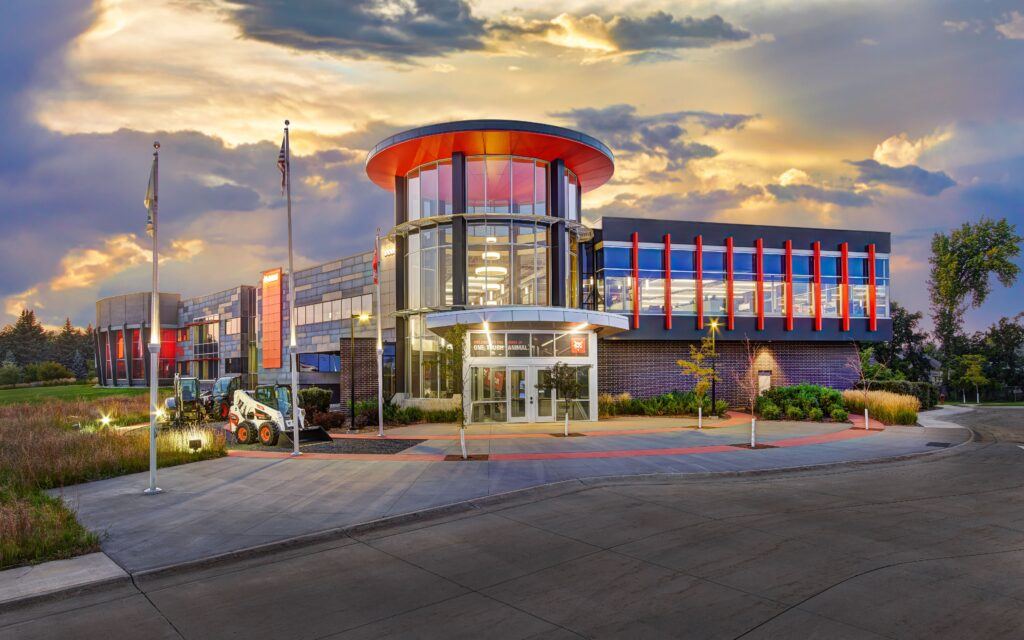
Brand recognized as stand-out industry leader in manufacturing, equipment design and automation Bobcat Company has been recognized as one of Fast Company’s 2024 Most Innovative Companies. The Most Innovative Companies honor places Bobcat in the spotlight among other organizations that are transforming industries and shaping society. “With innovation being at the core of our legacy, Bobcat is driving the industry forward reaching new heights,” said Joel Honeyman, Doosan Bobcat vice president of global innovation. “We believe that embracing technology and innovation is vital to long-term success, and we are thrilled to be recognized on Fast Company’s Most Innovative Companies list.” Since 1958, Bobcat has been looking forward in all aspects of its business to transform how the world works, build cities, and support communities for a more sustainable future. Advancing Manufacturing for Efficiency and Precision Bobcat is recognized in Fast Company’s Most Innovative Companies’ manufacturing awards category. Bobcat has advanced its manufacturing facilities—both in terms of its footprint and the technology within its many global locations. Recent updates to its facilities have included a $9.3 million automated press system in its Gwinner, N.D., manufacturing facility; technology in its Statesville, N.C., facility that streamlines component inspection; and a new robotic forming press in its Johnson Creek, Wis., location that minimizes operators’ manual labor while improving precision. All of these advancements have led to improved efficiencies, greater precision and more ergonomic worksites for its employees. Inventions for the Job Site of Tomorrow With a focus on innovation, Bobcat is paving the way for electrification and autonomy in equipment design and development. Since 2022, the brand has launched several industry-first machines, including the all-electric T7X compact track loader, the all-electric concept S7X skid-steer loader, and the fully electric and autonomous concept pair of loaders, the RogueX and the RogueX2. These new machines have garnered many new patents and patents pending, signifying how Bobcat is defining a new work experience while bringing sustainable solutions to the marketplace. Recognition, Optimism in Moving the World Forward This year’s Most Innovative Companies program showcases 58 industry categories—with manufacturing, health, climate, energy and AI among its popular categories. A panel of Fast Company editors and writers identified the companies driving progress around the world and across industries, evaluating thousands of submissions through a competitive application process. The result is a globe-spanning guide to innovation today, from early-stage startups to some of the most valuable companies in the world. “Our list of the Most Innovative Companies is both a comprehensive look at the innovation economy and a snapshot of the business trends that defined the year,” said Fast Company editor-in-chief Brendan Vaughan. “We saw extraordinary innovation across the board in 2023, but we also saw a handful of clear patterns: the growing footprint and impact of AI, the triumphant return of live events, and great leaps forward in climate tech. We face daunting challenges on many fronts, but the solutions we celebrate in MIC give me plenty of hope about the future.”
Dorner and Garvey partner on New AquaGard GT Stainless Steel Conveyor
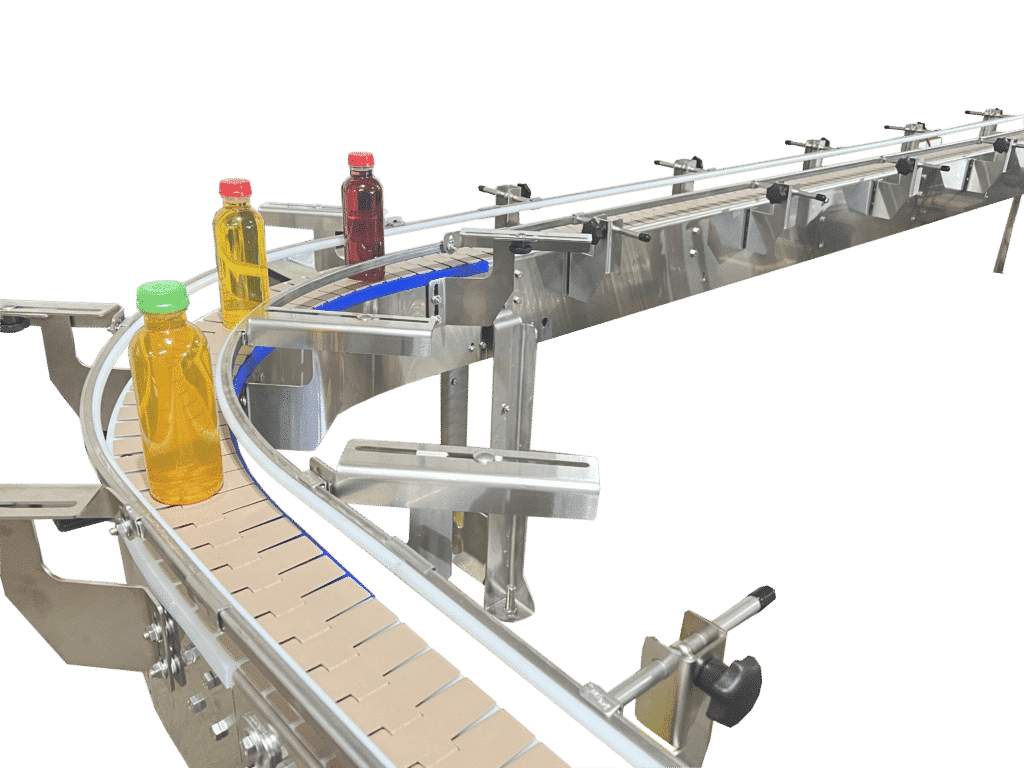
Dorner and Garvey are well-established brands with decades of proven success. But now, they are combining their strengths to write a new chapter together with the recent launch of its AquaGard GT Stainless Steel conveyor. This new line combines the best conveyance expertise of both brands to develop a platform with an attractive price point that integrates with accumulation systems and other machinery to create a fully automated processing line for bottling, canning, and food processing applications. The AquaGard GT merges the strengths of Garvey’s GT Series conveyor with Dorner’s AquaGard 7100 Series sanitary stainless steel conveyor. The AquaGard GT is a meticulously designed infeed and outfeed conveyor ideal for accumulation-type applications to prevent bottlenecks in industries such as packaging, bottling, dry food processing, and part handling. All components (except motors) are either stainless steel or FDA-approved plastics, which are ideal for operating in environments that require wipe-down or occasional washdown cleanings of the conveyor. Simple Design and Function The AquaGard GT conveyor system is designed to be as simple as possible, ensuring the highest level of reliability. These conveyors are engineered for flexibility and can be inserted virtually anywhere in the system, making line expansions or complete changeovers fast and efficient. With Dorner’s best industry lead time, conveyors can be custom-engineered and shipped out quickly to minimize downtime and get a production line up and running in no time. Versatility in Applications The AquaGard GT conveyor is a versatile solution suitable for an array of applications across a wide variety of industries. Primarily designed for packaged goods transport, its robust construction and advanced engineering ensure seamless movement of goods with precision and reliability. Its adaptability shines in integrated solutions by navigating through machines for efficient processing. Moreover, its seamless integration extends to end-of-line packaging and palletizers as well where it ensures smooth transitions and optimized throughput, enhancing overall operational efficiency. The AquaGard GT integrates features and benefits such as powered transfer units, flush side tails, and pre-engineered transfer modules, among others that in-house machine builders cannot match. The conveyor is competitively priced and comes with a short 10-day lead time.
ARA’s updated economic forecast

The updated forecast released at The ARA Show™, the American Rental Association (ARA) indicates that the United States equipment rental industry’s growth has a fairly positive outlook. Last quarter, the year-over-year growth was expected to be 7.6% in 2023 and 3.1% in 2024. The most current projections indicate a 7.9% increase in 2024 totaling $77.3 billion in construction and general tool rental revenue. “The ARA Rentalytics™ quarterly forecast reinforces the strength of the rental industry,” says Tom Doyle, ARA vice president, program development. “Rental should benefit with tailwinds from interest rates, inflation, improving supply, a preference to rent, and government and private spending. Rental revenue is again forecasted to increase.” Looking more granularly at construction and industrial equipment (CIE) growth in the United States, $60.9 billion is the projected revenue in 2024, which is 7.5% growth. In the coming years, 2025, 2026, and 2027, 3% growth is projected. The difference is smaller but still appreciable and more in line with a steadily growing economy. “We see a slowing of growth this year compared to last year but bear in mind, we have a slowing of inflation this year as well,” says Scott Hazelton, managing director at S&P Global. “The growth rates tail off in the future years, with growth of 4.3% in 2025 and 3.9% in 2026.” The current forecast for total Canadian equipment rental revenue shows a 3.1% growth to $974 million in 2024. 2024 growth is stronger in Canada than in 2023 growth due to inflation and resilient demand. In addition, Canada’s housing market and non-residential structure construction are both improving. While CIE investment will decline from previous years, a 7.2% increase is forecasted. The stark contrast from previous years is attributed to the lack of post-COVID investments in 2024. As businesses choose rental over ownership, the CIE rental penetration rate follows. The 2023 estimate of 56.4% is near the pre-pandemic peak. General tool investment in the United States is not quite as positive of an outlook. There is muted investment growth at 6.8%. Manufacturing is driving the growth and housing is still the weak spot. “ARA’s quarterly member survey showed conflicting results amongst members with just over half of respondents saying they saw a revenue increase in quarter four, a slight improvement over quarter three which saw an even split between those an increase and decrease,” says Mike Savely, ARA director, program development. It is worth noting that in current forecasts, no state in the United States has a decline in rental revenue growth in the next five years. There are states with weaknesses, but there is still growth.
Lift and Tilt table lowers to floor level for hand pallet truck accessibility
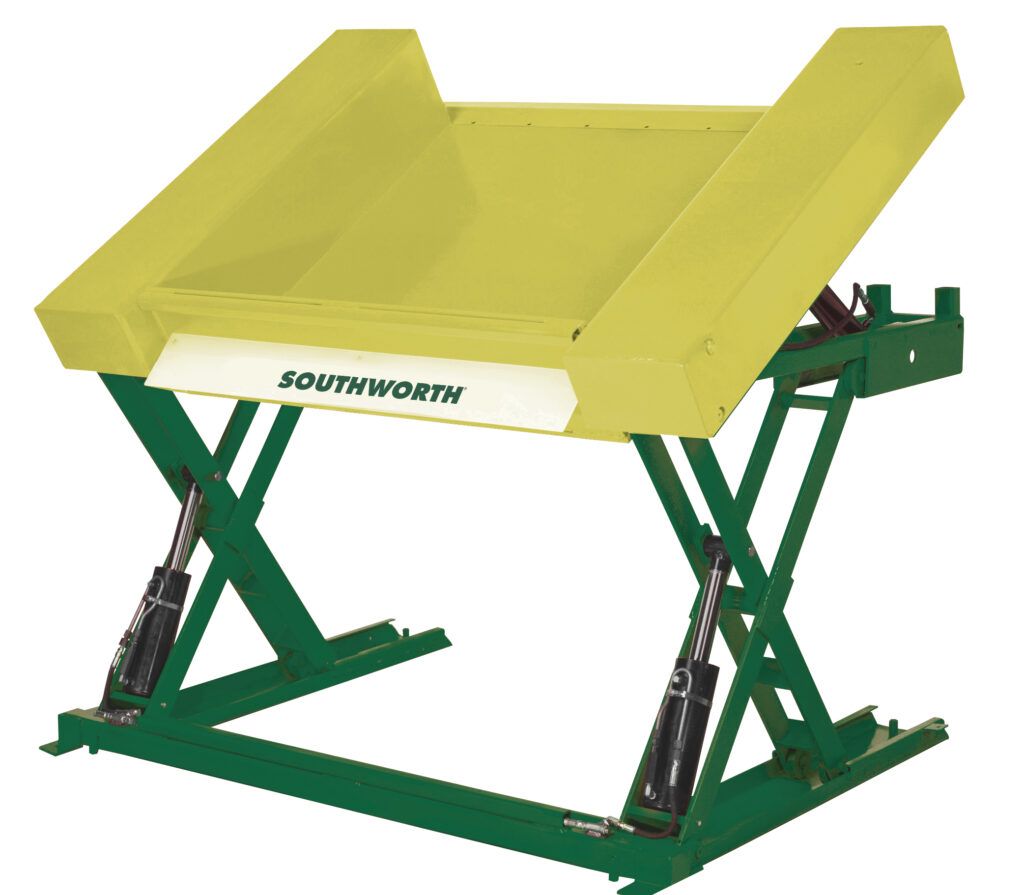
An extension of the popular ZLS line of floor height lifts, the new ZLS-T from Southworth is a combination lifter and tilter designed for accessing items stored in containers, totes, or gaylords. Its unique pan-style platform sits essentially flush with the floor when lowered allowing it to be loaded and unloaded by a hand pallet truck. It is ideal for use in facilities without forklifts or stackers or in areas where forklifts are prohibited. Lift and tilt are controlled independently so operators can precisely position loads at the most convenient height and angle for easy access without bending, reaching, or stretching. As the level of items in the container changes, the operator adjusts the height, angle, or both to maintain optimal ergonomic positioning throughout a shift. The ZLS-T tilts loads up to 30˚ while at any height from floor level to 33½” making it ideal for use with tall- or short-sided containers and drop gate containers. The operator controls lift and tilt position from either a hand pendant or foot control switch. Capacities of 2,000 or 4,000 pounds are available. The platform is 50” x 48”. A single-power unit with a 1 HP motor that operates on 115/1/60 power is used for both lift and tilt functions. ZLS-T models can be equipped with a wide range of safety and convenience options including bellows accordion skirting, photo-eye toe protection, portability chains, three-phase power units, custom platform sizes, and corrosion-resistant finishes.
Configura wins best IT Innovation Award at MODEX 2024
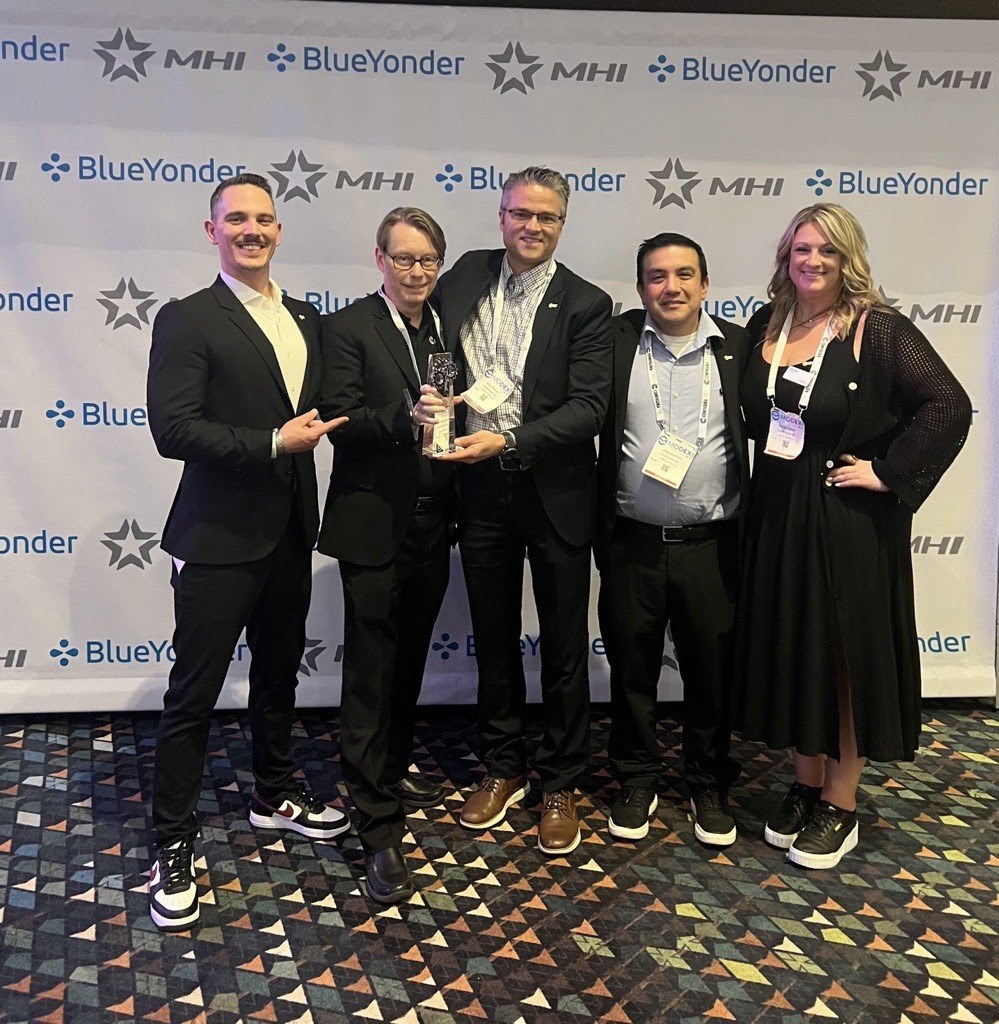
Recognition underscores the platform’s ability to help users design, envision, and implement the future warehouse. Configura, a design-oriented software solutions, was honored with the MHI Innovation Award for Best IT Innovation for its CET Material Handling product. This prestigious award was announced at MODEX 2024, North America’s largest material handling and supply chain conference, with more than 1,200 exhibitors in Atlanta, Georgia. The MHI Innovation Awards educate MODEX attendees and provide valuable insights on the latest manufacturing and supply chain products and services. Out of nearly 200 submissions for this year’s awards, MHI recognized Configura for its dedication to creating revolutionary software for intralogistics, warehousing, and distribution center design. CET Material Handling sets a new standard in material handling system design. CET operates seamlessly in 2D and 3D and utilizes Parametric Graphical Configuration (PGC) technology to eliminate errors, improve efficiency and streamline the design process. Real-time Bill of Materials, pricing, and comprehensive documentation creation contribute to error reduction and overall project success. “I’m so proud and happy to be a part of this great team and the work we have accomplished to position Configura at the forefront of the material handling industry,” said Stefan Persson, CEO of Configura. “After more than 30 years, we continue to produce innovative products and services for the global design community and remain committed to listening to our customers and developing our products to best suit their needs.” MODEX 2024 exhibitors were invited to submit a new product, product line, technology, service or new application of existing products or technology that creates quantifiable and sustainable results regarding ROI, cost savings, customer satisfaction, etc. The event brought together thousands of industry experts, professionals, and businesses from around the world to showcase the latest technologies, products, and solutions in the field of automation and material handling. Conference attendees witnessed live demonstrations of CET Material Handling to see how easy it can be to design a full-blown warehouse, including anything from racking to conveyors, with instant visualization and an automatic bill of materials. “We’re grateful for this recognition from the material handling community and appreciate MHI for putting together such a fantastic event,” said Rich Trahey, VP of Sales and Marketing at Configura. “We’re excited to keep pushing boundaries in the industry and continuing to be a resource for all material handling design needs.”
ORBIS enters into agreement for manufacturing plant in Texas

ORBIS® Corporation has announced it is entering into a lease-to-own agreement for manufacturing space in Greenville, Texas, with EPM Partners of New York. ORBIS Corporation is a wholly owned subsidiary of 175-year-old Menasha Corporation, based in Neenah, Wis. The agreement includes 420,000 square feet of manufacturing space that will be used to produce reusable pallets, totes, and bulk containers. Improvements and infrastructure will be required to prepare the space for ORBIS’ manufacturing activities. ORBIS will also enter a lease agreement with EPM Partners for 240,000 square feet of warehousing space in the same building. “We are excited to see this investment come to life and support our customers’ growth,” stated Norm Kukuk, president of ORBIS Corporation. “This plant enables ORBIS to expand its geographic footprint and increase production capacity to serve our customers with industry-leading solutions while making an impact in the community.” ORBIS expects to add more than 190 employees within two years of the lease commencement in order to support operations at the new plant. “ORBIS is bringing great new manufacturing jobs to Hunt County and we are very excited to partner with this world class leader for the long term,” states Hunt County Judge, Bobby Stovall. This plant is projected to begin some operations by the end of 2024. “We are so pleased to join the Greenville business community, where many investments have been made to create a strong business climate,” states Lynn Hediger, vice president of product management at ORBIS. This plant is located about fifty miles northeast of Dallas. According to Jerry Ransom, City of Greenville, Tex. Mayor, “We are excited to expand our business community with this world-class manufacturer who is focused on providing sustainable packaging solutions for the supply chain.” As a steward of sustainability, ORBIS is committed to driving the circular economy and a better world for future generations through reuse with environmentally friendly designed products, end-of-life recycling, material innovations and sustainable operations.
Google, Microsoft, and Nucor announced a new clean electricity technology initiative

Google LLC, Microsoft Corporation, and Nucor Corporation have announced they will work together across the electricity ecosystem to develop new business models and aggregate their demand for advanced clean electricity technologies. These models will be designed to accelerate the development of first-of-a-kind (FOAK) and early commercial projects, including advanced nuclear, next-generation geothermal, clean hydrogen, long-duration energy storage (LDES), and others. As a first step, the companies will issue an RFI in several US regions for potential projects in need of offtake, and encourage technology providers, developers, investors, utilities, and others interested in responding to get in touch here. According to the International Energy Agency (IEA), firm, dispatchable clean electricity technologies and advanced energy storage systems are needed to cost-effectively decarbonize grids and help the world meet its growing electricity demand with carbon-free energy sources. These advanced clean electricity technologies can fill gaps in wind and solar production and support grid reliability – needs that today are still being met by fossil fuel generation. Yet, these advanced clean electricity technologies face challenges, in part because the novelty and risk of early projects make it difficult to secure the financing they need. By developing new commercial structures and aggregating demand from three of the world’s largest energy buyers, this approach aims to reduce the risks for utilities and developers considering early commercial projects and enable the investments that are needed – ultimately helping to bring these projects online by the early 2030s and reducing technology costs through repeated deployment. The companies will initially focus on proving out the demand aggregation and procurement model through advanced technology pilot projects in the United States. The companies will pilot a project delivery framework focused on three enabling levers for early commercial projects: signing offtake agreements for technologies that are still early on the cost curve, bringing a clear customer voice to policymakers and other stakeholders on broader long-term ecosystem improvements, and developing new enabling tariff structures in partnership with energy providers and utilities. In addition to supporting innovative technologies that can help decarbonize electricity systems worldwide, this demand aggregation model will bring clear benefits to large energy buyers. Pooling demand enables buyers to offtake larger volumes of carbon-free electricity from a portfolio of plants, reducing project-specific development risk, and enables procurement efficiencies and shared learnings. To ensure that the project delivery framework that they develop is transparent and scalable, Google, Microsoft, and Nucor will share their lessons learned and the roadmap from their first pilot projects, and encourage other companies to consider how they can also support advanced clean electricity projects.
Episode 470: Perpetual Power in warehousing with CaPow

This episode of The New Warehouse Podcast features Dr. Mor Peretz, CEO of CaPow. CaPow, short for capacitive power, is transforming charging and power delivery technologies for the warehouse industry. CaPow aims to solve operational efficiency problems within warehouses, focusing on the energy issues that hinder productivity. Dr. Peretz shares insights into the inception of CaPow, its core technology, and how it promises to redefine energy solutions for automated systems and vehicles in warehousing. Understanding Perpetual Power: A Game-Changer for Warehousing Perpetual power, as Dr. Peretz explains, is the ability to provide power to vehicles, robots, and machines while they are in motion, contrasting the traditional stationary charging methods. This innovative approach allows for the downsizing or eliminating onboard batteries, paving the way for more efficient and sustainable operations. “So in the tagline perpetual power, what we’re trying to convey is the fact that we’re supporting power for vehicles, robots, machines while they’re on the ground…able to support the delivery of power or energy while in motion,” Dr. Peretz notes, highlighting the flexibility and efficiency it brings to warehouse operations. Why Perpetual Power Matters in Warehousing The introduction of perpetual power significantly impacts the warehousing industry by minimizing downtime associated with charging, thus enhancing operational efficiency. Dr. Peretz elaborates on the substantial time savings and operational improvements, stating, “Now what we’re after is finding the best way to have the robots work 100 percent of the fleet would work 100 percent of the time without compromise…taking the energy issue out of the equation.” The Impact of Perpetual Power on Warehouse Efficiency The adoption of perpetual power technology by CaPow leads to a noticeable reduction in the fleet size required for operations due to decreased downtime. Dr. Peretz shares insights from over 100 discovery talks with customers, revealing a potential efficiency increase of 20-35%, depending on various factors such as cluster size and work-to-charge ratios. “We can quantify the benefit of CaPow anywhere from 20 percent to 35 percent… in some cases even more,” he asserts, emphasizing the direct correlation between CaPow’s technology and improved operational metrics. Sustainability and Environmental Benefits of Perpetual Power CaPow’s technology not only boosts efficiency but also offers significant environmental benefits by reducing reliance on lithium-ion batteries, known for their sustainability challenges. Dr. Peretz discusses a research project estimating a reduction of 55.0 megatons of CO2 equivalent by 2027 due to CaPow’s interventions. “We end up that in 2027 we would save 55.0 megatons of CO2 equivalent…by 2050 we will be way beyond one gigaton,” he explains, underscoring CaPow’s commitment to environmental sustainability. Key Takeaways CaPow’s perpetual power technology enables continuous energy delivery to warehouse robots and vehicles, eliminating the need for stationary charging. Adopting this technology can lead to significant operational efficiency improvements, with potential savings of 20-35% in fleet operational costs. Beyond operational benefits, CaPow’s solution contributes to environmental sustainability by reducing the dependency on lithium-ion batteries and minimizing CO2 emissions. The New Warehouse Podcast Episode 470: Perpetual Power in Warehousing With CaPow
Kardex launches fastest order fulfillment per sq ft with FulFillX powering AutoStore at MODEX 2024

Kardex appeared at MODEX 2024 where it unveiled its FulfillX solution, specially designed by expert automation engineers to maximize the capabilities of AutoStore robotic cube storage systems and deliver the fastest order fulfillment solution per square foot on the market. The latest development in automated storage and retrieval systems (ASRS), AutoStore powered by Kardex allows new systems to ramp up faster and takes the unexpected surprises out of go-live, with systems capable of meeting or exceeding business cases in as little as 6 months. Kardex teamed up with cube storage pioneer AutoStore to launch FulfillX, demonstrating how the innovative warehouse execution system (WES) can maximize the potential of automation and robotics. Bringing together the right automation with the right global AutoStore partner, the flexible FulfillX WES is tailored to optimize picking and packing, maximizing the capabilities of AutoStore to complete orders for fulfillment while also streamlining putaway and other inventory processes. With Kardex FulfillX, users get a real-time overview of their whole operation, viewing and managing work in a simple window, receiving downtime estimates, and rapidly deploying enhancements, supported by Kardex’s dedicated AutoStore support team. Cutter & Buck harnesses the power of AutoStore with FulfillX With retail customers becoming more demanding when it comes to delivery times and efficient order fulfillment, conventional solutions are falling behind. Kardex FulfillX for AutoStore can ramp up to full capacity in as little as 6 months. Iconic US clothing retailer Cutter & Buck was able to reinvent its omnichannel business by harnessing the capabilities of AutoStore powered by Kardex’s precise FulfillX WES. The company needed a system to help it handle rising online and bricks-and-mortar sales, and growing inventory levels. The company opted to install an AutoStore system with Kardex FulfillX at its site in Renton, WA. The speed and density of the AutoStore robotic cube solution and the FulfillX-focused ‘pick to pack’ solution were ideal for Cutter & Buck’s existing fulfillment center near Seattle. Combined with Cutter & Buck’s commitment to leverage automation to address business challenges and its forward-looking approach, the project successfully optimized inventory and order fulfillment processes to deliver streamlined results. Kardex at Modex 2024 Visitors to the Kardex booth (B6410) at MODEX 2024 were able to see how Kardex combines its software know-how with the capabilities of AutoStore cube storage solutions to create user-friendly, highly configurable and focused ASRS solutions. In addition to new developments in warehouse software, visitors experienced live demonstrations of Kardex’s Intuitive Pick Assistant. With a user-friendly picking display, the innovative warehouse solution responds to movements and projects relevant picking information directly onto the surface of the access opening. It is compatible with both Kardex Remstar and AutoStore ports to facilitate accurate, ergonomic picking. Using digital tools and augmented reality, Kardex brought to life its full portfolio of solutions, including vertical lift modules, vertical carousel modules, vertical buffer modules, and AutoStore systems. Mitch Hayes, President of Kardex Solutions AutoStore, comments: “It was great to be able to demonstrate the capabilities of our portfolio of automation solutions at MODEX 2024, including Kardex FulFillX for AutoStore, our Intuitive Pick Assistant, and our wide range of modules, software packages and concepts. At Kardex, we assess each customer and understand their needs to develop a tailored solution designed to transform their warehouse operations. “MODEX 2024 was also the ideal opportunity to showcase the real-world success leading apparel company Cutter & Buck has had in North America with FulFillX. FulFillX has been designed to enhance the power of AutoStore, helping companies meet and exceed their business cases quickly by providing exceptional results within months. The modern microservices backend and simple window have been developed by our team of experienced automation engineers with extensive experience of AutoStore and complementary technologies.” Commenting on the capabilities of FulFillX, AutoStore Partner Sales Manager, Matt Savoie, adds, “We are delighted to work in partnership with Kardex on its innovative FulfillX warehouse execution system. AutoStore solutions are built for the future and Kardex has successfully pushed the boundaries of what cube storage can achieve to deliver the fastest order fulfillment system per square foot on the market.”