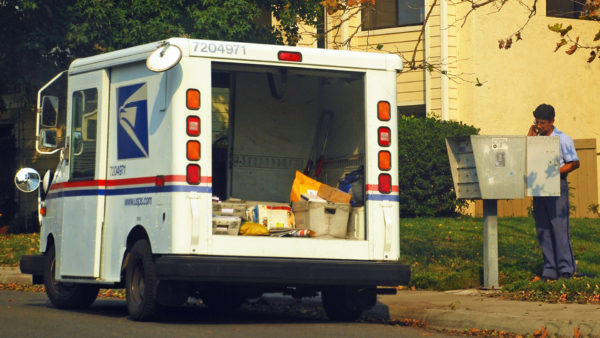
The U.S. Postal Service (USPS) could experience a 32% decline in total parcel volume and a 20% drop in parcel revenue should three large customers take most, if not all, of their last-mile parcel delivery business in-house rather than outsourcing it to USPS as they have done for years, according to estimates from a prominent consultancy.
The estimates by ShipMatrix quantify the impact of steps being taken by Amazon.com.Inc. (NASDAQ:AMZN); UPS Inc. (NYSE:UPS) and FedEx Corp (NYSE:FDX) to divert last-mile parcels into their own networks, which are being vastly re-engineered in an effort to deliver last-mile parcels more cost-effectively than USPS can under its popular “Parcel Select” service, in which customers induct large parcel volumes deep in the USPS network for last-mile deliveries by letter carriers to residences and businesses. The objective of the three firms is to merge last-mile parcels with routes where their drivers are already making deliveries, thus building massive package density and driving down costs. The companies account for two-thirds of Parcel Select volume, according to ShipMatrix estimates.
USPS faces a problem on another front, according to ShipMatrix. FedEx and UPS have been aggressively targeting small to medium-sized shippers that are big users of USPS’ Priority Mail two- to three-day delivery service. USPS stands to lose about 10% of that volume due to diversion to rivals, according to ShipMatrix estimates. That would boost the total loss of parcel volume to 34% and revenue to 24%, it said. Priority Mail, which USPS handles from pick-up to delivery, generates four times the revenue per piece compared to Parcel Select. In its fiscal third quarter, the most recent, USPS generated about $2.38 in revenue on each piece tendered under Parcel Select.
The ShipMatrix estimates are based on full-year 2018 figures and include all of USPS’ parcel products.
USPS charges a relatively nominal fee for the Parcel Select service because it is required by law to serve every U.S. address and has fixed-cost routes. The program has worked well for years. It has bolstered USPS’ revenue as it struggles with secular declines in first-class and marketing mail, its two most profitable segments. It has enabled customers like FedEx, UPS and Amazon to serve every address without deploying their own equipment and drivers. It has also allowed retailers to offer shipping to consumers at low or no cost to them.
In recent months and years, however, FedEx and UPS have diverted last-mile business into their own networks. Amazon, a late-comer to the parcel delivery game, has begun doing it as well. The dam broke in June when FedEx announced it would in-source by the end of 2020 all of its USPS business, which totaled 2 million parcels a day at its peak. UPS, which is believed to have in-sourced 35% of all traffic it had tendered to USPS, may eventually head in the same direction. Amazon, if other data points are accurate, has already begun to shift last-mile parcel traffic in high-density urban areas to its own fleet, leaving USPS with deliveries to less-populated locations that it still has to serve but which would be less cost-effective for Amazon to handle.
The effect of the lost business was demonstrated in August when USPS’ released its fiscal third-quarter results. It reported that quarterly package and shipping volumes declined year-over-year for the first time in nine years. In the quarter, shipping and packages generated revenue of $5.4 billion, about one-third of USPS’ total revenue. Volume was reported at more than 1.42 billion pieces.
USPS has been aware for some time that it may lose the three companies’ last-mile business. In an October 2 statement, USPS appeared confident it could weather the storm as more e-commerce traffic comes its way. “We continue to attract e-commerce customers and business partners because our customers see the value of our predictable service, enhanced visibility and reasonable pricing,” the statement said. “Our unparalleled delivery network coupled with the quality and professionalism of our workforce enables us to provide a value proposition unique in the shipping marketplace that even the largest e-commerce players cannot match.”
USPS, which has been involved in Sunday deliveries for years, said in the statement that it hopes to win Sunday business from companies like UPS, which along with FedEx launch Sunday deliveries next year. Gordon Glazer, a USPS expert at consultancy Shipware, LLC, said USPS should be able to downshift its parcel network to account for lower volumes. The real issue, Glazer said, is for USPS to achieve legislative solutions to the problem of its $5.5 billion annual tab to pre-fund retiree health-care costs. Cost improvements should also be gained through a restructuring of a parcel reseller program that was costing USPS about $1 billion a year as a result of pricing abuses, Glazer said.
USPS won an important battle on the international front last week when the Universal Postal Union (UPU), a 192-member body that regulates international postal pricing, agreed to changes in the “terminal dues” structure which determines how much a destination postal system can charge origin posts for processing and delivering incoming mail. Under the compromise agreement, USPS will be able to dramatically raise its dues effective in 2020.