A central theme of the 2026 State of Logistics Report is a new supply chain paradigm of persistent disruption that has emerged for shippers and logistics providers, and only the most successful are adapting to this challenging business environment.
The Council of Supply Chain Management Professionals (CSCMP) released its findings today during a press briefing at the Empire State Building.
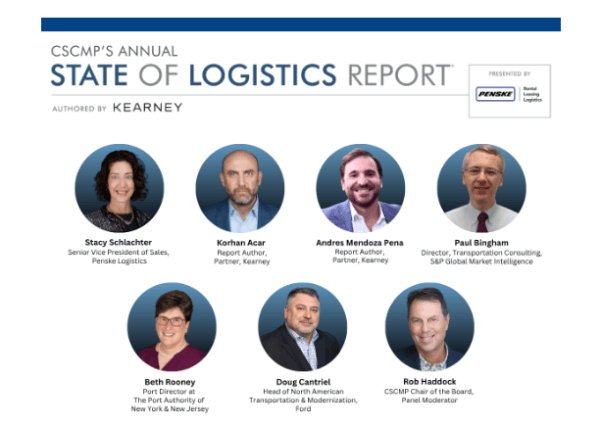
The publication is authored annually by global consulting firm Kearney and presented by Penske Logistics, a leading supply chain solutions provider.
The State of Logistics Report provides a snapshot of the American economy through the prism of the supply chain sector. Notable facts from this year’s report include:
-
U.S. business logistics costs totaled $2.4 trillion, accounting for 7.8% of national GDP. In 2025, those numbers were $2.6 trillion and 8.7% of GDP.
- There are five structural forces that define the macro environment and show no signs of resolution: Asymmetrical global growth, tightening financial conditions due to persistent inflation and rising public debt, accelerating trade flow and geoeconomic realignment, labor market and productivity constraints, and energy price volatility.
- Artificial Intelligence has made the crossover from a technology to try to one that delivers measurable commercial returns in specific, well-defined applications. AI use in the supply chain creates value through four capabilities: interpreting, predicting, recommending, and executing. Adoption of AI remains uneven among shippers and logistics providers across the supply chain, with a large gap between companies that have integrated AI into core workflows and those still restricted to isolated point solutions, with many having none at all.
- Companies are responding to labor constraints by accelerating the use of automation and digital investments in AI.
- The State of Logistics Report provides some strategic implications that can be applied to the current environment, including: Design for resilience, not just efficiency; prioritizing asset productivity over footprint expansion; intelligence, and the competitive capabilities that accompany end-to-end visibility; accelerating digital and automation ROI; and reassessing capital structure and investment pacing.
Korhan Acar, Kearney partner and lead author for the State of Logistics Report, stated: “This year’s report arrives at a moment when the forces reshaping global supply chains are no longer temporary disruptions, but enduring features of the operating environment. Rising costs driven by energy volatility, inflation, and geopolitical instability are placing pressure on margins and forcing leaders to rethink traditional operating models. At the same time, we’ve reached a genuine turning point in the autonomous era. AI, robotics, and autonomous trucking are moving rapidly from pilots to scaled deployment. Against this backdrop, profitable growth has become the defining priority. The companies that will lead are those combining resilience, intelligent logistics, and disciplined execution to protect margins and outperform in an increasingly volatile world.”
Stacy Schlachter, senior vice president of sales, Penske Logistics, said: “The report captures the essence of how we are helping our customers meet the realities of rising cost pressures and ongoing supply chain turbulence with the technology and solutions they need to accelerate performance.”
Mark Baxa, CSCMP president and CEO, concluded: “The supply chain of right now is incredibly complex and requires a series of constant adjustments. This year’s State of Logistics Report, expertly crafted by Kearney and presented by Penske Logistics, paints an accurate picture of the myriad dynamics of managing a logistics network constructed to navigate the current business and geopolitical landscape. Last year’s supply chain looks different than today’s supply chain. I surmise that next year’s logistics network will be hardly recognizable.”
Download the 2026 State of Logistics Report® here.