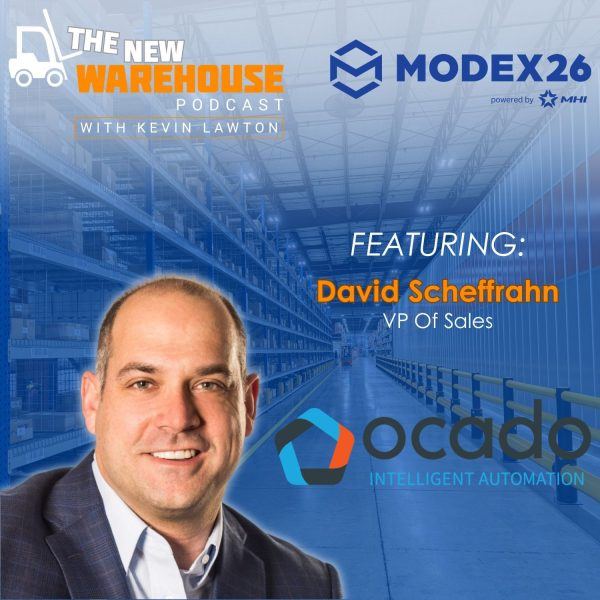
Welcome to this episode of The New Warehouse Podcast, where Kevin Lawton speaks with David Scheffrahn live from MODEX 2026 in Atlanta. Representing Ocado Intelligent Automation(OIA), Scheffrahn shares how the company is combining high-density storage, robotic fulfillment, AI-driven orchestration, and autonomous mobile robots to improve warehouse fulfillment automation.
The conversation explores Ocado’s storage and retrieval system, its fulfillment software platform Ocado IQ, and a new AMR focused on pallet and case fulfillment.
High-Density Warehouse Fulfillment Automation
Ocado’s fulfillment system focuses heavily on maximizing warehouse density and throughput. The company’s tote-based storage and retrieval system uses robots that move across the top of a grid to retrieve inventory and fulfill orders with minimal human intervention. Scheffrahn explains that the system is already operating at a significant scale, noting, “In fact, we do approximately 5 million picks a week, right now with these robots.”
Rather than emphasizing aesthetics, Ocado’s robots are engineered to reduce weight and improve performance. As Scheffrahn explains, “Every design decision that we’re making is about throughput.” He adds, “Light robots mean they can accelerate faster. It means we can have more robots on the grid because they’re lighter.”
That same thinking extends into warehouse cube utilization. While the MODEX demo displayed a smaller version of the system, Scheffrahn explained that production deployments can scale significantly higher. “Normally we do 21 totes high,” he says, allowing operators to “cube out an entire warehouse.”
Warehouse Automation Planning: When to Start Thinking About AMRs
AI and Resiliency Drive Fulfillment Decisions
Scheffrahn explains, “There’s a massive AI component to figuring out what to pick, where to place it, where to stage it.” The robotic picking process also relies heavily on machine learning and operational feedback loops. Ocado continuously evaluates which items robots handle effectively and which should remain human-assisted. Scheffrahn describes the process by saying, “Our goal is to have a larger percentage of the items in the grid to be able to be picked by the robot.”
Resiliency is another major focus. The system reroutes workflows when issues occur, reducing operational disruption automatically. That resiliency mindset even impacts battery management. Instead of parking robots to recharge, Ocado uses another robot to swap batteries in roughly 30 seconds.
Ocado IQ Connects Warehouse Fulfillment Automation
The second half of the conversation shifts toward Ocado IQ, the company’s fulfillment execution software platform. The software sits below the WMS layer and coordinates workflows across Ocado’s autonomous mobile robots, including Chuck and the newly introduced Porter. Scheffrahn explains, “It’s our software that creates the most efficient fulfillment strategy for that.”
While Chuck focuses on individual-item fulfillment, Porter supports mixed-pallet and case-fulfillment workflows. Porter also addresses one of the more difficult AMR challenges in warehousing: handling empty or lightweight pallets. Scheffrahn explains, “Porter’s got a really unique fork design where it actually pulls up to the pallet, it extends true forks into the pallet, picks it up, and then places it on the AMR.” He notes, “They work in the same operation, in the same workflow.”
Key Takeaways
- Ocado’s storage and retrieval system currently supports approximately 5 million robotic picks per week.
- The company’s fulfillment system can scale up to 21 totes high to maximize warehouse cube utilization.
- Ocado’s robots are 3D printed to reduce weight, improve acceleration, and extend battery life.
- AI continuously determines which items should be robot-picked versus human-picked
- Porter specifically improves the handling of lightweight and empty pallets.
- Goods-to-person pallet fulfillment workflows are gaining traction in omnichannel operations.